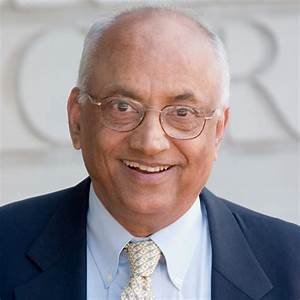
Venkatesh Naryanamurti, a Benjamin Peirce Professor of Technology and Public Policy at Harvard, was at the recently concluded MIT ECIR Workshop event to share his unique perspective on innovation and policymaking in the interconnected era.
Naryanamurti, known for his work in the areas of condensed matter and applied physics, believes that innovation is a creative process just like any other form of research. The rapid pace of IT sets it apart as an exceptional catalyst for scientific discovery, he says, with the Internet facilitating effective communications among thought leaders on a global scale. But the incredible pace of technological change should not be taken for granted: now that foreign powers, including China and Russia, are vying for online prominence, the cyber governance structure needs to be realigned with today's geopolitical landscape.
Transforming the U.S.-centric Internet into a multi-stakeholder environment won't be easy: policymakers will have to persuade Google, Amazon and other dominant tech firms into giving up their advantageous position for the greater good. Naryanamurti says that for this vision to truly come to together, mutual trust is required at multiple levels.
"We have to build that trust. Ultimately, our companies have to realize that they are now global companies; the populations which are going to grow are in China and India and Brazil and all those other places. So I think this will evolve, and ultimately, it has to become multi-stakeholder, multi-lateral," he remarks.
Trust is at the heart of open source, which Naryanamurti views as the most accommodating governance model for cyberspace. But successfully implementing a set of cohesive rules for the digital universe will require much than just a shared vision -- the language divide between technologists and policymakers must also be bridged. Failing to do so could lead to the fracturing of the Internet, a scenario that would adversely affect commerce and innovation worldwide.
"German companies are also global companies, Chinese companies are global companies, and therefore they will have to be able work with each other," Naryanamurti explains. "My own view is that the main Internet should be really an open Internet. For certain very, very special things you might need a Chinese Internet, a military Internet, and so on."
Looking ahead, another major barrier to governance reform is the growing threat of cyber attacks from both state and non-state actors such as criminal organizations. Enforcement authorities will have to use all tools at their disposal, including analytics, to stay ahead of hackers.
@thecube
#mitecir
Forgot Password
Almost there!
We just sent you a verification email. Please verify your account to gain access to
MIT Explorations in Cyber International Relations (ECIR) 2014 | Cambridge. If you don’t think you received an email check your
spam folder.
Sign in to MIT Explorations in Cyber International Relations (ECIR) 2014 | Cambridge.
In order to sign in, enter the email address you used to registered for the event. Once completed, you will receive an email with a verification link. Open this link to automatically sign into the site.
Register For MIT Explorations in Cyber International Relations (ECIR) 2014 | Cambridge
Please fill out the information below. You will recieve an email with a verification link confirming your registration. Click the link to automatically sign into the site.
You’re almost there!
We just sent you a verification email. Please click the verification button in the email. Once your email address is verified, you will have full access to all event content for MIT Explorations in Cyber International Relations (ECIR) 2014 | Cambridge.
Thanks for confirming your account. Now you can access MIT Explorations in Cyber International Relations (ECIR) 2014 | Cambridge with this email address.
I want my badge and interests to be visible to all attendees.
Checking this box will display your presense on the attendees list, view your profile and allow other attendees to contact you via 1-1 chat. Read the Privacy Policy. At any time, you can choose to disable this preference.
Select your Interests!
add
Upload your photo
Uploading..
OR
Connect via Twitter
Connect via Linkedin
EDIT PASSWORD
Share
Forgot Password
Almost there!
We just sent you a verification email. Please verify your account to gain access to
MIT Explorations in Cyber International Relations (ECIR) 2014 | Cambridge. If you don’t think you received an email check your
spam folder.
Sign in to MIT Explorations in Cyber International Relations (ECIR) 2014 | Cambridge.
In order to sign in, enter the email address you used to registered for the event. Once completed, you will receive an email with a verification link. Open this link to automatically sign into the site.
Sign in to gain access to MIT Explorations in Cyber International Relations (ECIR) 2014 | Cambridge
Please sign in with LinkedIn to continue to MIT Explorations in Cyber International Relations (ECIR) 2014 | Cambridge. Signing in with LinkedIn ensures a professional environment.
Are you sure you want to remove access rights for this user?
Details
Manage Access
email address
Community Invitation
Venkatesh Naryanamurti - MIT ECIR 2014 - theCUBE
Venkatesh Naryanamurti, a Benjamin Peirce Professor of Technology and Public Policy at Harvard, was at the recently concluded MIT ECIR Workshop event to share his unique perspective on innovation and policymaking in the interconnected era.
Naryanamurti, known for his work in the areas of condensed matter and applied physics, believes that innovation is a creative process just like any other form of research. The rapid pace of IT sets it apart as an exceptional catalyst for scientific discovery, he says, with the Internet facilitating effective communications among thought leaders on a global scale. But the incredible pace of technological change should not be taken for granted: now that foreign powers, including China and Russia, are vying for online prominence, the cyber governance structure needs to be realigned with today's geopolitical landscape.
Transforming the U.S.-centric Internet into a multi-stakeholder environment won't be easy: policymakers will have to persuade Google, Amazon and other dominant tech firms into giving up their advantageous position for the greater good. Naryanamurti says that for this vision to truly come to together, mutual trust is required at multiple levels.
"We have to build that trust. Ultimately, our companies have to realize that they are now global companies; the populations which are going to grow are in China and India and Brazil and all those other places. So I think this will evolve, and ultimately, it has to become multi-stakeholder, multi-lateral," he remarks.
Trust is at the heart of open source, which Naryanamurti views as the most accommodating governance model for cyberspace. But successfully implementing a set of cohesive rules for the digital universe will require much than just a shared vision -- the language divide between technologists and policymakers must also be bridged. Failing to do so could lead to the fracturing of the Internet, a scenario that would adversely affect commerce and innovation worldwide.
"German companies are also global companies, Chinese companies are global companies, and therefore they will have to be able work with each other," Naryanamurti explains. "My own view is that the main Internet should be really an open Internet. For certain very, very special things you might need a Chinese Internet, a military Internet, and so on."
Looking ahead, another major barrier to governance reform is the growing threat of cyber attacks from both state and non-state actors such as criminal organizations. Enforcement authorities will have to use all tools at their disposal, including analytics, to stay ahead of hackers.
@thecube
#mitecir