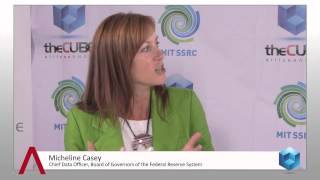
Michael Nix, Director of Analytics of the James M. Jeffords Institute for Quality and Operational Effectiveness, Fletcher Allen Health Care, discussed the challenges of driving value technology advancements in the healthcare industry with theCUBE co-hosts Paul Gillin and Dave Vellante, live at the MIT CDOIQ Symposium.
Commenting on the role of healthcare in data analytics, Nix explained that "we are servicing a relatively rural area and activity, people we're dealing with as patients are friends, family, neighbors. It's up close and personal for us." Healthcare is one of the most information-dependent industries, where one needs accurate, complete, timely information to make good decisions. "The technology boom we're experiencing is an incredible increase in both the span and the absolute volume of information," he added.
ObamaCare led to an increase of resources directed to expanding the Electronic Health Records system. Before this push, "when you went into an electronic system, there was a lot of information missing," Nix said. The investment in the electronic records drove a move for a more integrated electronic system, which brought a technology challenge, a paradigm shift, but also an incredible opportunity.
"Every organization that delivers healthcare is acutely interested in trying to overcome the structural obstacles," said Nix. "As we think of data quality, we're thinking about it in terms of delivering care to the patient, what is the implication of not knowing or having the wrong info when making critical decisions." Not only in emergency services, but even in routine care settings, reliable information is paramount.
Matching policies & care methods
Asked how close we were to a world where people carry a single medical record that can be accessed by every healthcare organization, NIX said it was "a policy well above my pay grade." In the United States, the fundamental issue of the technology increases and innovations is that they are ruled by legal and policy constraints. "We as healthcare delivery systems must learn to push back into these policies and say they are not resulting in the best possible care," Nix explains, the main goal being to share information to provide the best possible care. HIPAA and ObamaCare are trying to achieve conflicting objectives, he explained, but the technology is going to push the policy envelope and the public perception.
Asked to explain the concept of meaningful use, which would follow the first stage in ObamaCare referring to implementing the needed software and hardware platforms, Nix said that "just having a system where people share information, that isn't really information being captured. It means having tools that are friendly and useful to the providers, it has to be part of the clinical workflow, it cannot be tasks that are adding to a chaotic business schedule." Designing effective tools is critical to meaningful use. "Achieving meaningful use is achieving better care for your patients."
However, there is a big challenge in redesigning incredibly complex care delivery systems. "The technology innovation is resulting in significant paradigm shifts," Nix stated. Healthcare delivery is one of the most complex industries in the whole world, involving 14-15 distinctly different business operations under one umbrella.
Michael Nix, Fletcher Allen Healthcare, at MIT Information Quality 2013 with Dave Vellante and Paul Gillin
@thecube
#MITIQ
Forgot Password
Almost there!
We just sent you a verification email. Please verify your account to gain access to
MITChief Data Officer and Information Quality Symposium (CDOIQ) | 2013. If you don’t think you received an email check your
spam folder.
Sign in to MITChief Data Officer and Information Quality Symposium (CDOIQ) | 2013.
In order to sign in, enter the email address you used to registered for the event. Once completed, you will receive an email with a verification link. Open this link to automatically sign into the site.
Register For MITChief Data Officer and Information Quality Symposium (CDOIQ) | 2013
Please fill out the information below. You will recieve an email with a verification link confirming your registration. Click the link to automatically sign into the site.
You’re almost there!
We just sent you a verification email. Please click the verification button in the email. Once your email address is verified, you will have full access to all event content for MITChief Data Officer and Information Quality Symposium (CDOIQ) | 2013.
I want my badge and interests to be visible to all attendees.
Checking this box will display your presense on the attendees list, view your profile and allow other attendees to contact you via 1-1 chat. Read the Privacy Policy. At any time, you can choose to disable this preference.
Select your Interests!
add
Upload your photo
Uploading..
OR
Connect via Twitter
Connect via Linkedin
EDIT PASSWORD
Share
Forgot Password
Almost there!
We just sent you a verification email. Please verify your account to gain access to
MITChief Data Officer and Information Quality Symposium (CDOIQ) | 2013. If you don’t think you received an email check your
spam folder.
Sign in to MITChief Data Officer and Information Quality Symposium (CDOIQ) | 2013.
In order to sign in, enter the email address you used to registered for the event. Once completed, you will receive an email with a verification link. Open this link to automatically sign into the site.
Sign in to gain access to MITChief Data Officer and Information Quality Symposium (CDOIQ) | 2013
Please sign in with LinkedIn to continue to MITChief Data Officer and Information Quality Symposium (CDOIQ) | 2013. Signing in with LinkedIn ensures a professional environment.
Are you sure you want to remove access rights for this user?
Details
Manage Access
email address
Community Invitation
Michael Nix, Fletcher Allen Health Care - MIT Information Quality 2013 - #MIT #CDOIQ #theCUBE
Michael Nix, Director of Analytics of the James M. Jeffords Institute for Quality and Operational Effectiveness, Fletcher Allen Health Care, discussed the challenges of driving value technology advancements in the healthcare industry with theCUBE co-hosts Paul Gillin and Dave Vellante, live at the MIT CDOIQ Symposium.
Commenting on the role of healthcare in data analytics, Nix explained that "we are servicing a relatively rural area and activity, people we're dealing with as patients are friends, family, neighbors. It's up close and personal for us." Healthcare is one of the most information-dependent industries, where one needs accurate, complete, timely information to make good decisions. "The technology boom we're experiencing is an incredible increase in both the span and the absolute volume of information," he added.
ObamaCare led to an increase of resources directed to expanding the Electronic Health Records system. Before this push, "when you went into an electronic system, there was a lot of information missing," Nix said. The investment in the electronic records drove a move for a more integrated electronic system, which brought a technology challenge, a paradigm shift, but also an incredible opportunity.
"Every organization that delivers healthcare is acutely interested in trying to overcome the structural obstacles," said Nix. "As we think of data quality, we're thinking about it in terms of delivering care to the patient, what is the implication of not knowing or having the wrong info when making critical decisions." Not only in emergency services, but even in routine care settings, reliable information is paramount.
Matching policies & care methods
Asked how close we were to a world where people carry a single medical record that can be accessed by every healthcare organization, NIX said it was "a policy well above my pay grade." In the United States, the fundamental issue of the technology increases and innovations is that they are ruled by legal and policy constraints. "We as healthcare delivery systems must learn to push back into these policies and say they are not resulting in the best possible care," Nix explains, the main goal being to share information to provide the best possible care. HIPAA and ObamaCare are trying to achieve conflicting objectives, he explained, but the technology is going to push the policy envelope and the public perception.
Asked to explain the concept of meaningful use, which would follow the first stage in ObamaCare referring to implementing the needed software and hardware platforms, Nix said that "just having a system where people share information, that isn't really information being captured. It means having tools that are friendly and useful to the providers, it has to be part of the clinical workflow, it cannot be tasks that are adding to a chaotic business schedule." Designing effective tools is critical to meaningful use. "Achieving meaningful use is achieving better care for your patients."
However, there is a big challenge in redesigning incredibly complex care delivery systems. "The technology innovation is resulting in significant paradigm shifts," Nix stated. Healthcare delivery is one of the most complex industries in the whole world, involving 14-15 distinctly different business operations under one umbrella.
Michael Nix, Fletcher Allen Healthcare, at MIT Information Quality 2013 with Dave Vellante and Paul Gillin
@thecube
#MITIQ