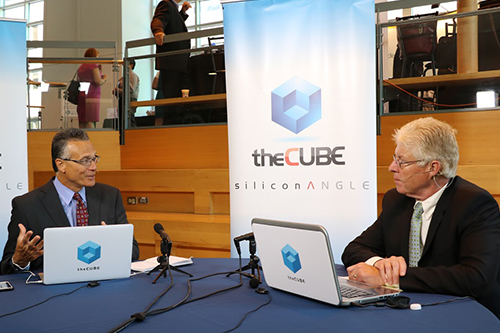
Alex ‘Sandy’ Pentland on Enigma using the Bitcoin blockchain to compute with secure data | #MITCDOIQ #theCUBE #MIT #CDOIQ
by Kyt Dotson | Jul 22, 2015
With a name like Enigma readers would be right to suspect that MIT was working on something used by a super villain, of course the premise of the project is to make everyday people smarter and safer. Alex “Sandy” Pentland, the Toshiba Professor at MIT, advises the Enigma project which uses the Bitcoin blockchain to securely track encrypted data so that it can be processed without revealing the underlying raw information.
Today at the MIT CDOIQ Symposium Petland spoke with Dave Vellante, co-founder of Wikibon, and Paul Gillin, SiliconANGLE enterprise editor, about the capabilities and the scope of the Enigma project during a visit to theCUBE, operated by SiliconANGLE Media.
Pentland said that people correctly feel paranoid that their data given to companies may be leaked, especially personal or sensitive data. The problem is that a great deal of sensitive data is extremely important to providing better services to people. A noteworthy example is medical or financial data.
“All lot of it has to do with safe sharing,” explained Pentland. “Another aspect of this problem is security. We are getting an increasing amount of attacks on [sensitive data]. Bad for companies. Bad for people. It’s just going to get worse.”
The answer he posed is “data is encrypted all the time everywhere.”
Enigma works by making sure that data can still be processed without ever being shared with anyone who shouldn’t have access to it. A problem arises is that bad actors tend to attempt to short circuit security measures or reveal the underlying sensitive data, and this is possible because at some point that data needs to be processed in order to produce actionable results.
MIT adapted the Bitcoin blockchain technology to build Enigma, which grabs data in its encrypted form, processes it while encrypted, and then shares it only in its encrypted form. The idea is to use the blockchain to form a sort of consensus on who can view what based on the distributed ledger.
For further details on how Enigma works, MIT has published a whitepaper [PDF] outlining the technology and the technical aspects of its implementation:
A peer-to-peer network, enabling different parties to jointly store and run computations on data while keeping the data completely private. Enigma’s computational model is based on a highly optimized version of secure multi-party computation, guaranteed by a verifiable secret-sharing scheme. For storage, we use a modified distributed hashtable for holding secret-shared data. An external blockchain is utilized as the controller of the network, manages access control, identities and serves as a tamper-proof log of events. Security deposits and fees incentivize operation, correctness and fairness of the system. Similar to Bitcoin, Enigma removes the need for a trusted third party, enabling autonomous control of personal data. For the first time, users are able to share their data with cryptographic guarantees regarding their privacy.
A beta version is also launching soon and signups to be part of it are available on the Enigma website.
Vellante described Enigma as a “distributed black box” and not a “walled garden,” nobody has direct control of the entire system, even though everyone can see the entire system. It is through the distributed ledger that trust can be devised between multiple partially-trusted entities (using the Bitcoin blockchain) in order to provide a consensus agreement to who has access to what.
How do you solve the problem of performing calculations on encrypted data?
Since Enigma proposes that all data is encrypted all the time, Gillin asked how the system manages to process data without ever decrypting it.
The ability to perform calculations on encrypted data without revealing it is a holy grail of computational systems, and it is very difficult to do without revealing too much about the underlying raw data–point in fact, knowing enough about it would essentially be decrypting it.
Pentland explained that it uses old techniques that have been around for a long time but have poor scaling capability and has trouble tracking data in a secure manner. He explained that the first part was solved by multi-scaling that is inherent to the technology and the second is fixed by the Bitcoin blockchain which allows for tracking and validating the information without revealing the underlying data.
@theCUBE
#MITIQ
Forgot Password
Almost there!
We just sent you a verification email. Please verify your account to gain access to
MIT Chief Data Officer and Information Quality Symposium (CDOIQ) 2015 | Cambridge. If you don’t think you received an email check your
spam folder.
Sign in to MIT Chief Data Officer and Information Quality Symposium (CDOIQ) 2015 | Cambridge.
In order to sign in, enter the email address you used to registered for the event. Once completed, you will receive an email with a verification link. Open this link to automatically sign into the site.
Register For MIT Chief Data Officer and Information Quality Symposium (CDOIQ) 2015 | Cambridge
Please fill out the information below. You will recieve an email with a verification link confirming your registration. Click the link to automatically sign into the site.
You’re almost there!
We just sent you a verification email. Please click the verification button in the email. Once your email address is verified, you will have full access to all event content for MIT Chief Data Officer and Information Quality Symposium (CDOIQ) 2015 | Cambridge.
Thanks for confirming your account. Now you can access MIT Chief Data Officer and Information Quality Symposium (CDOIQ) 2015 | Cambridge with this email address.
I want my badge and interests to be visible to all attendees.
Checking this box will display your presense on the attendees list, view your profile and allow other attendees to contact you via 1-1 chat. Read the Privacy Policy. At any time, you can choose to disable this preference.
Select your Interests!
add
Upload your photo
Uploading..
OR
Connect via Twitter
Connect via Linkedin
EDIT PASSWORD
Share
Forgot Password
Almost there!
We just sent you a verification email. Please verify your account to gain access to
MIT Chief Data Officer and Information Quality Symposium (CDOIQ) 2015 | Cambridge. If you don’t think you received an email check your
spam folder.
Sign in to MIT Chief Data Officer and Information Quality Symposium (CDOIQ) 2015 | Cambridge.
In order to sign in, enter the email address you used to registered for the event. Once completed, you will receive an email with a verification link. Open this link to automatically sign into the site.
Sign in to gain access to MIT Chief Data Officer and Information Quality Symposium (CDOIQ) 2015 | Cambridge
Please sign in with LinkedIn to continue to MIT Chief Data Officer and Information Quality Symposium (CDOIQ) 2015 | Cambridge. Signing in with LinkedIn ensures a professional environment.
Are you sure you want to remove access rights for this user?
Details
Manage Access
email address
Community Invitation
Alex "Sandy" Pentland, MIT | MIT CDOIQ Symposium 2015
Alex ‘Sandy’ Pentland on Enigma using the Bitcoin blockchain to compute with secure data | #MITCDOIQ #theCUBE #MIT #CDOIQ
by Kyt Dotson | Jul 22, 2015
With a name like Enigma readers would be right to suspect that MIT was working on something used by a super villain, of course the premise of the project is to make everyday people smarter and safer. Alex “Sandy” Pentland, the Toshiba Professor at MIT, advises the Enigma project which uses the Bitcoin blockchain to securely track encrypted data so that it can be processed without revealing the underlying raw information.
Today at the MIT CDOIQ Symposium Petland spoke with Dave Vellante, co-founder of Wikibon, and Paul Gillin, SiliconANGLE enterprise editor, about the capabilities and the scope of the Enigma project during a visit to theCUBE, operated by SiliconANGLE Media.
Pentland said that people correctly feel paranoid that their data given to companies may be leaked, especially personal or sensitive data. The problem is that a great deal of sensitive data is extremely important to providing better services to people. A noteworthy example is medical or financial data.
“All lot of it has to do with safe sharing,” explained Pentland. “Another aspect of this problem is security. We are getting an increasing amount of attacks on [sensitive data]. Bad for companies. Bad for people. It’s just going to get worse.”
The answer he posed is “data is encrypted all the time everywhere.���
Enigma works by making sure that data can still be processed without ever being shared with anyone who shouldn’t have access to it. A problem arises is that bad actors tend to attempt to short circuit security measures or reveal the underlying sensitive data, and this is possible because at some point that data needs to be processed in order to produce actionable results.
MIT adapted the Bitcoin blockchain technology to build Enigma, which grabs data in its encrypted form, processes it while encrypted, and then shares it only in its encrypted form. The idea is to use the blockchain to form a sort of consensus on who can view what based on the distributed ledger.
For further details on how Enigma works, MIT has published a whitepaper [PDF] outlining the technology and the technical aspects of its implementation:
A peer-to-peer network, enabling different parties to jointly store and run computations on data while keeping the data completely private. Enigma’s computational model is based on a highly optimized version of secure multi-party computation, guaranteed by a verifiable secret-sharing scheme. For storage, we use a modified distributed hashtable for holding secret-shared data. An external blockchain is utilized as the controller of the network, manages access control, identities and serves as a tamper-proof log of events. Security deposits and fees incentivize operation, correctness and fairness of the system. Similar to Bitcoin, Enigma removes the need for a trusted third party, enabling autonomous control of personal data. For the first time, users are able to share their data with cryptographic guarantees regarding their privacy.
A beta version is also launching soon and signups to be part of it are available on the Enigma website.
Vellante described Enigma as a “distributed black box” and not a “walled garden,” nobody has direct control of the entire system, even though everyone can see the entire system. It is through the distributed ledger that trust can be devised between multiple partially-trusted entities (using the Bitcoin blockchain) in order to provide a consensus agreement to who has access to what.
How do you solve the problem of performing calculations on encrypted data?
Since Enigma proposes that all data is encrypted all the time, Gillin asked how the system manages to process data without ever decrypting it.
The ability to perform calculations on encrypted data without revealing it is a holy grail of computational systems, and it is very difficult to do without revealing too much about the underlying raw data–point in fact, knowing enough about it would essentially be decrypting it.
Pentland explained that it uses old techniques that have been around for a long time but have poor scaling capability and has trouble tracking data in a secure manner. He explained that the first part was solved by multi-scaling that is inherent to the technology and the second is fixed by the Bitcoin blockchain which allows for tracking and validating the information without revealing the underlying data.
@theCUBE
#MITIQ