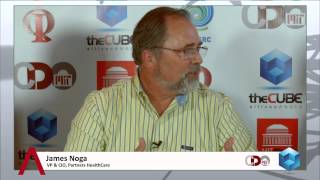
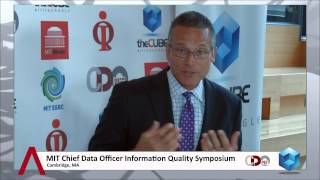
David Saul, State Street Corporation, at MITCDOIQ 2014 with Dave Vellante and Paul Gillin
8th Annual MIT Chief Data Officer & Information Quality Symposium
@theCUBE
#MITIQ
As as is happening with other regulated industries, the financial services sector is seeing a sharp increase in the number of chief data officers at the top of the business, but some companies are still going against the flow – and succeeding. One of the most notable examples is State Street Corporation, where the task of addressing the rapid growth in unstructured information has been relegated not to a CDO but rather chief scientist David Saul, who oversees all aspects of technological change throughout the organization. He dropped by SiliconANGLE’s theCUBE at MIT’s recently concluded CDOIQ Symposium to share how the industry’s hottest trends and analytics in particular are shaping his firm’s IT roadmap with hosts Dave Vellante and Paul Gillin.
The Boston-based State Street is the second oldest financial institution in the United States and among the largest in the world in terms of assets. The buy-side giant claims to have over $28 trillion under management in its primary custodian business and another $2.3 trillion or so in its investment services unit, which adds up to a lot of responsibility for management to shoulder. Saul, who has held the title of chief scientist since the unique position was created four years ago, is charged with elevating that formidable challenge through the identification and implementation of new solutions that can help meet business objects more effectively.
State Street has always been persistent in trying to stay on top of the trends, he highlighted. The firm counts itself as one of the very first global financial powerhouses to adopt cloud computing at the organizational level, a move that opened the way for new initiatives that would have been more difficult if not impossible to support in a legacy environment. The many fruits of the transition include Springboard, the company’s mobile service, which allows clients to check their investment portfolios directly from their tablets.
Even more notable than the app is State Street’s internal social network, which Saul said enables employees to communicate and collaborate with one another across its dozens of geographically distributed offices. Setting up the platform was a complex undertaking, not least of which because the firm required that the software provide integration with the file sharing technologies that were already used prior to the roll-out. “We didn’t want to go through a major tool become that comes back to the cultural point, if people were satisfied with using a particular tool we wanted to make sure that tool is included in the portfolio,” he explained.
Forgot Password
Almost there!
We just sent you a verification email. Please verify your account to gain access to
MIT Chief Data Officer and Information Quality Symposium (CDOIQ) | 2014. If you don’t think you received an email check your
spam folder.
Sign in to MIT Chief Data Officer and Information Quality Symposium (CDOIQ) | 2014.
In order to sign in, enter the email address you used to registered for the event. Once completed, you will receive an email with a verification link. Open this link to automatically sign into the site.
Register For MIT Chief Data Officer and Information Quality Symposium (CDOIQ) | 2014
Please fill out the information below. You will recieve an email with a verification link confirming your registration. Click the link to automatically sign into the site.
You’re almost there!
We just sent you a verification email. Please click the verification button in the email. Once your email address is verified, you will have full access to all event content for MIT Chief Data Officer and Information Quality Symposium (CDOIQ) | 2014.
Thanks for confirming your account. Now you can access MIT Chief Data Officer and Information Quality Symposium (CDOIQ) | 2014 with this email address.
I want my badge and interests to be visible to all attendees.
Checking this box will display your presense on the attendees list, view your profile and allow other attendees to contact you via 1-1 chat. Read the Privacy Policy. At any time, you can choose to disable this preference.
Select your Interests!
add
Upload your photo
Uploading..
OR
Connect via Twitter
Connect via Linkedin
EDIT PASSWORD
Share
Forgot Password
Almost there!
We just sent you a verification email. Please verify your account to gain access to
MIT Chief Data Officer and Information Quality Symposium (CDOIQ) | 2014. If you don’t think you received an email check your
spam folder.
Sign in to MIT Chief Data Officer and Information Quality Symposium (CDOIQ) | 2014.
In order to sign in, enter the email address you used to registered for the event. Once completed, you will receive an email with a verification link. Open this link to automatically sign into the site.
Sign in to gain access to MIT Chief Data Officer and Information Quality Symposium (CDOIQ) | 2014
Please sign in with LinkedIn to continue to MIT Chief Data Officer and Information Quality Symposium (CDOIQ) | 2014. Signing in with LinkedIn ensures a professional environment.
Are you sure you want to remove access rights for this user?
Details
Manage Access
email address
Community Invitation
David Saul - MIT CDOIQ 2014 - theCUBE - #MITIQ
David Saul, State Street Corporation, at MITCDOIQ 2014 with Dave Vellante and Paul Gillin
8th Annual MIT Chief Data Officer & Information Quality Symposium
@theCUBE
#MITIQ
As as is happening with other regulated industries, the financial services sector is seeing a sharp increase in the number of chief data officers at the top of the business, but some companies are still going against the flow – and succeeding. One of the most notable examples is State Street Corporation, where the task of addressing the rapid growth in unstructured information has been relegated not to a CDO but rather chief scientist David Saul, who oversees all aspects of technological change throughout the organization. He dropped by SiliconANGLE’s theCUBE at MIT’s recently concluded CDOIQ Symposium to share how the industry’s hottest trends and analytics in particular are shaping his firm’s IT roadmap with hosts Dave Vellante and Paul Gillin.
The Boston-based State Street is the second oldest financial institution in the United States and among the largest in the world in terms of assets. The buy-side giant claims to have over $28 trillion under management in its primary custodian business and another $2.3 trillion or so in its investment services unit, which adds up to a lot of responsibility for management to shoulder. Saul, who has held the title of chief scientist since the unique position was created four years ago, is charged with elevating that formidable challenge through the identification and implementation of new solutions that can help meet business objects more effectively.
State Street has always been persistent in trying to stay on top of the trends, he highlighted. The firm counts itself as one of the very first global financial powerhouses to adopt cloud computing at the organizational level, a move that opened the way for new initiatives that would have been more difficult if not impossible to support in a legacy environment. The many fruits of the transition include Springboard, the company’s mobile service, which allows clients to check their investment portfolios directly from their tablets.
Even more notable than the app is State Street’s internal social network, which Saul said enables employees to communicate and collaborate with one another across its dozens of geographically distributed offices. Setting up the platform was a complex undertaking, not least of which because the firm required that the software provide integration with the file sharing technologies that were already used prior to the roll-out. “We didn’t want to go through a major tool become that comes back to the cultural point, if people were satisfied with using a particular tool we wanted to make sure that tool is included in the portfolio,” he explained.