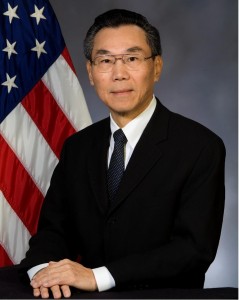
James Meng, U.S. Navy at MIT CDOIQ 2014 with Dave Vellante and Paul Gillin
8th Annual MIT Chief Data Officer & Information Quality Symposium
@theCUBE
#MITIQ
The US Navy has been undergoing a long process of IT infrastructure and resource centralization, an initiative started over 12 years ago. Detailing their progress along this journey to add efficiency and effectiveness is James Meng, Deputy Assistant Secretary of the Navy, Architectures, Standards and Integration for the Navy, participating in a live interview with theCUBE co-hosts Jeff Kelly and Dave Vellante at last week’s annual information quality event at MIT.
“The Navy is a very large organization,” Meng explained, with twenty commands that span the globe. “The business has been run primarily to help the mission. Due to the… complexity of the types of operations that we span, historically each mission area has been left alone. As we progress into today’s business environment, just delivering the mission is not sufficient. We have to truly be also efficient.”
The US Navy runs its business by dividing it into five major functional areas: programming for acquisition, financial management, manpower and reserves, the infrastructure installation – peers, airstrips, facilities, and the materials management. “Each of them largely run independently,” Meng said, which leads to a lack of an enterprise business viewpoint and understanding. “If you don’t have the whole enterprise view, you can do it by gut feeling and it does not carry much credibility.”
“When you want to compose an overall picture to determine the most effective way to deliver mission readiness, you really don’t have a way to figure out how to do the balance,” said Meng, explaining the core challenge that led to the US Navy’s need to centralize its operations. There is currently a strong focus on cybersecurity, intelligence, data science, but the US Navy does not have enough resources, staff included, for this area. As Meng points out, “most of us learned on the job.”
“We have to generate more actionable business intelligence from the business data we want. We want to minimize duplicates in terms of business systems; driving down, so that we can have the entire Navy business community drive their business towards that over time without any interruptions,” Meng stated.
Read more on the role of data in actionable business after the video:
The role of data in actionable business
One of the major goals of his efforts is “to bring the entire community the awareness that data is truly a Navy asset. It’s not locally owned, locally consumed. Locally stewarded, but enterprise-wide consumed,” Meng explained. The Navy has been on this road for close to twelve years. The first step was adapting the set of ERP systems, and then over the past seven years “we embarked into evolving the taxonomy for all the products and services, and also the function processes,” he noted. The third dimension of the process is the Congressional budget.
Data standardization has a specific goal for the US Navy. “One of the fundamental issues of doing data standardization is to translate the data into actionable intelligence,” Meng said. “The one message I like to deliver is focus on amplifying your ability to enhance your mission effectiveness. Never, ever deviate from that. The data science project has to be related to how you impact mission effectiveness. Fundamentally the entire organization is there only to deliver mission success.”
Forgot Password
Almost there!
We just sent you a verification email. Please verify your account to gain access to
MIT Chief Data Officer and Information Quality Symposium (CDOIQ) | 2014. If you don’t think you received an email check your
spam folder.
Sign in to MIT Chief Data Officer and Information Quality Symposium (CDOIQ) | 2014.
In order to sign in, enter the email address you used to registered for the event. Once completed, you will receive an email with a verification link. Open this link to automatically sign into the site.
Register For MIT Chief Data Officer and Information Quality Symposium (CDOIQ) | 2014
Please fill out the information below. You will recieve an email with a verification link confirming your registration. Click the link to automatically sign into the site.
You’re almost there!
We just sent you a verification email. Please click the verification button in the email. Once your email address is verified, you will have full access to all event content for MIT Chief Data Officer and Information Quality Symposium (CDOIQ) | 2014.
Thanks for confirming your account. Now you can access MIT Chief Data Officer and Information Quality Symposium (CDOIQ) | 2014 with this email address.
I want my badge and interests to be visible to all attendees.
Checking this box will display your presense on the attendees list, view your profile and allow other attendees to contact you via 1-1 chat. Read the Privacy Policy. At any time, you can choose to disable this preference.
Select your Interests!
add
Upload your photo
Uploading..
OR
Connect via Twitter
Connect via Linkedin
EDIT PASSWORD
Share
Forgot Password
Almost there!
We just sent you a verification email. Please verify your account to gain access to
MIT Chief Data Officer and Information Quality Symposium (CDOIQ) | 2014. If you don’t think you received an email check your
spam folder.
Sign in to MIT Chief Data Officer and Information Quality Symposium (CDOIQ) | 2014.
In order to sign in, enter the email address you used to registered for the event. Once completed, you will receive an email with a verification link. Open this link to automatically sign into the site.
Sign in to gain access to MIT Chief Data Officer and Information Quality Symposium (CDOIQ) | 2014
Please sign in with LinkedIn to continue to MIT Chief Data Officer and Information Quality Symposium (CDOIQ) | 2014. Signing in with LinkedIn ensures a professional environment.
Are you sure you want to remove access rights for this user?
Details
Manage Access
email address
Community Invitation
James Meng - MIT CDOIQ 2014 - theCUBE - #MITIQ
James Meng, U.S. Navy at MIT CDOIQ 2014 with Dave Vellante and Paul Gillin
8th Annual MIT Chief Data Officer & Information Quality Symposium
@theCUBE
#MITIQ
The US Navy has been undergoing a long process of IT infrastructure and resource centralization, an initiative started over 12 years ago. Detailing their progress along this journey to add efficiency and effectiveness is James Meng, Deputy Assistant Secretary of the Navy, Architectures, Standards and Integration for the Navy, participating in a live interview with theCUBE co-hosts Jeff Kelly and Dave Vellante at last week’s annual information quality event at MIT.
“The Navy is a very large organization,” Meng explained, with twenty commands that span the globe. “The business has been run primarily to help the mission. Due to the… complexity of the types of operations that we span, historically each mission area has been left alone. As we progress into today’s business environment, just delivering the mission is not sufficient. We have to truly be also efficient.”
The US Navy runs its business by dividing it into five major functional areas: programming for acquisition, financial management, manpower and reserves, the infrastructure installation – peers, airstrips, facilities, and the materials management. “Each of them largely run independently,” Meng said, which leads to a lack of an enterprise business viewpoint and understanding. “If you don’t have the whole enterprise view, you can do it by gut feeling and it does not carry much credibility.”
“When you want to compose an overall picture to determine the most effective way to deliver mission readiness, you really don’t have a way to figure out how to do the balance,” said Meng, explaining the core challenge that led to the US Navy’s need to centralize its operations. There is currently a strong focus on cybersecurity, intelligence, data science, but the US Navy does not have enough resources, staff included, for this area. As Meng points out, “most of us learned on the job.”
“We have to generate more actionable business intelligence from the business data we want. We want to minimize duplicates in terms of business systems; driving down, so that we can have the entire Navy business community drive their business towards that over time without any interruptions,” Meng stated.
Read more on the role of data in actionable business after the video:
The role of data in actionable business
One of the major goals of his efforts is “to bring the entire community the awareness that data is truly a Navy asset. It’s not locally owned, locally consumed. Locally stewarded, but enterprise-wide consumed,” Meng explained. The Navy has been on this road for close to twelve years. The first step was adapting the set of ERP systems, and then over the past seven years “we embarked into evolving the taxonomy for all the products and services, and also the function processes,” he noted. The third dimension of the process is the Congressional budget.
Data standardization has a specific goal for the US Navy. “One of the fundamental issues of doing data standardization is to translate the data into actionable intelligence,” Meng said. “The one message I like to deliver is focus on amplifying your ability to enhance your mission effectiveness. Never, ever deviate from that. The data science project has to be related to how you impact mission effectiveness. Fundamentally the entire organization is there only to deliver mission success.”