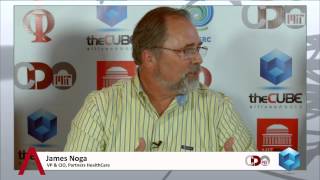
Bill Inmon, Forest Rim Technology, at MIT CDOIQ 2014 with Dave Vellante and Paul Gillin
8th Annual MIT Chief Data Officer & Information Quality Symposium
@theCUBE
#MITIQ
he “father of the data warehouse” hasn’t talked data warehousing in a decade. Instead, Bill Inmon is tackling the thorny problem of making the 80 percent of corporate data that’s in unstructured form easily available for analysis.
Inmon, who is credited with writing the first book about data warehousing as well as coining the term, said his latest venture holds even more promise than his previous two successful startups. Forest Rim Technology Inc. provides textual ETL (extract, transform, load) software that mines insight from free-form text. Inmon dropped by SiliconANGLE’s theCUBE at the recently concluded MIT Chief Data Officer and Information Quality (CDOIQ) Symposium to provide a rare look behind the scenes of the ambitious effort.
The Colorado-based Forest Rim sets itself apart with a unique approach that attempts to discern the meaning of raw text by its context rather than just the contents, Inmon told hosts Dave Vellante and Paul Gillin, a methodology that it claims allows it to tackle even the most unwieldy of datasets. That includes everything from contact center transcripts to the clinical narratives used by doctors to describe a specific medical situation to their colleagues, linguistically complex workloads that necessitate an equally elaborate analytic process to ingest.
“We take language for granted because we speak it and to us language is very natural and normal, but when you start to put language into a computer, it’s anything but natural and normal,” Inmon explained. “So when it comes to the question of how you do contextual analysis, you have a hundred different ways that you do it because in language, there’s a hundred different ways context can occur and appear to us.”
It took Inmon and his team of researchers a full 12 years to develop a set of algorithms can handle that tremendous amount of variety, he detailed, and they’re still no where near the 100 mark. But he said that the offering has nonetheless proven itself in the field to be effective in addressing the formidable challenge of mapping unstructured text into the rows and columns of the relational databases enterprises rely on today.
From there, the information can be easily fed into a downstream analytical process, be it a traditional business intelligence (BI) solution like SAP BusinessObjects or a virtualization product like Tableau or QlikView. Inmon said that simplicity has earned Forest Rim several paying customers across multiple industries, including several household brands he wouldn’t mention by name.
Forgot Password
Almost there!
We just sent you a verification email. Please verify your account to gain access to
MIT Chief Data Officer and Information Quality Symposium (CDOIQ) | 2014. If you don’t think you received an email check your
spam folder.
Sign in to MIT Chief Data Officer and Information Quality Symposium (CDOIQ) | 2014.
In order to sign in, enter the email address you used to registered for the event. Once completed, you will receive an email with a verification link. Open this link to automatically sign into the site.
Register For MIT Chief Data Officer and Information Quality Symposium (CDOIQ) | 2014
Please fill out the information below. You will recieve an email with a verification link confirming your registration. Click the link to automatically sign into the site.
You’re almost there!
We just sent you a verification email. Please click the verification button in the email. Once your email address is verified, you will have full access to all event content for MIT Chief Data Officer and Information Quality Symposium (CDOIQ) | 2014.
Thanks for confirming your account. Now you can access MIT Chief Data Officer and Information Quality Symposium (CDOIQ) | 2014 with this email address.
I want my badge and interests to be visible to all attendees.
Checking this box will display your presense on the attendees list, view your profile and allow other attendees to contact you via 1-1 chat. Read the Privacy Policy. At any time, you can choose to disable this preference.
Select your Interests!
add
Upload your photo
Uploading..
OR
Connect via Twitter
Connect via Linkedin
EDIT PASSWORD
Share
Forgot Password
Almost there!
We just sent you a verification email. Please verify your account to gain access to
MIT Chief Data Officer and Information Quality Symposium (CDOIQ) | 2014. If you don’t think you received an email check your
spam folder.
Sign in to MIT Chief Data Officer and Information Quality Symposium (CDOIQ) | 2014.
In order to sign in, enter the email address you used to registered for the event. Once completed, you will receive an email with a verification link. Open this link to automatically sign into the site.
Sign in to gain access to MIT Chief Data Officer and Information Quality Symposium (CDOIQ) | 2014
Please sign in with LinkedIn to continue to MIT Chief Data Officer and Information Quality Symposium (CDOIQ) | 2014. Signing in with LinkedIn ensures a professional environment.
Are you sure you want to remove access rights for this user?
Details
Manage Access
email address
Community Invitation
Bill Inmon - MIT CDOIQ 2014 - theCUBE - #MITIQ
Bill Inmon, Forest Rim Technology, at MIT CDOIQ 2014 with Dave Vellante and Paul Gillin
8th Annual MIT Chief Data Officer & Information Quality Symposium
@theCUBE
#MITIQ
he “father of the data warehouse” hasn’t talked data warehousing in a decade. Instead, Bill Inmon is tackling the thorny problem of making the 80 percent of corporate data that’s in unstructured form easily available for analysis.
Inmon, who is credited with writing the first book about data warehousing as well as coining the term, said his latest venture holds even more promise than his previous two successful startups. Forest Rim Technology Inc. provides textual ETL (extract, transform, load) software that mines insight from free-form text. Inmon dropped by SiliconANGLE’s theCUBE at the recently concluded MIT Chief Data Officer and Information Quality (CDOIQ) Symposium to provide a rare look behind the scenes of the ambitious effort.
The Colorado-based Forest Rim sets itself apart with a unique approach that attempts to discern the meaning of raw text by its context rather than just the contents, Inmon told hosts Dave Vellante and Paul Gillin, a methodology that it claims allows it to tackle even the most unwieldy of datasets. That includes everything from contact center transcripts to the clinical narratives used by doctors to describe a specific medical situation to their colleagues, linguistically complex workloads that necessitate an equally elaborate analytic process to ingest.
“We take language for granted because we speak it and to us language is very natural and normal, but when you start to put language into a computer, it’s anything but natural and normal,” Inmon explained. “So when it comes to the question of how you do contextual analysis, you have a hundred different ways that you do it because in language, there’s a hundred different ways context can occur and appear to us.”
It took Inmon and his team of researchers a full 12 years to develop a set of algorithms can handle that tremendous amount of variety, he detailed, and they’re still no where near the 100 mark. But he said that the offering has nonetheless proven itself in the field to be effective in addressing the formidable challenge of mapping unstructured text into the rows and columns of the relational databases enterprises rely on today.
From there, the information can be easily fed into a downstream analytical process, be it a traditional business intelligence (BI) solution like SAP BusinessObjects or a virtualization product like Tableau or QlikView. Inmon said that simplicity has earned Forest Rim several paying customers across multiple industries, including several household brands he wouldn’t mention by name.