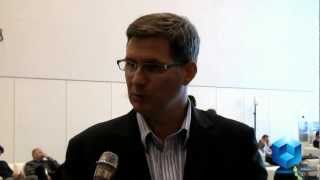
John Furrier speaking with James Greene, Sr. Security Engineer for Intel at Intel Developer Forum, 2012.
When it comes to security architecture, many developments in the stack seem to be an afterthought, particularly in the application layer. Instead of a full replacement approach, Jim Greene is a senior security engineer for Intel proposes an incremental method to updating enterprise infrastructure. In fact, Greene has a very clear take on the state of cyber-security today – he shares his perspective with SiliconANGLE founder John Furrier at the Intel Developer Forum last month.
Greene says that the industry is in a very pragmatic place today: now that the enterprises no longer have a false sense of security and are past the doom and gloom stage, vendors like Intel are tackling the topic of how to make the cloud more secure while accommodating modern workloads.
He elaborated, adding that there are three things to take into consideration in cyber-security today: the hackers, the IT landscape, and the regulatory part. As a chipmaker Intel’s approach is to make the underlying hardware that powers consumer devices and data center products more efficient, reliable, and harder to crack. The firm is also collaborating with partners such as McAfee to offer security software and services that run on top of its processors.
According to Greene it’s impossible for enterprises to start implementing more modernized security measures. Implementing new technologies is an incremental process, much like the step-by-step transition to the cloud that these organizations take. The theme right now is rationalizing this process.
This is on one end. Over at the application layer, Greene says that it’s best to develop applications with security in mind from the get-go, rather than bolting on data protection features as an afterthought. He notes that this concept of ‘security DNA’ is also what defines the next generation cloud service providers: vendors that focus on keeping the data that customers store on their servers safe.
The emphasis on data is something Greene stressed. The security perimeter is changing –the cloud is nullifying traditional technological boundaries, and the perimeter is now around the data itself rather than the business infrastructure
Forgot Password
Almost there!
We just sent you a verification email. Please verify your account to gain access to
Intel Developer Forum 2012 | San Francisco. If you don’t think you received an email check your
spam folder.
Sign in to Intel Developer Forum 2012 | San Francisco.
In order to sign in, enter the email address you used to registered for the event. Once completed, you will receive an email with a verification link. Open this link to automatically sign into the site.
Register For Intel Developer Forum 2012 | San Francisco
Please fill out the information below. You will recieve an email with a verification link confirming your registration. Click the link to automatically sign into the site.
You’re almost there!
We just sent you a verification email. Please click the verification button in the email. Once your email address is verified, you will have full access to all event content for Intel Developer Forum 2012 | San Francisco.
I want my badge and interests to be visible to all attendees.
Checking this box will display your presense on the attendees list, view your profile and allow other attendees to contact you via 1-1 chat. Read the Privacy Policy. At any time, you can choose to disable this preference.
Select your Interests!
add
Upload your photo
Uploading..
OR
Connect via Twitter
Connect via Linkedin
EDIT PASSWORD
Share
Forgot Password
Almost there!
We just sent you a verification email. Please verify your account to gain access to
Intel Developer Forum 2012 | San Francisco. If you don’t think you received an email check your
spam folder.
Sign in to Intel Developer Forum 2012 | San Francisco.
In order to sign in, enter the email address you used to registered for the event. Once completed, you will receive an email with a verification link. Open this link to automatically sign into the site.
Sign in to gain access to Intel Developer Forum 2012 | San Francisco
Please sign in with LinkedIn to continue to Intel Developer Forum 2012 | San Francisco. Signing in with LinkedIn ensures a professional environment.
Are you sure you want to remove access rights for this user?
Details
Manage Access
email address
Community Invitation
James Greene, Intel - Intel Developer Forum 2012 - #theCUBE
John Furrier speaking with James Greene, Sr. Security Engineer for Intel at Intel Developer Forum, 2012.
When it comes to security architecture, many developments in the stack seem to be an afterthought, particularly in the application layer. Instead of a full replacement approach, Jim Greene is a senior security engineer for Intel proposes an incremental method to updating enterprise infrastructure. In fact, Greene has a very clear take on the state of cyber-security today – he shares his perspective with SiliconANGLE founder John Furrier at the Intel Developer Forum last month.
Greene says that the industry is in a very pragmatic place today: now that the enterprises no longer have a false sense of security and are past the doom and gloom stage, vendors like Intel are tackling the topic of how to make the cloud more secure while accommodating modern workloads.
He elaborated, adding that there are three things to take into consideration in cyber-security today: the hackers, the IT landscape, and the regulatory part. As a chipmaker Intel’s approach is to make the underlying hardware that powers consumer devices and data center products more efficient, reliable, and harder to crack. The firm is also collaborating with partners such as McAfee to offer security software and services that run on top of its processors.
According to Greene it’s impossible for enterprises to start implementing more modernized security measures. Implementing new technologies is an incremental process, much like the step-by-step transition to the cloud that these organizations take. The theme right now is rationalizing this process.
This is on one end. Over at the application layer, Greene says that it’s best to develop applications with security in mind from the get-go, rather than bolting on data protection features as an afterthought. He notes that this concept of ‘security DNA’ is also what defines the next generation cloud service providers: vendors that focus on keeping the data that customers store on their servers safe.
The emphasis on data is something Greene stressed. The security perimeter is changing –the cloud is nullifying traditional technological boundaries, and the perimeter is now around the data itself rather than the business infrastructure