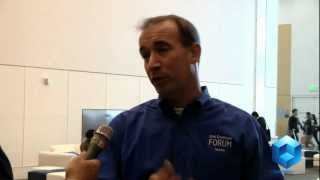
John Furrier speaking with David Tuhy, General Manager of the Intel Storage Group at Intel Developer Forum, 2012.
Photo courtesy of Intel
There’s a definite shift in the datacenter, a trend that’s forcing companies to rethink architecture and applications across the stack. For Intel it’s been quite a journey, but one the chip maker was prepared for. During the Intel Developer Forum last month SiliconANGLE founder John Furrier interviewed David Tuhy, the general manager of Intel Storage Group, to learn more.
Tuhy says that his unit and the surrounding ecosystem are witnessing three major trends today: the cloud, big data, and high-performance computing (HPC). He notes that Intel spends 13 percent of its revenue on R&D, which helped put his company is a very good position to monetize this shift in the data center.
Furrier concurs, citing the company’s growing presence in the cloud as well as increased investments in embedded systems and big data.
Tuhy offers more details about how these trends are influencing his business in particular. The Intel GM says that server virtualization is expanding to other parts of the data center, namely software and the network.
The executive divides the change in the storage paradigm to two different scenarios. On one end, there are the traditional enterprises that are starting to make use of the unstructured data sitting in their ERP systems and Oracle databases: they’re doing this on spinning disk, while leveraging deduplication and compression to reduce physical infrastructure requirements.
Tuhy goes on to say that Intel’s highest performance CPUs are being put to use in these environments, but not exclusively. His company’s chips also help power other CPU-intensive technologies such as flash-as-cache, which extends to the second scenario.
Organizations that are scaling towards big data are facing bottlenecks in storage – the spinning disk is getting bigger, but it’s not getting any faster. That’s why Intel is starting to use SSDs to bridge this gap. Flash is facilitating a new type of architecture where one storage tier is located in the server, one in the network and another in the capacity store.
Tuhy’s expects that over the course of the next five to ten years, flash is going to change the way the way data is managed in the enterprise. And Intel will be supplying the silicon that powers this transition.
Forgot Password
Almost there!
We just sent you a verification email. Please verify your account to gain access to
Intel Developer Forum 2012 | San Francisco. If you don’t think you received an email check your
spam folder.
Sign in to Intel Developer Forum 2012 | San Francisco.
In order to sign in, enter the email address you used to registered for the event. Once completed, you will receive an email with a verification link. Open this link to automatically sign into the site.
Register For Intel Developer Forum 2012 | San Francisco
Please fill out the information below. You will recieve an email with a verification link confirming your registration. Click the link to automatically sign into the site.
You’re almost there!
We just sent you a verification email. Please click the verification button in the email. Once your email address is verified, you will have full access to all event content for Intel Developer Forum 2012 | San Francisco.
I want my badge and interests to be visible to all attendees.
Checking this box will display your presense on the attendees list, view your profile and allow other attendees to contact you via 1-1 chat. Read the Privacy Policy. At any time, you can choose to disable this preference.
Select your Interests!
add
Upload your photo
Uploading..
OR
Connect via Twitter
Connect via Linkedin
EDIT PASSWORD
Share
Forgot Password
Almost there!
We just sent you a verification email. Please verify your account to gain access to
Intel Developer Forum 2012 | San Francisco. If you don’t think you received an email check your
spam folder.
Sign in to Intel Developer Forum 2012 | San Francisco.
In order to sign in, enter the email address you used to registered for the event. Once completed, you will receive an email with a verification link. Open this link to automatically sign into the site.
Sign in to gain access to Intel Developer Forum 2012 | San Francisco
Please sign in with LinkedIn to continue to Intel Developer Forum 2012 | San Francisco. Signing in with LinkedIn ensures a professional environment.
Are you sure you want to remove access rights for this user?
Details
Manage Access
email address
Community Invitation
David Tuhy - Intel Developer Forum 2012 - theCUBE
John Furrier speaking with David Tuhy, General Manager of the Intel Storage Group at Intel Developer Forum, 2012.
Photo courtesy of Intel
There’s a definite shift in the datacenter, a trend that’s forcing companies to rethink architecture and applications across the stack. For Intel it’s been quite a journey, but one the chip maker was prepared for. During the Intel Developer Forum last month SiliconANGLE founder John Furrier interviewed David Tuhy, the general manager of Intel Storage Group, to learn more.
Tuhy says that his unit and the surrounding ecosystem are witnessing three major trends today: the cloud, big data, and high-performance computing (HPC). He notes that Intel spends 13 percent of its revenue on R&D, which helped put his company is a very good position to monetize this shift in the data center.
Furrier concurs, citing the company’s growing presence in the cloud as well as increased investments in embedded systems and big data.
Tuhy offers more details about how these trends are influencing his business in particular. The Intel GM says that server virtualization is expanding to other parts of the data center, namely software and the network.
The executive divides the change in the storage paradigm to two different scenarios. On one end, there are the traditional enterprises that are starting to make use of the unstructured data sitting in their ERP systems and Oracle databases: they’re doing this on spinning disk, while leveraging deduplication and compression to reduce physical infrastructure requirements.
Tuhy goes on to say that Intel’s highest performance CPUs are being put to use in these environments, but not exclusively. His company’s chips also help power other CPU-intensive technologies such as flash-as-cache, which extends to the second scenario.
Organizations that are scaling towards big data are facing bottlenecks in storage – the spinning disk is getting bigger, but it’s not getting any faster. That’s why Intel is starting to use SSDs to bridge this gap. Flash is facilitating a new type of architecture where one storage tier is located in the server, one in the network and another in the capacity store.
Tuhy’s expects that over the course of the next five to ten years, flash is going to change the way the way data is managed in the enterprise. And Intel will be supplying the silicon that powers this transition.