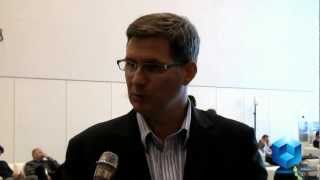
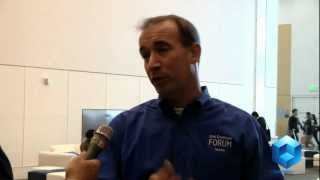
John Furrier speaking with Das Kamout, Principal Engineer for Intel IT at Intel Developer Forum, 2012.
Intel's alpha geeks are gathered at IDF 2012 this year. In the Developer Zone, Principal Engineer for Intel, Das Kamhout was happy to chat with SiliconANGLE's own John Furrier. The two discussed what is on Intel's agenda, their vision and how that relates to the real world. Touching on Dadi Perlmutter, who runs the Intel architectural group, Kamhout reiterates that the focus is about enriching the lives of everybody on earth over the next decade.
The topic of enterprise was next on the list to discuss. Currently we are seeing much innovation and a transformation in enterprise as we go forward into this new era of computing. Kamhout talks briefly about this change and its potential impact on enterprises. Companies such as Facebook, Amazon and a few others have begun to run the datacenter as software, which is a pretty stark change according to Kamhout. He believes it is an inspiring time to be working in IT because of these changes.
Software in the datacenter and the cloud has begun to see many new changes and innovations. What is going on with the emerging software innovations? On the side of the application and code development things need to move quickly. In order to do meet the level of agility needed the datacenter must operate in an expedited fashion as well. When we talk about software defined networks, computing or storage as services, were talking about exposing all these things as software and API, so that software developers can build their solution on to gain the agility needed.
Given the tremendous change in storage and networking Furrier asks how the changes will affect the IT department. "What we are seeing is this transformation of the datacenter into a massively powerful environment that is exposed through software." Kamhout however, believes that this is merely the beginning and states that in the future he hopes to see a lot of Intel powering this change. He goes on to mention the cloud sysadmin, which is someone who knows server, storage, and network all in one package. We're also starting to see a lot of the capability that has been running the internet appear in IT shops. From security to big data solutions such as Hadoop, companies are starting to use these new technologies to benefit their customers. An additional change is the increases consumption of SAS, which is a game changer that is not often discussed.
Furrier closed asking Kamhout what new jobs and opportunity are being created and destroyed within the new enterprise growth system. Kamhout identifies what he believes are the new top demand positions an IT shop would need in this new climate. Among some of the new titles we see are No Ops, a term coined by Netflix referring to a cloud sysadmin that is invisible. The Dev Op is another important roll with increased demand as well. Lastly we need cloud integrators, engineers that tie it all together seamlessly. Kamhout states that he is of the belief that more people are needed for software development to make the industry move faster. He is encouraging anyone interested in the new wave of data to get familiar with the Open industry, meet with their peers and help push progress forward.
Forgot Password
Almost there!
We just sent you a verification email. Please verify your account to gain access to
Intel Developer Forum 2012 | San Francisco. If you don’t think you received an email check your
spam folder.
Sign in to Intel Developer Forum 2012 | San Francisco.
In order to sign in, enter the email address you used to registered for the event. Once completed, you will receive an email with a verification link. Open this link to automatically sign into the site.
Register For Intel Developer Forum 2012 | San Francisco
Please fill out the information below. You will recieve an email with a verification link confirming your registration. Click the link to automatically sign into the site.
You’re almost there!
We just sent you a verification email. Please click the verification button in the email. Once your email address is verified, you will have full access to all event content for Intel Developer Forum 2012 | San Francisco.
I want my badge and interests to be visible to all attendees.
Checking this box will display your presense on the attendees list, view your profile and allow other attendees to contact you via 1-1 chat. Read the Privacy Policy. At any time, you can choose to disable this preference.
Select your Interests!
add
Upload your photo
Uploading..
OR
Connect via Twitter
Connect via Linkedin
EDIT PASSWORD
Share
Forgot Password
Almost there!
We just sent you a verification email. Please verify your account to gain access to
Intel Developer Forum 2012 | San Francisco. If you don’t think you received an email check your
spam folder.
Sign in to Intel Developer Forum 2012 | San Francisco.
In order to sign in, enter the email address you used to registered for the event. Once completed, you will receive an email with a verification link. Open this link to automatically sign into the site.
Sign in to gain access to Intel Developer Forum 2012 | San Francisco
Please sign in with LinkedIn to continue to Intel Developer Forum 2012 | San Francisco. Signing in with LinkedIn ensures a professional environment.
Are you sure you want to remove access rights for this user?
Details
Manage Access
email address
Community Invitation
Das Kamhout - Intel Developer Forum 2012 - theCUBE
John Furrier speaking with Das Kamout, Principal Engineer for Intel IT at Intel Developer Forum, 2012.
Intel's alpha geeks are gathered at IDF 2012 this year. In the Developer Zone, Principal Engineer for Intel, Das Kamhout was happy to chat with SiliconANGLE's own John Furrier. The two discussed what is on Intel's agenda, their vision and how that relates to the real world. Touching on Dadi Perlmutter, who runs the Intel architectural group, Kamhout reiterates that the focus is about enriching the lives of everybody on earth over the next decade.
The topic of enterprise was next on the list to discuss. Currently we are seeing much innovation and a transformation in enterprise as we go forward into this new era of computing. Kamhout talks briefly about this change and its potential impact on enterprises. Companies such as Facebook, Amazon and a few others have begun to run the datacenter as software, which is a pretty stark change according to Kamhout. He believes it is an inspiring time to be working in IT because of these changes.
Software in the datacenter and the cloud has begun to see many new changes and innovations. What is going on with the emerging software innovations? On the side of the application and code development things need to move quickly. In order to do meet the level of agility needed the datacenter must operate in an expedited fashion as well. When we talk about software defined networks, computing or storage as services, were talking about exposing all these things as software and API, so that software developers can build their solution on to gain the agility needed.
Given the tremendous change in storage and networking Furrier asks how the changes will affect the IT department. "What we are seeing is this transformation of the datacenter into a massively powerful environment that is exposed through software." Kamhout however, believes that this is merely the beginning and states that in the future he hopes to see a lot of Intel powering this change. He goes on to mention the cloud sysadmin, which is someone who knows server, storage, and network all in one package. We're also starting to see a lot of the capability that has been running the internet appear in IT shops. From security to big data solutions such as Hadoop, companies are starting to use these new technologies to benefit their customers. An additional change is the increases consumption of SAS, which is a game changer that is not often discussed.
Furrier closed asking Kamhout what new jobs and opportunity are being created and destroyed within the new enterprise growth system. Kamhout identifies what he believes are the new top demand positions an IT shop would need in this new climate. Among some of the new titles we see are No Ops, a term coined by Netflix referring to a cloud sysadmin that is invisible. The Dev Op is another important roll with increased demand as well. Lastly we need cloud integrators, engineers that tie it all together seamlessly. Kamhout states that he is of the belief that more people are needed for software development to make the industry move faster. He is encouraging anyone interested in the new wave of data to get familiar with the Open industry, meet with their peers and help push progress forward.