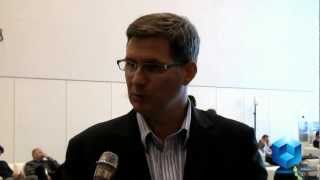
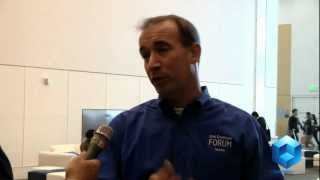
John Furrier speaking with John Hengeveld, Directory of Marketing, HPC for Intel at Intel Developer Forum, 2012.
From the Moscone Center in California, SiliconANGLE's John Furrier stopped to chat with Director of Marketing for Intel, John Hengeveld, about improving computation to improve the world. Intel's Director of Marketing was eager to talk about some of their new technology, and its potential impacts. The two discuss High Performance Computing, or HPC, Ultrabooks, cloud computing, Big Data and how Intel aspires to make the world a better place through better, faster, more efficient computing.
Furrier first discussed Intel's mission statement and asked Hengeveld to expand upon the ways in which Intel's technology was being used to "enrich the lives of a global work force." Hengeveld went on to mention how Intel's technology is creating advancements in energy, medicine, and enterprise. Hengeveld states, "We're in a green world today... In order to be blue, that's Intel, you have to be green." Using High Performance Computing, Hengeveld and his team aim deliver more performance and more performance per watts. Intel is trying to lower the power required to come to these amazing solutions in computation. Their customers are taking their technology and using it to better predict hurricanes, to develop better cancer treatments, and even provide better models of how our universe was created. To Hengeveld it is easy to see how HPC can enrich the world.
John Furrier went on to ask about how HPC is impacting the world of cancer research and cancer treatments. To this, Hengeveld talks about the Cancer Genome Atlas; this project gathers sets of Genomic data on patients and their tumors. The Cancer Genome Atlas is being studied to try and indentify and counteract the mutations in classes of cancers. The aim is to produce targeted therapies to address specific mutations and avoid affecting the non cancer cells. This is also very personal to Hengeveld who is a cancer patient himself. "This software is the hope for people like me and for therapies that might target their disorders," Hengeveld says. This feat would not have been practical in previous years due to computation costs. Now it is possible to consider taking a significant number of cancer cells and making the data for these cancer studies available for a Big Data class analysis.
The conversation shifted to alternative energy and the advancements that high performance computing could provide. HPC aids in maximizing our efficiency, how much energy we consume versus how much energy we waste. By using HPC programs a company could optimize a propeller for a wind farm or create the ideal solar panel design.
Furrier asks about the reality of business and use, and where does Hengeveld see the demand for HPC moving in the future. The notion of getting more performance out of the hardware has always been a main focus of Intel, in keeping with Moore's Law. "Now with larger companies taking advantage of this, what are some of the uses for high performance computing that you see?"
Intel's Director of Marketing gladly shared his thoughts for the future of HPC. As Moore's Law takes the top performance and biggest systems in the world up, it also takes the available performance to enterprises up significantly as well. Companies use more data to understand customers. From an enterprise perspective there is top line benefit and bottom line
benefit to having increase computing capability. The same technology can be used in modeling and simulation of products or to help locate new locations for drilling oil, even helping your local traffic flow more smoothly.
Given the surge of entrepreneurship and invention among scientists Ferrier asked Hengeveld, how big and disruptive is this new Big Data trend? Hengeveld explains that Big Data is making a tremendous impact on businesses today. He believes the potential to make more impact is not just possible, but more significant. Hengeveld doesn't believe there is a limit to how much impact big data will have. The volume of data we are producing each year is massively scaling beyond Moore's Law and with it the ability to use that data is also scaling faster. The conclusions we will reach from this data will be more impactful and more valuable going forward. Hengeveld firmly believes Big Data and HPC is a tremendous economic and social force.
Forgot Password
Almost there!
We just sent you a verification email. Please verify your account to gain access to
Intel Developer Forum 2012 | San Francisco. If you don’t think you received an email check your
spam folder.
Sign in to Intel Developer Forum 2012 | San Francisco.
In order to sign in, enter the email address you used to registered for the event. Once completed, you will receive an email with a verification link. Open this link to automatically sign into the site.
Register For Intel Developer Forum 2012 | San Francisco
Please fill out the information below. You will recieve an email with a verification link confirming your registration. Click the link to automatically sign into the site.
You’re almost there!
We just sent you a verification email. Please click the verification button in the email. Once your email address is verified, you will have full access to all event content for Intel Developer Forum 2012 | San Francisco.
I want my badge and interests to be visible to all attendees.
Checking this box will display your presense on the attendees list, view your profile and allow other attendees to contact you via 1-1 chat. Read the Privacy Policy. At any time, you can choose to disable this preference.
Select your Interests!
add
Upload your photo
Uploading..
OR
Connect via Twitter
Connect via Linkedin
EDIT PASSWORD
Share
Forgot Password
Almost there!
We just sent you a verification email. Please verify your account to gain access to
Intel Developer Forum 2012 | San Francisco. If you don’t think you received an email check your
spam folder.
Sign in to Intel Developer Forum 2012 | San Francisco.
In order to sign in, enter the email address you used to registered for the event. Once completed, you will receive an email with a verification link. Open this link to automatically sign into the site.
Sign in to gain access to Intel Developer Forum 2012 | San Francisco
Please sign in with LinkedIn to continue to Intel Developer Forum 2012 | San Francisco. Signing in with LinkedIn ensures a professional environment.
Are you sure you want to remove access rights for this user?
Details
Manage Access
email address
Community Invitation
John Hengeveld - Intel Developer Forum 2012 - theCUBE
John Furrier speaking with John Hengeveld, Directory of Marketing, HPC for Intel at Intel Developer Forum, 2012.
From the Moscone Center in California, SiliconANGLE's John Furrier stopped to chat with Director of Marketing for Intel, John Hengeveld, about improving computation to improve the world. Intel's Director of Marketing was eager to talk about some of their new technology, and its potential impacts. The two discuss High Performance Computing, or HPC, Ultrabooks, cloud computing, Big Data and how Intel aspires to make the world a better place through better, faster, more efficient computing.
Furrier first discussed Intel's mission statement and asked Hengeveld to expand upon the ways in which Intel's technology was being used to "enrich the lives of a global work force." Hengeveld went on to mention how Intel's technology is creating advancements in energy, medicine, and enterprise. Hengeveld states, "We're in a green world today... In order to be blue, that's Intel, you have to be green." Using High Performance Computing, Hengeveld and his team aim deliver more performance and more performance per watts. Intel is trying to lower the power required to come to these amazing solutions in computation. Their customers are taking their technology and using it to better predict hurricanes, to develop better cancer treatments, and even provide better models of how our universe was created. To Hengeveld it is easy to see how HPC can enrich the world.
John Furrier went on to ask about how HPC is impacting the world of cancer research and cancer treatments. To this, Hengeveld talks about the Cancer Genome Atlas; this project gathers sets of Genomic data on patients and their tumors. The Cancer Genome Atlas is being studied to try and indentify and counteract the mutations in classes of cancers. The aim is to produce targeted therapies to address specific mutations and avoid affecting the non cancer cells. This is also very personal to Hengeveld who is a cancer patient himself. "This software is the hope for people like me and for therapies that might target their disorders," Hengeveld says. This feat would not have been practical in previous years due to computation costs. Now it is possible to consider taking a significant number of cancer cells and making the data for these cancer studies available for a Big Data class analysis.
The conversation shifted to alternative energy and the advancements that high performance computing could provide. HPC aids in maximizing our efficiency, how much energy we consume versus how much energy we waste. By using HPC programs a company could optimize a propeller for a wind farm or create the ideal solar panel design.
Furrier asks about the reality of business and use, and where does Hengeveld see the demand for HPC moving in the future. The notion of getting more performance out of the hardware has always been a main focus of Intel, in keeping with Moore's Law. "Now with larger companies taking advantage of this, what are some of the uses for high performance computing that you see?"
Intel's Director of Marketing gladly shared his thoughts for the future of HPC. As Moore's Law takes the top performance and biggest systems in the world up, it also takes the available performance to enterprises up significantly as well. Companies use more data to understand customers. From an enterprise perspective there is top line benefit and bottom line
benefit to having increase computing capability. The same technology can be used in modeling and simulation of products or to help locate new locations for drilling oil, even helping your local traffic flow more smoothly.
Given the surge of entrepreneurship and invention among scientists Ferrier asked Hengeveld, how big and disruptive is this new Big Data trend? Hengeveld explains that Big Data is making a tremendous impact on businesses today. He believes the potential to make more impact is not just possible, but more significant. Hengeveld doesn't believe there is a limit to how much impact big data will have. The volume of data we are producing each year is massively scaling beyond Moore's Law and with it the ability to use that data is also scaling faster. The conclusions we will reach from this data will be more impactful and more valuable going forward. Hengeveld firmly believes Big Data and HPC is a tremendous economic and social force.