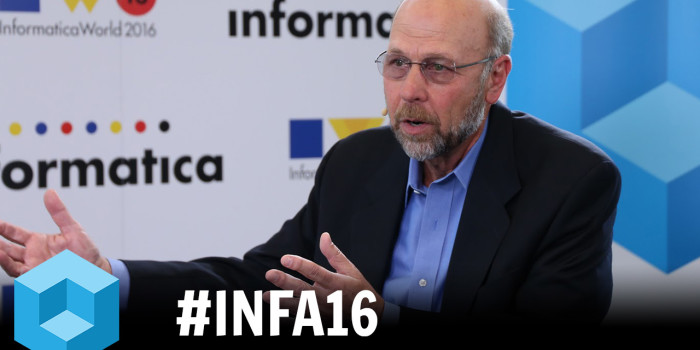
01. Stewart Bond, IDC, visits #theCUBE. (00:18)
02. Informatica: The Real Thing. (00:45)
03. Issues with Re-creating Data Silos in the Cloud. (02:17)
04. Looking at Real Impact, Share and Value. (02:55)
05. The Challenge for Companies Moving to the Cloud. (04:52)
06. Data is the Core of the Digital Transformation. (07:57)
07. The Five Ws of Data and Finding Relationships in Data. (09:15)
08. The Biggest Myths About Data Now. (10:29)
09. AI, Cognitive and Metadata: The Future or Myth?. (12:15)
10. Results from the 2015 Data User Survey. (14:40)
Track List created with http://www.vinjavideo.com.
--- ---
Delineating Cloud and data in the digital transformation | #infa16
by Teryn O'Brien | May 24, 2016
As applications move to the cloud, the difference between data and Cloud are blurring. So how can this be leveraged most effectively as companies move into the digital transformation?
Steward Bond, director of Data Integration Software at International Data Corp. (IDC) Canada, spoke with John Furrier (@furrier), cohost of theCUBE, from the SiliconANGLE Media team, during Informatica World 2016.
Cloud will be the deployment of data
“The lines between the different types of integration, where the data is, how the data is used — definitely those are getting very blurry,” said Bond. “At the end of the day, it’s really all the same thing.”
According to Bond, Cloud is really a deployment option where companies are putting their data. Companies have to make the choice of using different models — running on another vendor’s cloud or running one’s own cloud. Over time, a combination of
different Cloud services will arise.
How to leverage the expansion of Cloud
When implementing Cloud and Big Data, Bond said one of things companies will need to do is ask: “What is the business problem?” Companies will need to start there, and then work backwards.
The biggest barrier in progressing to a modern Cloud era, according to Bond, is data. “Data without integrity isn’t going to be able to support those digital transformations,” he concluded.
Forgot Password
Almost there!
We just sent you a verification email. Please verify your account to gain access to
Informatica World 2016 | San Francisco. If you don’t think you received an email check your
spam folder.
Sign in to Informatica World 2016 | San Francisco.
In order to sign in, enter the email address you used to registered for the event. Once completed, you will receive an email with a verification link. Open this link to automatically sign into the site.
Register For Informatica World 2016 | San Francisco
Please fill out the information below. You will recieve an email with a verification link confirming your registration. Click the link to automatically sign into the site.
You’re almost there!
We just sent you a verification email. Please click the verification button in the email. Once your email address is verified, you will have full access to all event content for Informatica World 2016 | San Francisco.
I want my badge and interests to be visible to all attendees.
Checking this box will display your presense on the attendees list, view your profile and allow other attendees to contact you via 1-1 chat. Read the Privacy Policy. At any time, you can choose to disable this preference.
Select your Interests!
add
Upload your photo
Uploading..
OR
Connect via Twitter
Connect via Linkedin
EDIT PASSWORD
Share
Forgot Password
Almost there!
We just sent you a verification email. Please verify your account to gain access to
Informatica World 2016 | San Francisco. If you don’t think you received an email check your
spam folder.
Sign in to Informatica World 2016 | San Francisco.
In order to sign in, enter the email address you used to registered for the event. Once completed, you will receive an email with a verification link. Open this link to automatically sign into the site.
Sign in to gain access to Informatica World 2016 | San Francisco
Please sign in with LinkedIn to continue to Informatica World 2016 | San Francisco. Signing in with LinkedIn ensures a professional environment.
Are you sure you want to remove access rights for this user?
Details
Manage Access
email address
Community Invitation
Stewart Bond, IDC - #infa16 - #theCUBE
01. Stewart Bond, IDC, visits #theCUBE. (00:18)
02. Informatica: The Real Thing. (00:45)
03. Issues with Re-creating Data Silos in the Cloud. (02:17)
04. Looking at Real Impact, Share and Value. (02:55)
05. The Challenge for Companies Moving to the Cloud. (04:52)
06. Data is the Core of the Digital Transformation. (07:57)
07. The Five Ws of Data and Finding Relationships in Data. (09:15)
08. The Biggest Myths About Data Now. (10:29)
09. AI, Cognitive and Metadata: The Future or Myth?. (12:15)
10. Results from the 2015 Data User Survey. (14:40)
Track List created with http://www.vinjavideo.com.
--- ---
Delineating Cloud and data in the digital transformation | #infa16
by Teryn O'Brien | May 24, 2016
As applications move to the cloud, the difference between data and Cloud are blurring. So how can this be leveraged most effectively as companies move into the digital transformation?
Steward Bond, director of Data Integration Software at International Data Corp. (IDC) Canada, spoke with John Furrier (@furrier), cohost of theCUBE, from the SiliconANGLE Media team, during Informatica World 2016.
Cloud will be the deployment of data
“The lines between the different types of integration, where the data is, how the data is used — definitely those are getting very blurry,” said Bond. “At the end of the day, it’s really all the same thing.”
According to Bond, Cloud is really a deployment option where companies are putting their data. Companies have to make the choice of using different models — running on another vendor’s cloud or running one’s own cloud. Over time, a combination of
different Cloud services will arise.
How to leverage the expansion of Cloud
When implementing Cloud and Big Data, Bond said one of things companies will need to do is ask: “What is the business problem?” Companies will need to start there, and then work backwards.
The biggest barrier in progressing to a modern Cloud era, according to Bond, is data. “Data without integrity isn’t going to be able to support those digital transformations,” he concluded.