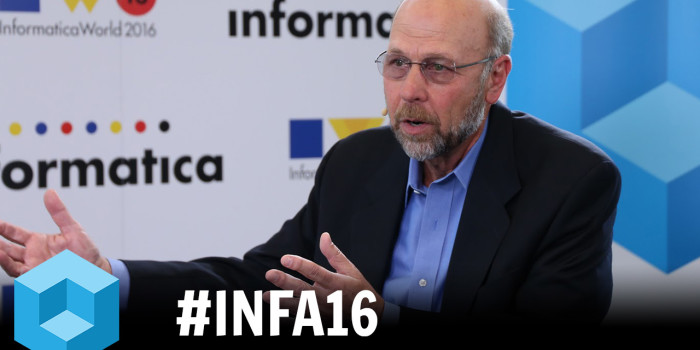
01. Greg Hanson, Informatica, visits #theCUBE!. (00:18)
02. EMEA, Moving Data and the Adoption of Cloud. (00:45)
03. Update on the On-Prem side of EMEA Cloud. (03:04)
04. The Affect of the Cloud Trend on Partnerships in the Channel. (04:22)
05. Informatica's Role in Guiding Customers to the Right Cloud. (06:11)
06. Informatica's Live Data Map to Navigate Metadata. (11:43)
07. Where Customers are Investing in the Data. (12:18)
08. Informatica's Role as "Data Switzerland". (14:21)
09. Exciting Things Happening at Informatica 2016. (16:00)
Track List created with http://www.vinjavideo.com.
--- ---
Local red tape hampering international cloud data | #infa16
by Gabriel Pesek | May 25, 2016
With nation-to-nation conflicts coming to light with the increasing adoption of cloud services and international hosting, finding ways to resolve these problems is gaining its own share of the industry within the companies that provide these utilities.
Greg Hanson, VP of Business Operations, EMEA, at Informatica Corp., joined John Furrier (@furrier) and Peter Burris (@plburris), cohosts of theCUBE, from the SiliconANGLE Media team, to talk about various aspects of the cloud market, including international data-transfer obstructions and the return of old mistakes.
Borders for data
Singled out early on by Hanson were the challenges with international deployment of cloud, with Middle Eastern countries, Germany and Russia singled out as particularly problematic, though he felt that advances were gradually being made to clear up the difficulties on these fronts.
Hanson noted that one of the issues complicating these matters was entangled in the laws each country has regarding data transfer and handling, and the further issues that arise from accessing storage centers hosted in one country from within the borders of another. “For us, on the data side specifically, I think one of the barriers to the adoption of cloud is … specifically about regulatory, and a lot of the SaaS vendors, including Informatica, generally have data hosted out of North American data centers,” he explained.
Finding room for growth
Hanson also felt that advances were being made across the board for businesses to connect more with the cloud and its utilities. “My perception is every business in three to five years is going to be what I call a hybrid organization, that has to adopt both cloud and on-premise in order to retain competitiveness moving forward,” he said.
Hanson also touched on some of the ways that addressing specific issues was resulting in new business enterprises: “We’re starting to see specific partnerships emerging around solutions,” he said, with efforts to develop a “common analytical framework for a specific use-case” driving a number of these projects.
Premise and cloud syncing
“Still a large proportion of our business in EMEA is on-premise-led,” Hanson noted, “but the fastest-growing part of our business is the cloud side of things. So we’re doing both, helping people shift with their digitization strategy in the movement to cloud, while supporting them in that journey by providing all the relevant integration quality mastering, masking, security services that they need on-prem as well.” He also felt that Informatica being “the Switzerland of data” was drawing customers who were anticipating the need for changing environments in the future.
Looking at the cloud-using market as a whole, Hanson identified one problem that was making a comeback. “A lot of the mistakes of the past in terms of the integration world are being made again with cloud, and I think it’s because if you look at the cloud adoption side, you’ll find that a lot of cloud adoption is being driven by line of business managers rather than IT,” he said.
While Hanson felt that the space of leveraging platforms is “very bright” for Informatica, with new connectivity and operational tools being developed, he acknowledged that there were still problems in the infrastructure and implementation of the cloud with many companies. “I don’t see much in the way of standards and interfaces to kind of help that commonality across different software applications in the cloud,” he said. Despite this, he was optimistic about the future, saying, “It’s data that’s the differentiator moving forward.”
Forgot Password
Almost there!
We just sent you a verification email. Please verify your account to gain access to
Informatica World 2016 | San Francisco. If you don’t think you received an email check your
spam folder.
Sign in to Informatica World 2016 | San Francisco.
In order to sign in, enter the email address you used to registered for the event. Once completed, you will receive an email with a verification link. Open this link to automatically sign into the site.
Register For Informatica World 2016 | San Francisco
Please fill out the information below. You will recieve an email with a verification link confirming your registration. Click the link to automatically sign into the site.
You’re almost there!
We just sent you a verification email. Please click the verification button in the email. Once your email address is verified, you will have full access to all event content for Informatica World 2016 | San Francisco.
I want my badge and interests to be visible to all attendees.
Checking this box will display your presense on the attendees list, view your profile and allow other attendees to contact you via 1-1 chat. Read the Privacy Policy. At any time, you can choose to disable this preference.
Select your Interests!
add
Upload your photo
Uploading..
OR
Connect via Twitter
Connect via Linkedin
EDIT PASSWORD
Share
Forgot Password
Almost there!
We just sent you a verification email. Please verify your account to gain access to
Informatica World 2016 | San Francisco. If you don’t think you received an email check your
spam folder.
Sign in to Informatica World 2016 | San Francisco.
In order to sign in, enter the email address you used to registered for the event. Once completed, you will receive an email with a verification link. Open this link to automatically sign into the site.
Sign in to gain access to Informatica World 2016 | San Francisco
Please sign in with LinkedIn to continue to Informatica World 2016 | San Francisco. Signing in with LinkedIn ensures a professional environment.
Are you sure you want to remove access rights for this user?
Details
Manage Access
email address
Community Invitation
Greg Hanson, Informatica - #infa16 - #theCUBE
01. Greg Hanson, Informatica, visits #theCUBE!. (00:18)
02. EMEA, Moving Data and the Adoption of Cloud. (00:45)
03. Update on the On-Prem side of EMEA Cloud. (03:04)
04. The Affect of the Cloud Trend on Partnerships in the Channel. (04:22)
05. Informatica's Role in Guiding Customers to the Right Cloud. (06:11)
06. Informatica's Live Data Map to Navigate Metadata. (11:43)
07. Where Customers are Investing in the Data. (12:18)
08. Informatica's Role as "Data Switzerland". (14:21)
09. Exciting Things Happening at Informatica 2016. (16:00)
Track List created with http://www.vinjavideo.com.
--- ---
Local red tape hampering international cloud data | #infa16
by Gabriel Pesek | May 25, 2016
With nation-to-nation conflicts coming to light with the increasing adoption of cloud services and international hosting, finding ways to resolve these problems is gaining its own share of the industry within the companies that provide these utilities.
Greg Hanson, VP of Business Operations, EMEA, at Informatica Corp., joined John Furrier (@furrier) and Peter Burris (@plburris), cohosts of theCUBE, from the SiliconANGLE Media team, to talk about various aspects of the cloud market, including international data-transfer obstructions and the return of old mistakes.
Borders for data
Singled out early on by Hanson were the challenges with international deployment of cloud, with Middle Eastern countries, Germany and Russia singled out as particularly problematic, though he felt that advances were gradually being made to clear up the difficulties on these fronts.
Hanson noted that one of the issues complicating these matters was entangled in the laws each country has regarding data transfer and handling, and the further issues that arise from accessing storage centers hosted in one country from within the borders of another. “For us, on the data side specifically, I think one of the barriers to the adoption of cloud is … specifically about regulatory, and a lot of the SaaS vendors, including Informatica, generally have data hosted out of North American data centers,” he explained.
Finding room for growth
Hanson also felt that advances were being made across the board for businesses to connect more with the cloud and its utilities. “My perception is every business in three to five years is going to be what I call a hybrid organization, that has to adopt both cloud and on-premise in order to retain competitiveness moving forward,” he said.
Hanson also touched on some of the ways that addressing specific issues was resulting in new business enterprises: “We’re starting to see specific partnerships emerging around solutions,” he said, with efforts to develop a “common analytical framework for a specific use-case” driving a number of these projects.
Premise and cloud syncing
“Still a large proportion of our business in EMEA is on-premise-led,” Hanson noted, “but the fastest-growing part of our business is the cloud side of things. So we’re doing both, helping people shift with their digitization strategy in the movement to cloud, while supporting them in that journey by providing all the relevant integration quality mastering, masking, security services that they need on-prem as well.” He also felt that Informatica being “the Switzerland of data” was drawing customers who were anticipating the need for changing environments in the future.
Looking at the cloud-using market as a whole, Hanson identified one problem that was making a comeback. “A lot of the mistakes of the past in terms of the integration world are being made again with cloud, and I think it’s because if you look at the cloud adoption side, you’ll find that a lot of cloud adoption is being driven by line of business managers rather than IT,” he said.
While Hanson felt that the space of leveraging platforms is “very bright” for Informatica, with new connectivity and operational tools being developed, he acknowledged that there were still problems in the infrastructure and implementation of the cloud with many companies. “I don’t see much in the way of standards and interfaces to kind of help that commonality across different software applications in the cloud,” he said. Despite this, he was optimistic about the future, saying, “It’s data that’s the differentiator moving forward.”