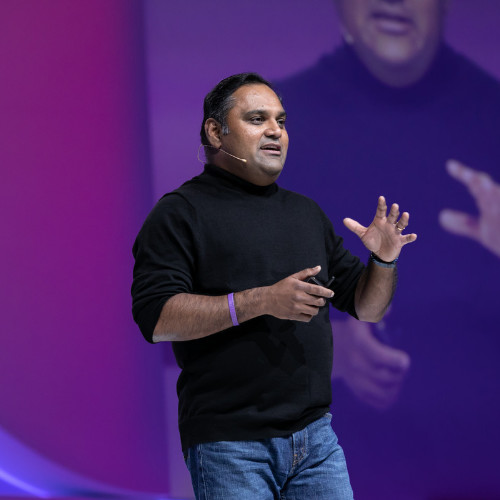
Sudhir Hasbe, Director, Product Management at Google Cloud sits down with John Furrier & Rebecca Knight at Informatica World 2019 in Las Vegas, NV.
#INFA19 #theCUBE #GoogleCloud
https://siliconangle.com/2019/05/24/qa-google-cloud-informatica-team-tame-data-infa19/
Q&A: Google Cloud and Informatica team up to ‘tame data’
As the enterprise delves deeper into cloud technology, data recovery is taking priority over other issues. How quickly can customers move their data from one platform to another? What are the most-effective ways of keeping data safe?
Through its new partnership with Informatica LLC, Google Cloud is looking to bring safety and quick data storage methods to its users, and its latest product portfolio offers tools to keep important data sources secure, according to Sudhir Hasbe (pictured), director of product management at Google Cloud
Hasbe spoke with John Furrier (@furrier) and Rebecca Knight (@knightrm), co-hosts of theCUBE, SiliconANGLE Media’s mobile livestreaming studio, during the Informatica World event in Las Vegas. They discussed how Google Cloud and Informatica will work together, the kinds of capabilities each company brings to customers, and the impact of Google Cloud’s BigQuery serverless platform as a service tool (see the full interview with transcript here). (* Disclosure below.)
[Editor’s note: The following answers have been condensed for clarity.]
Knight: The big story is that Google Cloud and Informatica are teaming up to “tame data.” Tell us more about this partnership.
Hasbe: If you look at the whole journey of data within organizations, a lot of data is siloed in different systems within different environments. Customers need this whole end-to-end experience where you can go ahead and take that data, move it to the cloud, do data cleansing on it, and do data preparation. You want to be able to go ahead and govern the data and know what data you have, like a catalog.
Informatica provides all those capabilities, and if you look at Google Cloud, we have some highly differentiated services which customers love across the globe. We can do large-scale analytics. We have customers from a few terabytes to 100-plus petabytes storing data in BigQuery, analyzing it and getting value out of it. This whole end-to-end experience is what customers need, and with this partnership, I think we are bringing all the key components our customers need for a perfect fit.
Furrier: With the solutions that you see with Informatica, what use cases are their low-hanging fruits right now? Where do you see that spectrum of solutions?
Hasbe: There are a few scenarios that I see across the board after talking to a lot of customers. The first thing I hear is about the modernization of data warehousing and analytics infrastructure. Lots of data is still siloed and stuck into these different systems that are there within organizations, and if you want to go ahead and leverage that data to build on top of the data, democratize it with everybody within the organization, or to leverage AI and machine -learning on top of it, you need to unwind what you’ve done and just take that data and put it into the cloud. I think modernization of data warehouses and analytics infrastructure is one key play across the IT systems and IT operations.
Furrier: Tell me about Google’s big capabilities, because you guys have a lot of internal power platform features. BigQuery is one of them. Is BigQuery the secret weapon? Is that the big power source for managing data?
Hasbe: Our customers love BigQuery primarily because of the capabilities it provides. There are different capabilities. I’ll just list a few. One is that we can do analytics at scale. As organizations grow, even if data sets are small within an organization, what I have seen over time is when you derive a lot of value from data, you will start collecting more data within an organization. So, you must think about scale, whether you’re starting with one terabyte or one petabyte or 100 petabytes. It doesn’t matter; analyzing data at scale is what we’re good at.
Second is democratizing data. We have done a good job of making data available through different tooling that customers have invested in, and our tooling is available to everybody. AirAsia is a good example. They have been able to go ahead and give insights to everyone within the organization, which has helped them save five to 10% in operations costs.
Knight: Talk a little bit about the impact of [BigQuery] on marketing.
...
(* Disclosure: TheCUBE is a paid media partner for Informatica World 2019. Neither Informatica LLC, the sponsor for theCUBE’s event coverage, nor other sponsors have editorial control over content on theCUBE or SiliconANGLE.)
Forgot Password
Almost there!
We just sent you a verification email. Please verify your account to gain access to
Informatica World 2019 | Las Vegas. If you don’t think you received an email check your
spam folder.
In order to sign in, enter the email address you used to registered for the event. Once completed, you will receive an email with a verification link. Open this link to automatically sign into the site.
Register For Informatica World 2019 | Las Vegas
Please fill out the information below. You will recieve an email with a verification link confirming your registration. Click the link to automatically sign into the site.
You’re almost there!
We just sent you a verification email. Please click the verification button in the email. Once your email address is verified, you will have full access to all event content for Informatica World 2019 | Las Vegas.
I want my badge and interests to be visible to all attendees.
Checking this box will display your presense on the attendees list, view your profile and allow other attendees to contact you via 1-1 chat. Read the Privacy Policy. At any time, you can choose to disable this preference.
Select your Interests!
add
Upload your photo
Uploading..
OR
Connect via Twitter
Connect via Linkedin
EDIT PASSWORD
Share
Forgot Password
Almost there!
We just sent you a verification email. Please verify your account to gain access to
Informatica World 2019 | Las Vegas. If you don’t think you received an email check your
spam folder.
In order to sign in, enter the email address you used to registered for the event. Once completed, you will receive an email with a verification link. Open this link to automatically sign into the site.
Sign in to gain access to Informatica World 2019 | Las Vegas
Please sign in with LinkedIn to continue to Informatica World 2019 | Las Vegas. Signing in with LinkedIn ensures a professional environment.
Are you sure you want to remove access rights for this user?
Details
Manage Access
email address
Community Invitation
Sudhir Hasbe, Google Cloud | Informatica World 2019
Sudhir Hasbe, Director, Product Management at Google Cloud sits down with John Furrier & Rebecca Knight at Informatica World 2019 in Las Vegas, NV.
#INFA19 #theCUBE #GoogleCloud
https://siliconangle.com/2019/05/24/qa-google-cloud-informatica-team-tame-data-infa19/
Q&A: Google Cloud and Informatica team up to ‘tame data’
As the enterprise delves deeper into cloud technology, data recovery is taking priority over other issues. How quickly can customers move their data from one platform to another? What are the most-effective ways of keeping data safe?
Through its new partnership with Informatica LLC, Google Cloud is looking to bring safety and quick data storage methods to its users, and its latest product portfolio offers tools to keep important data sources secure, according to Sudhir Hasbe (pictured), director of product management at Google Cloud
Hasbe spoke with John Furrier (@furrier) and Rebecca Knight (@knightrm), co-hosts of theCUBE, SiliconANGLE Media’s mobile livestreaming studio, during the Informatica World event in Las Vegas. They discussed how Google Cloud and Informatica will work together, the kinds of capabilities each company brings to customers, and the impact of Google Cloud’s BigQuery serverless platform as a service tool (see the full interview with transcript here). (* Disclosure below.)
[Editor’s note: The following answers have been condensed for clarity.]
Knight: The big story is that Google Cloud and Informatica are teaming up to “tame data.” Tell us more about this partnership.
Hasbe: If you look at the whole journey of data within organizations, a lot of data is siloed in different systems within different environments. Customers need this whole end-to-end experience where you can go ahead and take that data, move it to the cloud, do data cleansing on it, and do data preparation. You want to be able to go ahead and govern the data and know what data you have, like a catalog.
Informatica provides all those capabilities, and if you look at Google Cloud, we have some highly differentiated services which customers love across the globe. We can do large-scale analytics. We have customers from a few terabytes to 100-plus petabytes storing data in BigQuery, analyzing it and getting value out of it. This whole end-to-end experience is what customers need, and with this partnership, I think we are bringing all the key components our customers need for a perfect fit.
Furrier: With the solutions that you see with Informatica, what use cases are their low-hanging fruits right now? Where do you see that spectrum of solutions?
Hasbe: There are a few scenarios that I see across the board after talking to a lot of customers. The first thing I hear is about the modernization of data warehousing and analytics infrastructure. Lots of data is still siloed and stuck into these different systems that are there within organizations, and if you want to go ahead and leverage that data to build on top of the data, democratize it with everybody within the organization, or to leverage AI and machine -learning on top of it, you need to unwind what you’ve done and just take that data and put it into the cloud. I think modernization of data warehouses and analytics infrastructure is one key play across the IT systems and IT operations.
Furrier: Tell me about Google’s big capabilities, because you guys have a lot of internal power platform features. BigQuery is one of them. Is BigQuery the secret weapon? Is that the big power source for managing data?
Hasbe: Our customers love BigQuery primarily because of the capabilities it provides. There are different capabilities. I’ll just list a few. One is that we can do analytics at scale. As organizations grow, even if data sets are small within an organization, what I have seen over time is when you derive a lot of value from data, you will start collecting more data within an organization. So, you must think about scale, whether you’re starting with one terabyte or one petabyte or 100 petabytes. It doesn’t matter; analyzing data at scale is what we’re good at.
Second is democratizing data. We have done a good job of making data available through different tooling that customers have invested in, and our tooling is available to everybody. AirAsia is a good example. They have been able to go ahead and give insights to everyone within the organization, which has helped them save five to 10% in operations costs.
Knight: Talk a little bit about the impact of [BigQuery] on marketing.
...
(* Disclosure: TheCUBE is a paid media partner for Informatica World 2019. Neither Informatica LLC, the sponsor for theCUBE’s event coverage, nor other sponsors have editorial control over content on theCUBE or SiliconANGLE.)