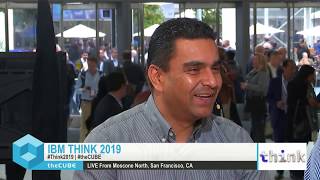
Stefanie Chiras, Vice President and General Manager, RHEL Business Unit, Red Hat sits down with Stu Miniman & Dave Vellante at IBM Think 2019 in San Francisco, CA.
#Think2019 #RedHat #theCUBE
https://siliconangle.com/2019/02/18/red-hats-true-value-may-be-strengthening-ibms-enterprise-cloud-rhelevance-think2019-guestoftheweek/
Red Hat’s true value may be strengthening IBM’s enterprise cloud ‘RHELevance’
Linux has blossomed into the right platform at the right time for enterprise computing.
When she was vice president of Cognitive Systems at IBM Corp., Stefanie Chiras (pictured) kept a vial of metal on her desk, a memento of an internship spent developing advanced materials for NASA that would be light enough to be carried into space yet strong enough to support a load. The vial was a reminder that the right materials must be matched to the right project or the outcome will likely be failure.
Since those days with NASA and IBM, Chiras has moved on to a different role as vice president and general manager, RHEL business unit, for Red Hat Inc., but the vial’s message is still the same. Today’s expanding computing infrastructure demands the right operating system, and Chiras is absolutely convinced that Red Hat Enterprise Linux, or RHEL, is the right solution at the right time.
“I always say to customers, you may not know the applications you’ll run next year, in three years or five years, you may not know where you’ll want to run them,” Chiras said. “What you do know is they’ll run on Linux. It’s the fastest-growing operating system in the industry today.”
Chiras spoke with Dave Vellante (@dvellante) and Stu Miniman (@stu), co-hosts of theCUBE, SiliconANGLE Media’s mobile livestreaming studio, during the IBM Think event in San Francisco. They discussed the role Linux plays in multicloud, features contained in the latest RHEL update, how Red Hat’s technology supports containerization, new tools to help manage a complex infrastructure, and passion exhibited by the open-source community. (* Disclosure below.)
This week, theCUBE features Stefanie Chiras as its Guest of the Week.
Central to Red Hat’s business
RHEL sits at the core of Red Hat’s business, and Linux is the foundation upon which the digital world is built. Developed in the early 1990s by Linus Torvalds, Linux today runs supercomputers, stock exchanges, smartphones and cars. It’s an open-source operating system that’s everywhere, and the best part is it’s free.
Red Hat Linux is not only the number one operating system for on-premises computing; it is also number one in the cloud, according to IBM chief executive Ginni Rometty. And what’s fueling its popularity is a reputation for stability, security and reliability in a multicloud world.
“You can buy a house, an office building, an apartment building, but what doesn’t change is the land underneath,” Chiras said. “You need that land to be stable, and you can build whatever you want on it. And that’s how we view Linux. Consume it anywhere you want. It’s always secure; it’s always stable in multiple public clouds.”
RHEL beta speeds updates
In November, Red Hat released a major RHEL update that was designed to recognize the cloud, application and container-based ecosystem of the current information technology landscape. One of the key new enhancements found in the beta version of RHEL 8 is Application Streams, which allows developers to upgrade user space packages, system memory allocated for running applications, without having to monkey with the core operating system. This allows for experimentation with newer programming package versions while running an older, more stable edition in production.
“It allows you to do faster updates, continue on your core, run multiple versions of your user space,” Chiras said.
The newly released beta version of RHEL also enables new Linux tools for container creation and management. These include Buildah for generating a container, Podman to run it, and Skopeo for application sharing.
Red Hat’s implementation of RHEL 8 demonstrates how the firm is positioning itself in the cloud ecosystem. The various elements contained in the new beta follow a carefully orchestrated trail from developer tools for applications to containers, with OpenShift, the firm’s enterprise container and Kubernetes platform, playing a key role in the ultimate move toward the hybrid cloud.
...
Watch the complete video interview below, and be sure to check out more of SiliconANGLE’s and theCUBE’s coverage of the IBM Think event. (* Disclosure: Red Hat Inc. sponsored this segment of theCUBE. Neither Red Hat nor other sponsors have editorial control over content on theCUBE or SiliconANGLE.)
Forgot Password
Almost there!
We just sent you a verification email. Please verify your account to gain access to
IBM Think 2019 | San Francisco. If you don’t think you received an email check your
spam folder.
In order to sign in, enter the email address you used to registered for the event. Once completed, you will receive an email with a verification link. Open this link to automatically sign into the site.
Register For IBM Think 2019 | San Francisco
Please fill out the information below. You will recieve an email with a verification link confirming your registration. Click the link to automatically sign into the site.
You’re almost there!
We just sent you a verification email. Please click the verification button in the email. Once your email address is verified, you will have full access to all event content for IBM Think 2019 | San Francisco.
I want my badge and interests to be visible to all attendees.
Checking this box will display your presense on the attendees list, view your profile and allow other attendees to contact you via 1-1 chat. Read the Privacy Policy. At any time, you can choose to disable this preference.
Select your Interests!
add
Upload your photo
Uploading..
OR
Connect via Twitter
Connect via Linkedin
EDIT PASSWORD
Share
Forgot Password
Almost there!
We just sent you a verification email. Please verify your account to gain access to
IBM Think 2019 | San Francisco. If you don’t think you received an email check your
spam folder.
In order to sign in, enter the email address you used to registered for the event. Once completed, you will receive an email with a verification link. Open this link to automatically sign into the site.
Sign in to gain access to IBM Think 2019 | San Francisco
Please sign in with LinkedIn to continue to IBM Think 2019 | San Francisco. Signing in with LinkedIn ensures a professional environment.
Are you sure you want to remove access rights for this user?
Details
Manage Access
email address
Community Invitation
Stefanie Chiras, Red Hat | IBM Think 2019
Stefanie Chiras, Vice President and General Manager, RHEL Business Unit, Red Hat sits down with Stu Miniman & Dave Vellante at IBM Think 2019 in San Francisco, CA.
#Think2019 #RedHat #theCUBE
https://siliconangle.com/2019/02/18/red-hats-true-value-may-be-strengthening-ibms-enterprise-cloud-rhelevance-think2019-guestoftheweek/
Red Hat’s true value may be strengthening IBM’s enterprise cloud ‘RHELevance’
Linux has blossomed into the right platform at the right time for enterprise computing.
When she was vice president of Cognitive Systems at IBM Corp., Stefanie Chiras (pictured) kept a vial of metal on her desk, a memento of an internship spent developing advanced materials for NASA that would be light enough to be carried into space yet strong enough to support a load. The vial was a reminder that the right materials must be matched to the right project or the outcome will likely be failure.
Since those days with NASA and IBM, Chiras has moved on to a different role as vice president and general manager, RHEL business unit, for Red Hat Inc., but the vial’s message is still the same. Today’s expanding computing infrastructure demands the right operating system, and Chiras is absolutely convinced that Red Hat Enterprise Linux, or RHEL, is the right solution at the right time.
“I always say to customers, you may not know the applications you’ll run next year, in three years or five years, you may not know where you’ll want to run them,” Chiras said. “What you do know is they’ll run on Linux. It’s the fastest-growing operating system in the industry today.”
Chiras spoke with Dave Vellante (@dvellante) and Stu Miniman (@stu), co-hosts of theCUBE, SiliconANGLE Media’s mobile livestreaming studio, during the IBM Think event in San Francisco. They discussed the role Linux plays in multicloud, features contained in the latest RHEL update, how Red Hat’s technology supports containerization, new tools to help manage a complex infrastructure, and passion exhibited by the open-source community. (* Disclosure below.)
This week, theCUBE features Stefanie Chiras as its Guest of the Week.
Central to Red Hat’s business
RHEL sits at the core of Red Hat’s business, and Linux is the foundation upon which the digital world is built. Developed in the early 1990s by Linus Torvalds, Linux today runs supercomputers, stock exchanges, smartphones and cars. It’s an open-source operating system that’s everywhere, and the best part is it’s free.
Red Hat Linux is not only the number one operating system for on-premises computing; it is also number one in the cloud, according to IBM chief executive Ginni Rometty. And what’s fueling its popularity is a reputation for stability, security and reliability in a multicloud world.
“You can buy a house, an office building, an apartment building, but what doesn’t change is the land underneath,” Chiras said. “You need that land to be stable, and you can build whatever you want on it. And that’s how we view Linux. Consume it anywhere you want. It’s always secure; it’s always stable in multiple public clouds.”
RHEL beta speeds updates
In November, Red Hat released a major RHEL update that was designed to recognize the cloud, application and container-based ecosystem of the current information technology landscape. One of the key new enhancements found in the beta version of RHEL 8 is Application Streams, which allows developers to upgrade user space packages, system memory allocated for running applications, without having to monkey with the core operating system. This allows for experimentation with newer programming package versions while running an older, more stable edition in production.
“It allows you to do faster updates, continue on your core, run multiple versions of your user space,” Chiras said.
The newly released beta version of RHEL also enables new Linux tools for container creation and management. These include Buildah for generating a container, Podman to run it, and Skopeo for application sharing.
Red Hat’s implementation of RHEL 8 demonstrates how the firm is positioning itself in the cloud ecosystem. The various elements contained in the new beta follow a carefully orchestrated trail from developer tools for applications to containers, with OpenShift, the firm’s enterprise container and Kubernetes platform, playing a key role in the ultimate move toward the hybrid cloud.
...
Watch the complete video interview below, and be sure to check out more of SiliconANGLE’s and theCUBE’s coverage of the IBM Think event. (* Disclosure: Red Hat Inc. sponsored this segment of theCUBE. Neither Red Hat nor other sponsors have editorial control over content on theCUBE or SiliconANGLE.)