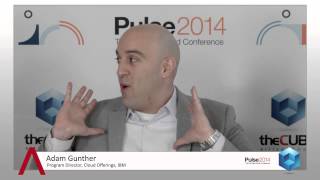
Matt Cadieux, Infiniti Red Bull Racing, at IBM Pulse 2014 with John Furrier and Dave Vellante
Pulse 2014, IBM's ongoing cloud event hailing from Las Vegas, is bringing together the luminaries of the tech world, exploring the strategic technology trends for 2014. Two we're looking at during this week's broadcast include the new era of workloads, and the trends driving the IT transformation to software-defined environments.
Matt Cadieux, Infinity Red Bull Racing's CIO, joined John Furrier and Dave Vellante in theCUBE, to discuss how their internal cloud infrastructure, powered by SDE, helped innovate the racing competition.
"Let's talk about technology meeting racing," invited Furrier.
Cadieux proceeded to elaborate on Red Bull Racing's method of applying data science in the auto racing field.
"My team is responsible for the applications and the underlying infrastructure that we use to design, make and race Formula 1 cars," stated Cadieux. "We have over 200 applications in the company and we make heavy use of simulations for things like computation fluid dynamics to design the shape of the car, we use data analytics to make the right decisions during the race events, our infrastructure has hundreds of servers and over 4 petabytes of managed data."
Cadieux also mentioned "a very sophisticated network" and the private cloud that allows them to meet the business demands for simulations and data analytics -- with the help of IBM platform computing.
"Everything is data-driven -- from inception, design, build," said Furrier who then asked Cadieux to talk the viewers through the magnitude of the data. "What's the CIO's challenge?"
Red Bull's CIO challenge
Red Bull Racing relies heavily on simulation, modeling, and virtual analysis to design the winning car, and the IT infrastructure is a critical component of the competitive advantage.
"The cars are instrumented, we have over 100 sensors on them, plus engineers at the track looking at telemetry. But we also have an MPLS connection back to an operations room. There are 20 engineers consuming telemetry. My big challenge is to make sure all of the infrastructure works and engineers get the data they need in a timely fashion so that they can make the right decisions," answered Matt Cadieux.
A real, real-time decision
Furrier asked for a specific example where Cadieux relied on real-time data to perform a tweak or a significant game-changing detail.
"The most compelling example we have was in 2012 when Sebastian Vettel was trying to win the Drivers Championship and was involved in an accident during his last lap. The car was damaged and we had to micro-manage the car for the entire length to do just well enough in order for him to finish and win the race."
"With the real time feeds, we were able to look at the general stats and instruct Sebastian how to nurse the car and finish the competition. That's the most high-profile example of data analytics that made a big difference to the race's outcome," said Cadieux.
"What would you have done differently, without this instrumentation?" asked the co-hosts.
"Vettel had to change the engine mode because the exhaust had been dented," said Cadieux. "If he pushed the car as hard as possible, the exhaust would have cracked and he wouldn't have finished," he admitted. "During the pit stop we also had to adjust the wings angles to adjust the balance on the car. All this was done at the advice of the people doing the simulation."
#theCUBE #IBM #SiliconANGLE @thecube @IBM @SiliconANGLE theCUBE
#ibmpulse
Forgot Password
Almost there!
We just sent you a verification email. Please verify your account to gain access to
IBM Pulse 2014 | Las Vegas. If you don’t think you received an email check your
spam folder.
In order to sign in, enter the email address you used to registered for the event. Once completed, you will receive an email with a verification link. Open this link to automatically sign into the site.
Register For IBM Pulse 2014 | Las Vegas
Please fill out the information below. You will recieve an email with a verification link confirming your registration. Click the link to automatically sign into the site.
You’re almost there!
We just sent you a verification email. Please click the verification button in the email. Once your email address is verified, you will have full access to all event content for IBM Pulse 2014 | Las Vegas.
I want my badge and interests to be visible to all attendees.
Checking this box will display your presense on the attendees list, view your profile and allow other attendees to contact you via 1-1 chat. Read the Privacy Policy. At any time, you can choose to disable this preference.
Select your Interests!
add
Upload your photo
Uploading..
OR
Connect via Twitter
Connect via Linkedin
EDIT PASSWORD
Share
Forgot Password
Almost there!
We just sent you a verification email. Please verify your account to gain access to
IBM Pulse 2014 | Las Vegas. If you don’t think you received an email check your
spam folder.
In order to sign in, enter the email address you used to registered for the event. Once completed, you will receive an email with a verification link. Open this link to automatically sign into the site.
Sign in to gain access to IBM Pulse 2014 | Las Vegas
Please sign in with LinkedIn to continue to IBM Pulse 2014 | Las Vegas. Signing in with LinkedIn ensures a professional environment.
Are you sure you want to remove access rights for this user?
Details
Manage Access
email address
Community Invitation
Matt Cadieux, Infiniti Red Bull Racing | IBM Pulse 2014
Matt Cadieux, Infiniti Red Bull Racing, at IBM Pulse 2014 with John Furrier and Dave Vellante
Pulse 2014, IBM's ongoing cloud event hailing from Las Vegas, is bringing together the luminaries of the tech world, exploring the strategic technology trends for 2014. Two we're looking at during this week's broadcast include the new era of workloads, and the trends driving the IT transformation to software-defined environments.
Matt Cadieux, Infinity Red Bull Racing's CIO, joined John Furrier and Dave Vellante in theCUBE, to discuss how their internal cloud infrastructure, powered by SDE, helped innovate the racing competition.
"Let's talk about technology meeting racing," invited Furrier.
Cadieux proceeded to elaborate on Red Bull Racing's method of applying data science in the auto racing field.
"My team is responsible for the applications and the underlying infrastructure that we use to design, make and race Formula 1 cars," stated Cadieux. "We have over 200 applications in the company and we make heavy use of simulations for things like computation fluid dynamics to design the shape of the car, we use data analytics to make the right decisions during the race events, our infrastructure has hundreds of servers and over 4 petabytes of managed data."
Cadieux also mentioned "a very sophisticated network" and the private cloud that allows them to meet the business demands for simulations and data analytics -- with the help of IBM platform computing.
"Everything is data-driven -- from inception, design, build," said Furrier who then asked Cadieux to talk the viewers through the magnitude of the data. "What's the CIO's challenge?"
Red Bull's CIO challenge
Red Bull Racing relies heavily on simulation, modeling, and virtual analysis to design the winning car, and the IT infrastructure is a critical component of the competitive advantage.
"The cars are instrumented, we have over 100 sensors on them, plus engineers at the track looking at telemetry. But we also have an MPLS connection back to an operations room. There are 20 engineers consuming telemetry. My big challenge is to make sure all of the infrastructure works and engineers get the data they need in a timely fashion so that they can make the right decisions," answered Matt Cadieux.
A real, real-time decision
Furrier asked for a specific example where Cadieux relied on real-time data to perform a tweak or a significant game-changing detail.
"The most compelling example we have was in 2012 when Sebastian Vettel was trying to win the Drivers Championship and was involved in an accident during his last lap. The car was damaged and we had to micro-manage the car for the entire length to do just well enough in order for him to finish and win the race."
"With the real time feeds, we were able to look at the general stats and instruct Sebastian how to nurse the car and finish the competition. That's the most high-profile example of data analytics that made a big difference to the race's outcome," said Cadieux.
"What would you have done differently, without this instrumentation?" asked the co-hosts.
"Vettel had to change the engine mode because the exhaust had been dented," said Cadieux. "If he pushed the car as hard as possible, the exhaust would have cracked and he wouldn't have finished," he admitted. "During the pit stop we also had to adjust the wings angles to adjust the balance on the car. All this was done at the advice of the people doing the simulation."
#theCUBE #IBM #SiliconANGLE @thecube @IBM @SiliconANGLE theCUBE
#ibmpulse