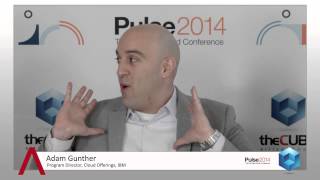
Steve Robinson, IBM, at IBM Pulse 2014 with John Furrier and Dave Vellante
Steve Robinson, General Manager of Cloud Platform Services with IBM, joined John Furrier and Dave Vellante in theCUBE, during the last day of IBM Pulse 2014 Conference in Las Vegas, Nevada.
The interview began with Furrier noting the modern era of enterprise, the importance of blending services and the relevance of agility, speed and cloud economics. His intuition regarding IBM's strategy pointed towards middleware, with SoftLayer as the foundation. Steve Robinson didn't deny it, describing a "rather organic path" for IBM and the requirements to make some fundamental decisions regarding what community groups to have constituency with.
"We made some key decisions along the way, but the goal was to build a good, solid, open platform that was attractive to the web shops and the enterprise developers at the same time," he said.
"There's a clear vote of confidence from the adoption side, but now there's the developer aspect of it. The old tactics of competing is all about having a good product -- both from the client adoption sales and winning the ecosystem. The lock-in spec is a thing of the past; talk about the Openness," invited Furrier.
"We used to do lock-in and having a whole lot of proprietary stack all the way down," admitted Robinson. "Customers want to make sure they have an angle they can move, should they want to, and the challenge for us is to offer a better value, a better hosting experience and a better support experience. The bar is set and we are going to break some of the old ways, moving towards the self-service type model with BlueMix and changing the support policy, opening some new ground," Robinson promised.
"The old buzz words are still a relevant part of the equation," added Furrier, clearly referring to web services and services around architecture. "I want to ask you about customer impact. What is the customer demand?"
"They see the opportunity of cloud and its impact on the data center. Most of the corporate accounts that we're talking to today are going to be looking at ways of leveraging those resources," said Robinson. "The public cloud is very appealing to them. We've reached the stage where data and elasticity that can be built with these types of public services are far beyond what could be imagined before. They see the advantages, but are still trying to figure out their transition and the way to take full advantage of the opportunities."
"Will DB2 run on cloud in the future?" asked Furrier.
"We'll have to do some API fronting and gateways. The strong demand is for taking what has been built and extending it out to the public community. It doesn't mean you take that asset into a full relocation, but there's various ways you can burst with it and move that asset forward," explained Robinson.
The function of middle-ware
Vellante wanted to take Robinson back to the days of the WebSphere, asking him to elaborate on the purpose of middleware (hardware, apps, OS), explaining what exactly middleware comprises.
"Most data centers have a base set of services around all of their applications so you end up having to build a multiple platform approach to 'how do I do consistent data across the board' and 'how do I do consistent system management and measuring the environment across the board', 'how do I lay out a consistent security policy across the board' and 'how do I lay out a consistent way to do transactions' and other business applications as well," detailed Robinson.
"So these are all services," clarified theCUBE co-hosts.
"Even with traditional middle-ware, there have always been layers that I would put in my data centers to build up my overall architecture. Services would be used across multiple applications while also representing a foundation architecture for all the software," added Robinson.
"How has that evolved into PaaS?" asked Vellante.
Robinson explained: "I've been in IT for over 30 years and some concepts are identical, while other areas are brand new. PaaS (Platform as a Service) is basically a capability to help you get an application framed out, get the services wired into it and then take the steps (that we never did with traditional development) to handle the deployment and the management of that application out on the public cloud domain."
"So there's a DevOps angle there," noted Vellante.
"Traditional development always started with base requirement through performance testing and then you handed it over to a CIO to do the deployment. The life cycle is extending now all the way to the DevOps piece," clarified Robinson.
#theCUBE #IBM #SiliconANGLE @IBM @SiliconANGLE theCUBE @thecube #ibmpulse
Forgot Password
Almost there!
We just sent you a verification email. Please verify your account to gain access to
IBM Pulse 2014 | Las Vegas. If you don’t think you received an email check your
spam folder.
In order to sign in, enter the email address you used to registered for the event. Once completed, you will receive an email with a verification link. Open this link to automatically sign into the site.
Register For IBM Pulse 2014 | Las Vegas
Please fill out the information below. You will recieve an email with a verification link confirming your registration. Click the link to automatically sign into the site.
You’re almost there!
We just sent you a verification email. Please click the verification button in the email. Once your email address is verified, you will have full access to all event content for IBM Pulse 2014 | Las Vegas.
I want my badge and interests to be visible to all attendees.
Checking this box will display your presense on the attendees list, view your profile and allow other attendees to contact you via 1-1 chat. Read the Privacy Policy. At any time, you can choose to disable this preference.
Select your Interests!
add
Upload your photo
Uploading..
OR
Connect via Twitter
Connect via Linkedin
EDIT PASSWORD
Share
Forgot Password
Almost there!
We just sent you a verification email. Please verify your account to gain access to
IBM Pulse 2014 | Las Vegas. If you don’t think you received an email check your
spam folder.
In order to sign in, enter the email address you used to registered for the event. Once completed, you will receive an email with a verification link. Open this link to automatically sign into the site.
Sign in to gain access to IBM Pulse 2014 | Las Vegas
Please sign in with LinkedIn to continue to IBM Pulse 2014 | Las Vegas. Signing in with LinkedIn ensures a professional environment.
Are you sure you want to remove access rights for this user?
Details
Manage Access
email address
Community Invitation
Steve Robinson, IBM | IBM Pulse 2014
Steve Robinson, IBM, at IBM Pulse 2014 with John Furrier and Dave Vellante
Steve Robinson, General Manager of Cloud Platform Services with IBM, joined John Furrier and Dave Vellante in theCUBE, during the last day of IBM Pulse 2014 Conference in Las Vegas, Nevada.
The interview began with Furrier noting the modern era of enterprise, the importance of blending services and the relevance of agility, speed and cloud economics. His intuition regarding IBM's strategy pointed towards middleware, with SoftLayer as the foundation. Steve Robinson didn't deny it, describing a "rather organic path" for IBM and the requirements to make some fundamental decisions regarding what community groups to have constituency with.
"We made some key decisions along the way, but the goal was to build a good, solid, open platform that was attractive to the web shops and the enterprise developers at the same time," he said.
"There's a clear vote of confidence from the adoption side, but now there's the developer aspect of it. The old tactics of competing is all about having a good product -- both from the client adoption sales and winning the ecosystem. The lock-in spec is a thing of the past; talk about the Openness," invited Furrier.
"We used to do lock-in and having a whole lot of proprietary stack all the way down," admitted Robinson. "Customers want to make sure they have an angle they can move, should they want to, and the challenge for us is to offer a better value, a better hosting experience and a better support experience. The bar is set and we are going to break some of the old ways, moving towards the self-service type model with BlueMix and changing the support policy, opening some new ground," Robinson promised.
"The old buzz words are still a relevant part of the equation," added Furrier, clearly referring to web services and services around architecture. "I want to ask you about customer impact. What is the customer demand?"
"They see the opportunity of cloud and its impact on the data center. Most of the corporate accounts that we're talking to today are going to be looking at ways of leveraging those resources," said Robinson. "The public cloud is very appealing to them. We've reached the stage where data and elasticity that can be built with these types of public services are far beyond what could be imagined before. They see the advantages, but are still trying to figure out their transition and the way to take full advantage of the opportunities."
"Will DB2 run on cloud in the future?" asked Furrier.
"We'll have to do some API fronting and gateways. The strong demand is for taking what has been built and extending it out to the public community. It doesn't mean you take that asset into a full relocation, but there's various ways you can burst with it and move that asset forward," explained Robinson.
The function of middle-ware
Vellante wanted to take Robinson back to the days of the WebSphere, asking him to elaborate on the purpose of middleware (hardware, apps, OS), explaining what exactly middleware comprises.
"Most data centers have a base set of services around all of their applications so you end up having to build a multiple platform approach to 'how do I do consistent data across the board' and 'how do I do consistent system management and measuring the environment across the board', 'how do I lay out a consistent security policy across the board' and 'how do I lay out a consistent way to do transactions' and other business applications as well," detailed Robinson.
"So these are all services," clarified theCUBE co-hosts.
"Even with traditional middle-ware, there have always been layers that I would put in my data centers to build up my overall architecture. Services would be used across multiple applications while also representing a foundation architecture for all the software," added Robinson.
"How has that evolved into PaaS?" asked Vellante.
Robinson explained: "I've been in IT for over 30 years and some concepts are identical, while other areas are brand new. PaaS (Platform as a Service) is basically a capability to help you get an application framed out, get the services wired into it and then take the steps (that we never did with traditional development) to handle the deployment and the management of that application out on the public cloud domain."
"So there's a DevOps angle there," noted Vellante.
"Traditional development always started with base requirement through performance testing and then you handed it over to a CIO to do the deployment. The life cycle is extending now all the way to the DevOps piece," clarified Robinson.
#theCUBE #IBM #SiliconANGLE @IBM @SiliconANGLE theCUBE @thecube #ibmpulse