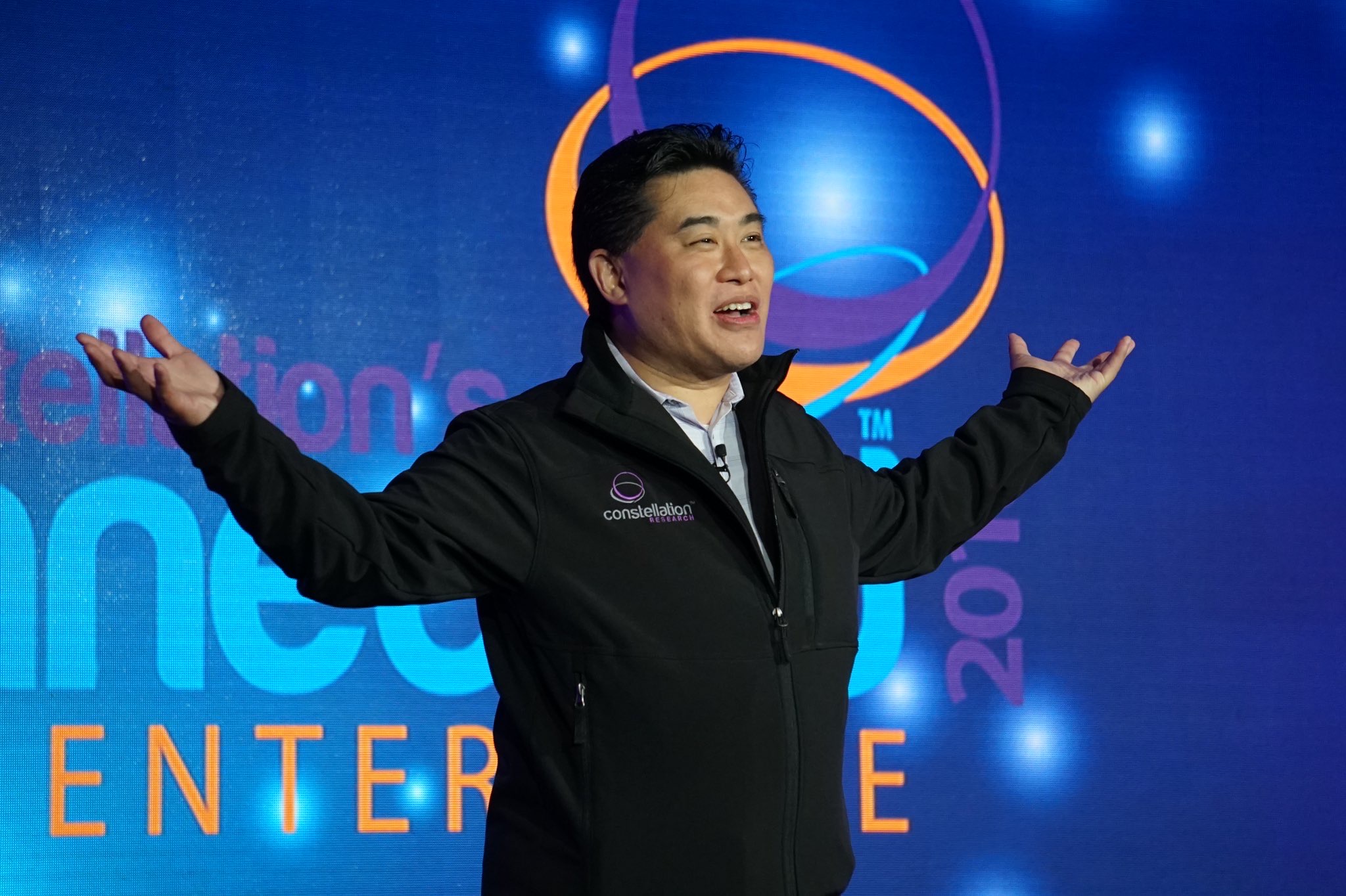
Ray Wang, Constellation Research Group, at IBM Pulse 2014 with John Furrier and Dave Vellante
IBM has built up a considerable arsenal of cloud services over the last couple of years (while bolstering its Big Data portfolio in parallel) as part of an aggressive growth strategy that focuses equally on organic innovation and acquisitions. The company's most important buy since embarking on this journey is SoftLayer, which underpins its push for dominance in what Constellation Research Group founder and principal analyst Ray Wang refers to as the "wide open" enterprise cloud market.
Appearing on SiliconANGLE's theCUBE at IBM Pulse, Wang -- a repeat guest -- tells hosts John Furrier and Dave Vellante that the so-called "swimming lanes" have not yet formed in this segment, providing ample growth opportunities for incumbent vendors that are looking to catch up with the pace of change and actually have the resources to pull it off.. "This is a game that requires lots of money, lots of scale, and there's only about 10 or 12 players that can do this," he observes.
IBM is on this list along with longtime competitors HP and Oracle, plus less entrenched firms such as Rackspace and Amazon. The retail-turned-cloud giant is at an advantage thanks to its leadership position in the infrastructure-as-a-service market but it has not yet extended its dominance over the platform layer, which Wang views as next frontier for the enterprise. AWS is being mobilized with the addition of managed solutions like Kinesis, however the competition is also making big strides, with IBM recently allocating a massive $1.2 billion to grow its global data center footprint.
The move is reminiscent of the company's $1 billion dollar Linux investment in 2001, which helped popularize the operating system, except this time around Red Hat is no where in sight. But Wang believes that the firm is merely keeping a low profile. The way he sees it, the open source stalwart is positioning as an arms dealer to the broader cloud ecosystem, an already crowded space that got even bigger at IBM Pulse with the introduction of BlueMix, a PaaS solution that layers Cloud Foundry over SoftLayer. The launch marks a significant evolution of Big Blue's cloud vision, which was practically non-existent two years ago.
"Back then we just looked at it as a bunch of disparate pieces that were just kinda been thrown into the cloud because cloud was cool," Wang recalls."What we saw here was the coming out of the full IBM cloud front attack, so this is where BlueMix is the beginning of that conversation but it's the recognition that cloud is gonna be there entry point."
Now that it has its foot in the door of the cloud market, IBM faces a new set of challenges. Wang says that the vendor will have to build a developer ecosystem around SoftLayer and double down on partnerships in order to keep up with rivals, which are pushing prices down in a race to zero that shows up prominently on CIOs' radar screens.
"They're looking at any vendor that can give them an opening to drive down costs, whether it's app modernization, whether it's testing, whether it's integration or whether it's just taking infrastructure and turning it around," he details. Meanwhile, forward-looking IT organizations that prioritize innovation over cost savings are also adopting cloud services to more effectively meet business objectives. The growing need to deliver consumer-grade experiences in the enterprise has placed developers in the center of this trend, according to Wang.
#theCUBE #IBM #SiliconANGLE @IBM @SiliconANGLE theCUBE @thecube
#ibmpulse
Forgot Password
Almost there!
We just sent you a verification email. Please verify your account to gain access to
IBM Pulse 2014 | Las Vegas. If you don’t think you received an email check your
spam folder.
In order to sign in, enter the email address you used to registered for the event. Once completed, you will receive an email with a verification link. Open this link to automatically sign into the site.
Register For IBM Pulse 2014 | Las Vegas
Please fill out the information below. You will recieve an email with a verification link confirming your registration. Click the link to automatically sign into the site.
You’re almost there!
We just sent you a verification email. Please click the verification button in the email. Once your email address is verified, you will have full access to all event content for IBM Pulse 2014 | Las Vegas.
I want my badge and interests to be visible to all attendees.
Checking this box will display your presense on the attendees list, view your profile and allow other attendees to contact you via 1-1 chat. Read the Privacy Policy. At any time, you can choose to disable this preference.
Select your Interests!
add
Upload your photo
Uploading..
OR
Connect via Twitter
Connect via Linkedin
EDIT PASSWORD
Share
Forgot Password
Almost there!
We just sent you a verification email. Please verify your account to gain access to
IBM Pulse 2014 | Las Vegas. If you don’t think you received an email check your
spam folder.
In order to sign in, enter the email address you used to registered for the event. Once completed, you will receive an email with a verification link. Open this link to automatically sign into the site.
Sign in to gain access to IBM Pulse 2014 | Las Vegas
Please sign in with LinkedIn to continue to IBM Pulse 2014 | Las Vegas. Signing in with LinkedIn ensures a professional environment.
Are you sure you want to remove access rights for this user?
Details
Manage Access
email address
Community Invitation
R "Ray" Wang, Constellation Research | IBM Pulse 2014
Ray Wang, Constellation Research Group, at IBM Pulse 2014 with John Furrier and Dave Vellante
IBM has built up a considerable arsenal of cloud services over the last couple of years (while bolstering its Big Data portfolio in parallel) as part of an aggressive growth strategy that focuses equally on organic innovation and acquisitions. The company's most important buy since embarking on this journey is SoftLayer, which underpins its push for dominance in what Constellation Research Group founder and principal analyst Ray Wang refers to as the "wide open" enterprise cloud market.
Appearing on SiliconANGLE's theCUBE at IBM Pulse, Wang -- a repeat guest -- tells hosts John Furrier and Dave Vellante that the so-called "swimming lanes" have not yet formed in this segment, providing ample growth opportunities for incumbent vendors that are looking to catch up with the pace of change and actually have the resources to pull it off.. "This is a game that requires lots of money, lots of scale, and there's only about 10 or 12 players that can do this," he observes.
IBM is on this list along with longtime competitors HP and Oracle, plus less entrenched firms such as Rackspace and Amazon. The retail-turned-cloud giant is at an advantage thanks to its leadership position in the infrastructure-as-a-service market but it has not yet extended its dominance over the platform layer, which Wang views as next frontier for the enterprise. AWS is being mobilized with the addition of managed solutions like Kinesis, however the competition is also making big strides, with IBM recently allocating a massive $1.2 billion to grow its global data center footprint.
The move is reminiscent of the company's $1 billion dollar Linux investment in 2001, which helped popularize the operating system, except this time around Red Hat is no where in sight. But Wang believes that the firm is merely keeping a low profile. The way he sees it, the open source stalwart is positioning as an arms dealer to the broader cloud ecosystem, an already crowded space that got even bigger at IBM Pulse with the introduction of BlueMix, a PaaS solution that layers Cloud Foundry over SoftLayer. The launch marks a significant evolution of Big Blue's cloud vision, which was practically non-existent two years ago.
"Back then we just looked at it as a bunch of disparate pieces that were just kinda been thrown into the cloud because cloud was cool," Wang recalls."What we saw here was the coming out of the full IBM cloud front attack, so this is where BlueMix is the beginning of that conversation but it's the recognition that cloud is gonna be there entry point."
Now that it has its foot in the door of the cloud market, IBM faces a new set of challenges. Wang says that the vendor will have to build a developer ecosystem around SoftLayer and double down on partnerships in order to keep up with rivals, which are pushing prices down in a race to zero that shows up prominently on CIOs' radar screens.
"They're looking at any vendor that can give them an opening to drive down costs, whether it's app modernization, whether it's testing, whether it's integration or whether it's just taking infrastructure and turning it around," he details. Meanwhile, forward-looking IT organizations that prioritize innovation over cost savings are also adopting cloud services to more effectively meet business objectives. The growing need to deliver consumer-grade experiences in the enterprise has placed developers in the center of this trend, according to Wang.
#theCUBE #IBM #SiliconANGLE @IBM @SiliconANGLE theCUBE @thecube
#ibmpulse