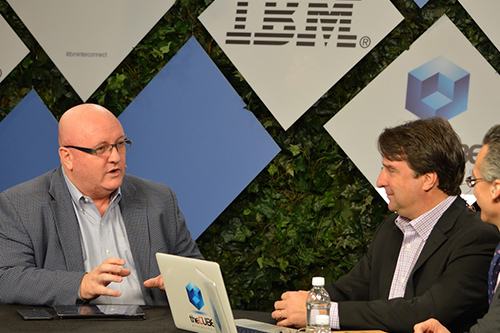
01. Chris O'Connor, IBM, Visits #theCUBE. (00:18)
02. The Starting Point Is Operational Value. (00:37)
03. Business Impact of the Connectivity Spectrum. (04:35)
04. Examples of Process Improvement. (09:26)
05. Cognitive Iot Increases Insightful Data. (12:30)
06. Pre-Cognitive Insights. (14:06)
07. The Learning System Is Learning. (16:11)
08. Investing in the Data or Improving Algorithms. (19:09)
09. Building Out Solutions and Enabling Developer Transformation. (23:07)
Track List created with http://www.vinjavideo.com.
--- ---
Cognitive IoT and instant value | #IBMInterConnect
by Gabriel Pesek | Feb 24, 2016
During the last day of this year’s IBM InterConnect event, conversations and presentations from the rest of the event were examined from new angles, with attendees from other companies and IBM’s representatives converging to find the best ways to utilize the latest developments and address new challenges.
John Furrier and Dave Vellante, cohosts of theCUBE, from the SiliconANGLE Media team, joined Chris O’Connor, GM of Internet of Things (IoT) Offerings at IBM, to get his perspective on what IoT has in store, as well as how it joins with the cognitive analytics methods being pushed by Watson (IBM’s cognitive processing technology).
The physical side of IoT
O’Connor had a lot to say about IoT’s potential, but he began by establishing the baseline: “Everybody’s starting from this point of operational data.” From there, he said, the added value pays for the cost of the upgrades needed to take fuller advantage of IoT data-leveraging, allowing those same companies to adjust their focuses to improving efficiency, pushing new dynamics with business partners based on the acquired abilities, and engaging in more meaningful dialogues with clients.
He also pointed out ways in which IoT is enabling companies that have been physically oriented to now talk to the client digitally, with examples of washing machines, refrigerators and plumbing used to illustrate ways in which these companies can not only reduce transport costs by ensuring the right parts to repair these appliances are delivered the first time, but also by letting them specifically identify the cause of the problem and talk the customer through the procedure of repairing it themselves.
Upgrading IoT capabilities
Giving a brief retrospective on connectivity’s improvement,
O’Connor traced its move from a reliance on wired functionality to the ubiquity of Wi-Fi, cellphone connectivity, Bluetooth, and various other specialty options to create seamless experiences.
From theoretical exploration-oriented to looking at the connectivity of a thing to fundamentally operationalizing the productivity, IoT is disrupting the market in ways that have yet to be fully explored.
Cognitive IoT ecosystem
“Cognitive analytics is about increasing the amount of data to improve the learning environment,” O’Connor said, noting how this reverses the old mantra of “slim down your data.” Referring to the “staging of information,” he also noted the importance of keeping data clean as it goes from point to point, but he emphasized that combining multiple data streams is where the cognitive value can be found.
“The value in the patterns that hit necessitate the move now,” he added, laying out how bringing in other vectors once the path to cognitive has already been started is a modular process that companies can use as their revenues increase from initial integration. “Operational efficiency can’t be stressed enough.”
With IoT tying into Watson and cognitive analytics, safety, security and verification of goods shipping, the range of ways to improve business efficiency and revenue really is only at the tip of the iceberg at this point.
@theCUBE
#IBMInterConnect
Forgot Password
Almost there!
We just sent you a verification email. Please verify your account to gain access to
IBM InterConnect 2016 | Las Vegas. If you don’t think you received an email check your
spam folder.
In order to sign in, enter the email address you used to registered for the event. Once completed, you will receive an email with a verification link. Open this link to automatically sign into the site.
Register For IBM InterConnect 2016 | Las Vegas
Please fill out the information below. You will recieve an email with a verification link confirming your registration. Click the link to automatically sign into the site.
You’re almost there!
We just sent you a verification email. Please click the verification button in the email. Once your email address is verified, you will have full access to all event content for IBM InterConnect 2016 | Las Vegas.
I want my badge and interests to be visible to all attendees.
Checking this box will display your presense on the attendees list, view your profile and allow other attendees to contact you via 1-1 chat. Read the Privacy Policy. At any time, you can choose to disable this preference.
Select your Interests!
add
Upload your photo
Uploading..
OR
Connect via Twitter
Connect via Linkedin
EDIT PASSWORD
Share
Forgot Password
Almost there!
We just sent you a verification email. Please verify your account to gain access to
IBM InterConnect 2016 | Las Vegas. If you don’t think you received an email check your
spam folder.
In order to sign in, enter the email address you used to registered for the event. Once completed, you will receive an email with a verification link. Open this link to automatically sign into the site.
Sign in to gain access to IBM InterConnect 2016 | Las Vegas
Please sign in with LinkedIn to continue to IBM InterConnect 2016 | Las Vegas. Signing in with LinkedIn ensures a professional environment.
Are you sure you want to remove access rights for this user?
Details
Manage Access
email address
Community Invitation
Chris O'Connor, IBM - #IBMInterConnect 2016 - #theCUBE
01. Chris O'Connor, IBM, Visits #theCUBE. (00:18)
02. The Starting Point Is Operational Value. (00:37)
03. Business Impact of the Connectivity Spectrum. (04:35)
04. Examples of Process Improvement. (09:26)
05. Cognitive Iot Increases Insightful Data. (12:30)
06. Pre-Cognitive Insights. (14:06)
07. The Learning System Is Learning. (16:11)
08. Investing in the Data or Improving Algorithms. (19:09)
09. Building Out Solutions and Enabling Developer Transformation. (23:07)
Track List created with http://www.vinjavideo.com.
--- ---
Cognitive IoT and instant value | #IBMInterConnect
by Gabriel Pesek | Feb 24, 2016
During the last day of this year’s IBM InterConnect event, conversations and presentations from the rest of the event were examined from new angles, with attendees from other companies and IBM’s representatives converging to find the best ways to utilize the latest developments and address new challenges.
John Furrier and Dave Vellante, cohosts of theCUBE, from the SiliconANGLE Media team, joined Chris O’Connor, GM of Internet of Things (IoT) Offerings at IBM, to get his perspective on what IoT has in store, as well as how it joins with the cognitive analytics methods being pushed by Watson (IBM’s cognitive processing technology).
The physical side of IoT
O’Connor had a lot to say about IoT’s potential, but he began by establishing the baseline: “Everybody’s starting from this point of operational data.” From there, he said, the added value pays for the cost of the upgrades needed to take fuller advantage of IoT data-leveraging, allowing those same companies to adjust their focuses to improving efficiency, pushing new dynamics with business partners based on the acquired abilities, and engaging in more meaningful dialogues with clients.
He also pointed out ways in which IoT is enabling companies that have been physically oriented to now talk to the client digitally, with examples of washing machines, refrigerators and plumbing used to illustrate ways in which these companies can not only reduce transport costs by ensuring the right parts to repair these appliances are delivered the first time, but also by letting them specifically identify the cause of the problem and talk the customer through the procedure of repairing it themselves.
Upgrading IoT capabilities
Giving a brief retrospective on connectivity’s improvement,
O’Connor traced its move from a reliance on wired functionality to the ubiquity of Wi-Fi, cellphone connectivity, Bluetooth, and various other specialty options to create seamless experiences.
From theoretical exploration-oriented to looking at the connectivity of a thing to fundamentally operationalizing the productivity, IoT is disrupting the market in ways that have yet to be fully explored.
Cognitive IoT ecosystem
“Cognitive analytics is about increasing the amount of data to improve the learning environment,” O’Connor said, noting how this reverses the old mantra of “slim down your data.” Referring to the “staging of information,” he also noted the importance of keeping data clean as it goes from point to point, but he emphasized that combining multiple data streams is where the cognitive value can be found.
“The value in the patterns that hit necessitate the move now,” he added, laying out how bringing in other vectors once the path to cognitive has already been started is a modular process that companies can use as their revenues increase from initial integration. “Operational efficiency can’t be stressed enough.”
With IoT tying into Watson and cognitive analytics, safety, security and verification of goods shipping, the range of ways to improve business efficiency and revenue really is only at the tip of the iceberg at this point.
@theCUBE
#IBMInterConnect