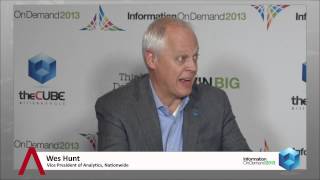
John Furrier and Dave Vellante, theCUBE co-hosts, were joined again by Merv Adrian, VP with Gartner and reputed analyst, who offered his insight on the IBM Information on Demand conference in Las Vegas this week.
What's your report card for #IBMIoD? asked Furrier.
"As always, it's overwhelmingly large. I think the number is 13,000 people. You have to see it to believe it. There are also a lot of suits here, a lot of people interested in the business side. Even in a session that I just sat through that was talking about competitive displacement by IBM, two people on the panel basically said they didn't really want to hear too much about the technology. It was as much about my relationship with the vendors I was working with as it was about the technology," said Adrian. "That's always been one of IBM strengths: they have a lifetime view of customer value and they cultivate their relationship very carefully over the years."
Talking about the present event, Merv Adrian said that "IBM's biggest challenge is reaching outside of their fan base, getting to the folks that are not already blue-stack loyalists."
"Eighty percent of IBM's revenue comes from 20 percent of their customers," Adrian went on. "Clearly they have a strong base in companies that have the highest mainstream requirements for security and reliability. Their big focus in several the speeches here was ease and simplicity.
"That's a story that has to be told with pictures and they didn't do that effectively today," noted Adrian. "If you want to tell me how simple your GUI is, and how easy it is to use your product for discovery, then don't use 5000 words to do it, put five pictures on the stage and show me that. They didn't do it."
Tools of the trade
"There's a great tool here called Discover, that is a marvelous way for an entry point into the unstructured and new data that people are trying to work with, that gives you a way to go play with it, find something useful, then persist something that will be of value -- which is the inevitable next step of most people's early Big Data experiments. IBM has a great portfolio of pieces that can be put together to tell that story," said Adrian. "Today I heard about that portfolio, I didn't hear about that story. I didn't hear a narrative, and the narrative is there to be told."
One of the presentations Merv liked was that of National Geographic, because they had a great opening, with great visualizations. It was greatly staged, combining data with geography.
"Social business is a great story, it's the face of analytics" said Furrier, and Vellante asked if the "performance is the reason people flock to the cloud."
"That's probably not when they go there at first," reckoned Adrian, "but performance is a second order variable. First I explore, I discover, I find value, and once I do, and I put this into production, then I start thinking about how can I do this more cost-effectively, how can I do with better performance, how can I make it more stable, secure, reliable. That's when people come to IBM, and they're still well positioned for answering those questions when those questions come up," he concluded.
Merv Adrian, Information Management, at IBM Information on Demand 2013 with John Furrier and Dave Vellante
@thecube
#IBMIOD
Forgot Password
Almost there!
We just sent you a verification email. Please verify your account to gain access to
IBM Information on Demand (IOD) 2013 | Las Vegas. If you don’t think you received an email check your
spam folder.
Sign in to IBM Information on Demand (IOD) 2013 | Las Vegas.
In order to sign in, enter the email address you used to registered for the event. Once completed, you will receive an email with a verification link. Open this link to automatically sign into the site.
Register For IBM Information on Demand (IOD) 2013 | Las Vegas
Please fill out the information below. You will recieve an email with a verification link confirming your registration. Click the link to automatically sign into the site.
You’re almost there!
We just sent you a verification email. Please click the verification button in the email. Once your email address is verified, you will have full access to all event content for IBM Information on Demand (IOD) 2013 | Las Vegas.
I want my badge and interests to be visible to all attendees.
Checking this box will display your presense on the attendees list, view your profile and allow other attendees to contact you via 1-1 chat. Read the Privacy Policy. At any time, you can choose to disable this preference.
Select your Interests!
add
Upload your photo
Uploading..
OR
Connect via Twitter
Connect via Linkedin
EDIT PASSWORD
Share
Forgot Password
Almost there!
We just sent you a verification email. Please verify your account to gain access to
IBM Information on Demand (IOD) 2013 | Las Vegas. If you don’t think you received an email check your
spam folder.
Sign in to IBM Information on Demand (IOD) 2013 | Las Vegas.
In order to sign in, enter the email address you used to registered for the event. Once completed, you will receive an email with a verification link. Open this link to automatically sign into the site.
Sign in to gain access to IBM Information on Demand (IOD) 2013 | Las Vegas
Please sign in with LinkedIn to continue to IBM Information on Demand (IOD) 2013 | Las Vegas. Signing in with LinkedIn ensures a professional environment.
Are you sure you want to remove access rights for this user?
Details
Manage Access
email address
Community Invitation
Merv Adrian - IBM Information on Demand 2013 - theCUBE
John Furrier and Dave Vellante, theCUBE co-hosts, were joined again by Merv Adrian, VP with Gartner and reputed analyst, who offered his insight on the IBM Information on Demand conference in Las Vegas this week.
What's your report card for #IBMIoD? asked Furrier.
"As always, it's overwhelmingly large. I think the number is 13,000 people. You have to see it to believe it. There are also a lot of suits here, a lot of people interested in the business side. Even in a session that I just sat through that was talking about competitive displacement by IBM, two people on the panel basically said they didn't really want to hear too much about the technology. It was as much about my relationship with the vendors I was working with as it was about the technology," said Adrian. "That's always been one of IBM strengths: they have a lifetime view of customer value and they cultivate their relationship very carefully over the years."
Talking about the present event, Merv Adrian said that "IBM's biggest challenge is reaching outside of their fan base, getting to the folks that are not already blue-stack loyalists."
"Eighty percent of IBM's revenue comes from 20 percent of their customers," Adrian went on. "Clearly they have a strong base in companies that have the highest mainstream requirements for security and reliability. Their big focus in several the speeches here was ease and simplicity.
"That's a story that has to be told with pictures and they didn't do that effectively today," noted Adrian. "If you want to tell me how simple your GUI is, and how easy it is to use your product for discovery, then don't use 5000 words to do it, put five pictures on the stage and show me that. They didn't do it."
Tools of the trade
"There's a great tool here called Discover, that is a marvelous way for an entry point into the unstructured and new data that people are trying to work with, that gives you a way to go play with it, find something useful, then persist something that will be of value -- which is the inevitable next step of most people's early Big Data experiments. IBM has a great portfolio of pieces that can be put together to tell that story," said Adrian. "Today I heard about that portfolio, I didn't hear about that story. I didn't hear a narrative, and the narrative is there to be told."
One of the presentations Merv liked was that of National Geographic, because they had a great opening, with great visualizations. It was greatly staged, combining data with geography.
"Social business is a great story, it's the face of analytics" said Furrier, and Vellante asked if the "performance is the reason people flock to the cloud."
"That's probably not when they go there at first," reckoned Adrian, "but performance is a second order variable. First I explore, I discover, I find value, and once I do, and I put this into production, then I start thinking about how can I do this more cost-effectively, how can I do with better performance, how can I make it more stable, secure, reliable. That's when people come to IBM, and they're still well positioned for answering those questions when those questions come up," he concluded.
Merv Adrian, Information Management, at IBM Information on Demand 2013 with John Furrier and Dave Vellante
@thecube
#IBMIOD