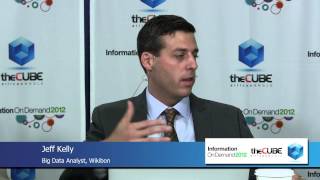
Randy Kahn is the founder of Delve and the Principal lawyer for Kahn Consulting. He is in attendance at the 2012 IBM Informtion on Demand Conference, and joins Wikibon Analyst Dave Vellante and SiliconAngle's John Furrier for a live interview inside theCUBE.
Like everything else, information has a lifespan, and just like a beautiful bouquet of daisies, when it gets old and wilts, when it has no further business value and is past any compliance retention dates, it should be thrown out, says Randolph (Randy) Kahn, esq., lawyer, principle of Kahn Consulting, author and founder last year of Delve. Today, however, "many IT people don't think of data as having a lifespan," he said in an interview in the Cube with SiliconAngle Founder/CEO John Furrier and Wilibon Cofounder/Chief Analyst David Vellante from the IBM Information OnDemand conference.
As a result, and because corporate general counsels are always warning them to be very careful about what they delete, IT staffers save everything forever. This results in hundreds of Tbytes, in some cases Pbytes, of aging data that costs enterprises millions in direct storage costs, increases the level of exposure in a legal action, clogs vital IT systems such as ERP, and makes it much harder to find data that is valuable and needed, as Kahn detailed in an interview with Vellante before the conference.
What companies need is a legally defensible method for identifying and eliminating data that is past its sell-by date and has become just an expense. Kahn's next book, Chucking the Daisies: How Companies Deal with Big Data, presents a series of rules for creating a workable records management system that does just that. However, rules are one thing and implementation another, and dealing with Pbytes of historical data requires a sophisticated technological system for the heavy lifting. That is where Delve comes in. It uses commercially available software, often systems the client already owns but does not know how to use effectively, to do all the "heavy lifting" of identifying the right data to delete.
This is not as easy as it might sound. "We are doing a big project right now for a large financial services company," Kahn said. "The first stage of that project is just finding mathematically and numerically precise duplicates. Not near duplicates. Even that exercise, taking away in some cases dozens of exact duplicates ... is a gargantuan savings in itself." And, he adds, finding those duplicates, in multiple systems and locations and in some cases different formats, in Pbytes of data, is not a simple exercise.
Once those duplicates are eliminated, Delve simplifies the company's retention rules and teaches that to the machine learning system along with the data types in use in the company. This also is not as simple as it seems. For instance, the Rules of Evidence and Rules of Civil Procedure require that companies retain records that may be used in evidence not only in legal actions presently underway, but also actions that may reasonably be expected in the future. That means that companies have to analyze things like complaints from customers, employees, and investors over anything from safety issues with products to possible harassment cases to financial questions involving company stock prices. And of course certain records have to be retained for specific amounts of time to comply with business regulations, and those requirements vary from jurisdiction to jurisdiction.
On the other hand, absent either an ongoing legal action or reasonable expectation of such an action, once those legal time limits expire if the data is no longer of business value, "do I need to predict the future? No." Understanding the nuances of those regulations and encoding them correctly into the records classification system correctly obviously requires special knowledge.
Ultimately data that no longer has business value, and that no longer needs to be retained for legal reasons, is a present cost center and a potential risk. "Companies need a legally defensible way without causing liability or causing us heartburn to get rid of it in a methodical way," Kahn said. "It's every big business's challenge today to address that."
#theCUBE #IBM #SiliconANGLE @IBM
Forgot Password
Almost there!
We just sent you a verification email. Please verify your account to gain access to
IBM Information On Demand (IOD) 2012 | Las Vegas. If you don’t think you received an email check your
spam folder.
Sign in to IBM Information On Demand (IOD) 2012 | Las Vegas.
In order to sign in, enter the email address you used to registered for the event. Once completed, you will receive an email with a verification link. Open this link to automatically sign into the site.
Register For IBM Information On Demand (IOD) 2012 | Las Vegas
Please fill out the information below. You will recieve an email with a verification link confirming your registration. Click the link to automatically sign into the site.
You’re almost there!
We just sent you a verification email. Please click the verification button in the email. Once your email address is verified, you will have full access to all event content for IBM Information On Demand (IOD) 2012 | Las Vegas.
I want my badge and interests to be visible to all attendees.
Checking this box will display your presense on the attendees list, view your profile and allow other attendees to contact you via 1-1 chat. Read the Privacy Policy. At any time, you can choose to disable this preference.
Select your Interests!
add
Upload your photo
Uploading..
OR
Connect via Twitter
Connect via Linkedin
EDIT PASSWORD
Share
Forgot Password
Almost there!
We just sent you a verification email. Please verify your account to gain access to
IBM Information On Demand (IOD) 2012 | Las Vegas. If you don’t think you received an email check your
spam folder.
Sign in to IBM Information On Demand (IOD) 2012 | Las Vegas.
In order to sign in, enter the email address you used to registered for the event. Once completed, you will receive an email with a verification link. Open this link to automatically sign into the site.
Sign in to gain access to IBM Information On Demand (IOD) 2012 | Las Vegas
Please sign in with LinkedIn to continue to IBM Information On Demand (IOD) 2012 | Las Vegas. Signing in with LinkedIn ensures a professional environment.
Are you sure you want to remove access rights for this user?
Details
Manage Access
email address
Community Invitation
Randy Kahn, Delve | IBM Information On Demand 2012
Randy Kahn is the founder of Delve and the Principal lawyer for Kahn Consulting. He is in attendance at the 2012 IBM Informtion on Demand Conference, and joins Wikibon Analyst Dave Vellante and SiliconAngle's John Furrier for a live interview inside theCUBE.
Like everything else, information has a lifespan, and just like a beautiful bouquet of daisies, when it gets old and wilts, when it has no further business value and is past any compliance retention dates, it should be thrown out, says Randolph (Randy) Kahn, esq., lawyer, principle of Kahn Consulting, author and founder last year of Delve. Today, however, "many IT people don't think of data as having a lifespan," he said in an interview in the Cube with SiliconAngle Founder/CEO John Furrier and Wilibon Cofounder/Chief Analyst David Vellante from the IBM Information OnDemand conference.
As a result, and because corporate general counsels are always warning them to be very careful about what they delete, IT staffers save everything forever. This results in hundreds of Tbytes, in some cases Pbytes, of aging data that costs enterprises millions in direct storage costs, increases the level of exposure in a legal action, clogs vital IT systems such as ERP, and makes it much harder to find data that is valuable and needed, as Kahn detailed in an interview with Vellante before the conference.
What companies need is a legally defensible method for identifying and eliminating data that is past its sell-by date and has become just an expense. Kahn's next book, Chucking the Daisies: How Companies Deal with Big Data, presents a series of rules for creating a workable records management system that does just that. However, rules are one thing and implementation another, and dealing with Pbytes of historical data requires a sophisticated technological system for the heavy lifting. That is where Delve comes in. It uses commercially available software, often systems the client already owns but does not know how to use effectively, to do all the "heavy lifting" of identifying the right data to delete.
This is not as easy as it might sound. "We are doing a big project right now for a large financial services company," Kahn said. "The first stage of that project is just finding mathematically and numerically precise duplicates. Not near duplicates. Even that exercise, taking away in some cases dozens of exact duplicates ... is a gargantuan savings in itself." And, he adds, finding those duplicates, in multiple systems and locations and in some cases different formats, in Pbytes of data, is not a simple exercise.
Once those duplicates are eliminated, Delve simplifies the company's retention rules and teaches that to the machine learning system along with the data types in use in the company. This also is not as simple as it seems. For instance, the Rules of Evidence and Rules of Civil Procedure require that companies retain records that may be used in evidence not only in legal actions presently underway, but also actions that may reasonably be expected in the future. That means that companies have to analyze things like complaints from customers, employees, and investors over anything from safety issues with products to possible harassment cases to financial questions involving company stock prices. And of course certain records have to be retained for specific amounts of time to comply with business regulations, and those requirements vary from jurisdiction to jurisdiction.
On the other hand, absent either an ongoing legal action or reasonable expectation of such an action, once those legal time limits expire if the data is no longer of business value, "do I need to predict the future? No." Understanding the nuances of those regulations and encoding them correctly into the records classification system correctly obviously requires special knowledge.
Ultimately data that no longer has business value, and that no longer needs to be retained for legal reasons, is a present cost center and a potential risk. "Companies need a legally defensible way without causing liability or causing us heartburn to get rid of it in a methodical way," Kahn said. "It's every big business's challenge today to address that."
#theCUBE #IBM #SiliconANGLE @IBM