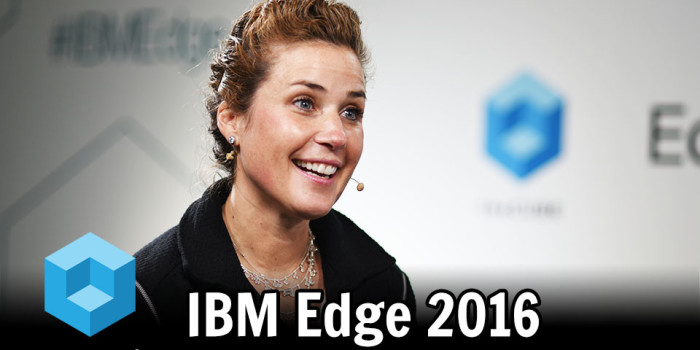
01. Dr. Stefanie Chiras, IBM, Visits #theCUBE. (00:20)
02. What Are You Gonna Talk About Tomorrow. (00:43)
03. How Did Open Power Change Your Life. (01:46)
04. How Much Of The Individual Contributor Is Based On Open Source. (03:09)
05. Where Is The Innovation Coming From To End Moore's Law. (04:28)
06. What Is The Bet That You're Making Now On Innovation. (06:05)
07. What Are The Challenges That You Have Architecting Cloud. (07:23)
08. What Is IBM's Take On China's Innovation. (09:47)
09. What Does It Mean That You're Supporting Little Endian. (10:46)
10. Where Have You Had Success. (13:01)
11. How Has In Memory Data Bases Come Back. (13:57)
12. What Is Getting You Excited In Tech. (15:56)
Track List created with http://www.vinjavideo.com.
--- ---
The end of Moore’s Law and the expansion of Linux; what do these mean to IBM? | #IBMEdge
by Bev Terrell | Sep 20, 2016
As many organizations are finding out, open-source computing is a game-changer. Many businesses now rely on open-source tools to lower costs, increase flexibility and freedom, and enhance security and accountability.
Stefanie Chiras, VP of IBM Power Systems Offering Management, Systems of Engagement, at IBM, joined Stu Miniman (@stu) and Dave Vellante (@dvellante), cohosts of theCUBE, from the SiliconANGLE Media team, during IBM Edge, held at the MGM Grand in Las Vegas, NV, to discuss the changing landscape around open source, the end of Moore’s Law, and how the cloud drives innovation for clients.
Open-source computing is a game-changer
“How Linux is being used by clients has changed dramatically… [in the 25 years since inception] it’s grown up from being a hobbyist’s sport … to running corporations,” Chiras pointed out.
She went on to comment that it’s becoming about the power of the open-source community to pull together, driving innovation in all aspects of technology, including the launch of IBM’s Power8 servers, which feature a renewed focus on Linux for data center workloads.
The end of Moore’s Law
As was pointed out by Vellante, we’ve come to the end of Moore’s Law, where innovation is no longer being driven by hardware, and he inquired as to where IBM is finding innovation now.
“[The] processor level; it’s all about return on investment for performance; it’s not happening at the same rate … based on shrinking your gates alone, every 18 months,” Chiras explained. “The laws of physics fundamentally will prevent it. Once Moore’s Law meets the law of physics, physics will win.”
Chiras went on to say IBM innovation is now about expanding past the processor and silicon level and more about pulling in things like accelerator technology. “[While] the architecture is important, it’s about the system and the system stack … [from the processor level] all the way up to the software that’s going to bring client value,” she said.
RELATED: Watch LIVE: Can machine learning help remove Hadoop complexities? | #BigDataNYC
Cloud’s power to drive innovation
“The benefit of the cloud is that it provides simple access to infrastructure [that clients] may not be willing to pull in on-prem,” said Chiras.
She went on to state, “I think cloud brings a new access point … to access new and emerging technology. … I’m very excited about open [source]. … The ability of everyone to participate, has created a much more rapid innovation cycle than we’ve ever seen before.”
Forgot Password
Almost there!
We just sent you a verification email. Please verify your account to gain access to
IBM Edge 2016 | Las Vegas. If you don’t think you received an email check your
spam folder.
In order to sign in, enter the email address you used to registered for the event. Once completed, you will receive an email with a verification link. Open this link to automatically sign into the site.
Register For IBM Edge 2016 | Las Vegas
Please fill out the information below. You will recieve an email with a verification link confirming your registration. Click the link to automatically sign into the site.
You’re almost there!
We just sent you a verification email. Please click the verification button in the email. Once your email address is verified, you will have full access to all event content for IBM Edge 2016 | Las Vegas.
I want my badge and interests to be visible to all attendees.
Checking this box will display your presense on the attendees list, view your profile and allow other attendees to contact you via 1-1 chat. Read the Privacy Policy. At any time, you can choose to disable this preference.
Select your Interests!
add
Upload your photo
Uploading..
OR
Connect via Twitter
Connect via Linkedin
EDIT PASSWORD
Share
Forgot Password
Almost there!
We just sent you a verification email. Please verify your account to gain access to
IBM Edge 2016 | Las Vegas. If you don’t think you received an email check your
spam folder.
In order to sign in, enter the email address you used to registered for the event. Once completed, you will receive an email with a verification link. Open this link to automatically sign into the site.
Sign in to gain access to IBM Edge 2016 | Las Vegas
Please sign in with LinkedIn to continue to IBM Edge 2016 | Las Vegas. Signing in with LinkedIn ensures a professional environment.
Are you sure you want to remove access rights for this user?
Details
Manage Access
email address
Community Invitation
Dr. Stefanie Chiras, IBM - #IBMEdge - #theCUBE
01. Dr. Stefanie Chiras, IBM, Visits #theCUBE. (00:20)
02. What Are You Gonna Talk About Tomorrow. (00:43)
03. How Did Open Power Change Your Life. (01:46)
04. How Much Of The Individual Contributor Is Based On Open Source. (03:09)
05. Where Is The Innovation Coming From To End Moore's Law. (04:28)
06. What Is The Bet That You're Making Now On Innovation. (06:05)
07. What Are The Challenges That You Have Architecting Cloud. (07:23)
08. What Is IBM's Take On China's Innovation. (09:47)
09. What Does It Mean That You're Supporting Little Endian. (10:46)
10. Where Have You Had Success. (13:01)
11. How Has In Memory Data Bases Come Back. (13:57)
12. What Is Getting You Excited In Tech. (15:56)
Track List created with http://www.vinjavideo.com.
--- ---
The end of Moore’s Law and the expansion of Linux; what do these mean to IBM? | #IBMEdge
by Bev Terrell | Sep 20, 2016
As many organizations are finding out, open-source computing is a game-changer. Many businesses now rely on open-source tools to lower costs, increase flexibility and freedom, and enhance security and accountability.
Stefanie Chiras, VP of IBM Power Systems Offering Management, Systems of Engagement, at IBM, joined Stu Miniman (@stu) and Dave Vellante (@dvellante), cohosts of theCUBE, from the SiliconANGLE Media team, during IBM Edge, held at the MGM Grand in Las Vegas, NV, to discuss the changing landscape around open source, the end of Moore’s Law, and how the cloud drives innovation for clients.
Open-source computing is a game-changer
“How Linux is being used by clients has changed dramatically… [in the 25 years since inception] it’s grown up from being a hobbyist’s sport … to running corporations,” Chiras pointed out.
She went on to comment that it’s becoming about the power of the open-source community to pull together, driving innovation in all aspects of technology, including the launch of IBM’s Power8 servers, which feature a renewed focus on Linux for data center workloads.
The end of Moore’s Law
As was pointed out by Vellante, we’ve come to the end of Moore’s Law, where innovation is no longer being driven by hardware, and he inquired as to where IBM is finding innovation now.
“[The] processor level; it’s all about return on investment for performance; it’s not happening at the same rate … based on shrinking your gates alone, every 18 months,” Chiras explained. “The laws of physics fundamentally will prevent it. Once Moore’s Law meets the law of physics, physics will win.”
Chiras went on to say IBM innovation is now about expanding past the processor and silicon level and more about pulling in things like accelerator technology. “[While] the architecture is important, it’s about the system and the system stack … [from the processor level] all the way up to the software that’s going to bring client value,” she said.
RELATED: Watch LIVE: Can machine learning help remove Hadoop complexities? | #BigDataNYC
Cloud’s power to drive innovation
“The benefit of the cloud is that it provides simple access to infrastructure [that clients] may not be willing to pull in on-prem,” said Chiras.
She went on to state, “I think cloud brings a new access point … to access new and emerging technology. … I’m very excited about open [source]. … The ability of everyone to participate, has created a much more rapid innovation cycle than we’ve ever seen before.”