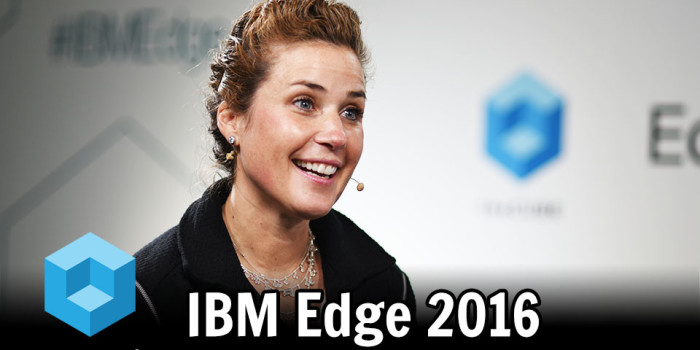
01. Doug Balog, IBM Power, visits #theCUBE!. (00:18)
02. New IBM Power Partnerships and the "Band of 5". (01:28)
03. New Use Cases in Power: Acceleration Technology. (03:12)
04. Real-Time in the Accelerated Relational Database. (05:25)
05. Update on Singapore and Block Chain. (06:06)
06. Power and the "Achilles Heel" of X86. (10:15)
07. Infrastructure Trends Driving Power. (11:25)
08. Competing in the Unix Market and Linux Investment. (13:19)
09. IBM: Listening to Clients, Finding Business Outcomes. (15:22)
Track List created with http://www.vinjavideo.com.
--- ---
Driving market change: IBM’s acceleration and Power System moves | #IBMEdge
by Gabriel Pesek | Sep 21, 2016
As IBM repositions itself and adjusts its investments and research foci, its OpenPOWER Architecture is coming into a position of high prominence in several of its plans for the future.
During the IBM Edge 2016 conference, Doug Balog, GM of Power Systems at IBM, joined Dave Vellante (@dvellante) and Stu Miniman (@stu), cohost of theCUBE, from the SiliconANGLE Media team, to discuss some of the ways in which OpenPOWER is being deployed in various fields and driving market change.
Building up
As the conversation got underway, Balog outlined a tenet that had been driving IBM’s Power Systems division. “Grow the capabilities Power had for Big Data, and now even more extend that to machine learning, deep learning and cognitive, and get Power into the cloud,” he said.
He also shared some insights into how the diversification of the market was serving customers, while competitors are bringing their own offerings into play. “It feels good to see kind of the ecosystem now building on itself and bringing that kind of differentiation to the marketplace,” Balog said.
He continued: “We have bet big on acceleration. We see a post-Moore’s Law world, where it’s a really good general-purpose processor, married together with a set of acceleration technology.”
Speed and function
Balog proceeded with a further explanation of what these processing changes make possible, citing retail implementation as a use-case. “It’s a matter of taking the data that existed already in a relational database, move it into this accelerated relational database, so that again, analytics can be done on a much faster basis,” he said. “Because again, in that retail space, the buying and selling and the bidding, if you’re not catching it at the right point, you’re losing pennies on the dollar, which adds up over time.”
Beyond that part of their Power deployment, he also addressed IBM’s growth in the server market. “We now see Linux on [OpenPOWER Architecture] being over 10 percent of the hardware revenue that I generate in the Power business,” he said. “If you’re going to be viewed as a viable player in the market, you’ve got to have at least double-digit share, and so for us, nothing but upside is how we see the Linux server market today.”
RELATED: Will the Industrial Internet usher in a bigger, better algorithm? | #PredixTransform
Advance notice
Touching on how the Chinese market and chip partners in that locale are a big interest for IBM, Balog continued on to some of the tech interests that have yet to reach firm market penetration. Among these, cognitive computing, spearheaded by IBM’s Watson project, were a key point, with its use of Power tech spotlighted. “Not only does Watson run a Power core … but now these [other cognitive] frameworks … and how we can optimize those [as well],” said Balag
He continued: “I think we’re still on an early cusp with containers. A lot of clients [are] looking at it, trying to figure out ‘how do you move workloads around using a container-based model?’”
But overall, he felt confident that IBM would prove itself across the spectrum. “Whether it be containers or virtualization, and then of course bare-metal [clouds], all modes are in play these days,” he concluded.
Forgot Password
Almost there!
We just sent you a verification email. Please verify your account to gain access to
IBM Edge 2016 | Las Vegas. If you don’t think you received an email check your
spam folder.
In order to sign in, enter the email address you used to registered for the event. Once completed, you will receive an email with a verification link. Open this link to automatically sign into the site.
Register For IBM Edge 2016 | Las Vegas
Please fill out the information below. You will recieve an email with a verification link confirming your registration. Click the link to automatically sign into the site.
You’re almost there!
We just sent you a verification email. Please click the verification button in the email. Once your email address is verified, you will have full access to all event content for IBM Edge 2016 | Las Vegas.
I want my badge and interests to be visible to all attendees.
Checking this box will display your presense on the attendees list, view your profile and allow other attendees to contact you via 1-1 chat. Read the Privacy Policy. At any time, you can choose to disable this preference.
Select your Interests!
add
Upload your photo
Uploading..
OR
Connect via Twitter
Connect via Linkedin
EDIT PASSWORD
Share
Forgot Password
Almost there!
We just sent you a verification email. Please verify your account to gain access to
IBM Edge 2016 | Las Vegas. If you don’t think you received an email check your
spam folder.
In order to sign in, enter the email address you used to registered for the event. Once completed, you will receive an email with a verification link. Open this link to automatically sign into the site.
Sign in to gain access to IBM Edge 2016 | Las Vegas
Please sign in with LinkedIn to continue to IBM Edge 2016 | Las Vegas. Signing in with LinkedIn ensures a professional environment.
Are you sure you want to remove access rights for this user?
Details
Manage Access
email address
Community Invitation
Doug Balog, IBM - #IBMEdge - #theCUBE
01. Doug Balog, IBM Power, visits #theCUBE!. (00:18)
02. New IBM Power Partnerships and the "Band of 5". (01:28)
03. New Use Cases in Power: Acceleration Technology. (03:12)
04. Real-Time in the Accelerated Relational Database. (05:25)
05. Update on Singapore and Block Chain. (06:06)
06. Power and the "Achilles Heel" of X86. (10:15)
07. Infrastructure Trends Driving Power. (11:25)
08. Competing in the Unix Market and Linux Investment. (13:19)
09. IBM: Listening to Clients, Finding Business Outcomes. (15:22)
Track List created with http://www.vinjavideo.com.
--- ---
Driving market change: IBM’s acceleration and Power System moves | #IBMEdge
by Gabriel Pesek | Sep 21, 2016
As IBM repositions itself and adjusts its investments and research foci, its OpenPOWER Architecture is coming into a position of high prominence in several of its plans for the future.
During the IBM Edge 2016 conference, Doug Balog, GM of Power Systems at IBM, joined Dave Vellante (@dvellante) and Stu Miniman (@stu), cohost of theCUBE, from the SiliconANGLE Media team, to discuss some of the ways in which OpenPOWER is being deployed in various fields and driving market change.
Building up
As the conversation got underway, Balog outlined a tenet that had been driving IBM’s Power Systems division. “Grow the capabilities Power had for Big Data, and now even more extend that to machine learning, deep learning and cognitive, and get Power into the cloud,” he said.
He also shared some insights into how the diversification of the market was serving customers, while competitors are bringing their own offerings into play. “It feels good to see kind of the ecosystem now building on itself and bringing that kind of differentiation to the marketplace,” Balog said.
He continued: “We have bet big on acceleration. We see a post-Moore’s Law world, where it’s a really good general-purpose processor, married together with a set of acceleration technology.”
Speed and function
Balog proceeded with a further explanation of what these processing changes make possible, citing retail implementation as a use-case. “It’s a matter of taking the data that existed already in a relational database, move it into this accelerated relational database, so that again, analytics can be done on a much faster basis,” he said. “Because again, in that retail space, the buying and selling and the bidding, if you’re not catching it at the right point, you’re losing pennies on the dollar, which adds up over time.”
Beyond that part of their Power deployment, he also addressed IBM’s growth in the server market. “We now see Linux on [OpenPOWER Architecture] being over 10 percent of the hardware revenue that I generate in the Power business,” he said. “If you’re going to be viewed as a viable player in the market, you’ve got to have at least double-digit share, and so for us, nothing but upside is how we see the Linux server market today.”
RELATED: Will the Industrial Internet usher in a bigger, better algorithm? | #PredixTransform
Advance notice
Touching on how the Chinese market and chip partners in that locale are a big interest for IBM, Balog continued on to some of the tech interests that have yet to reach firm market penetration. Among these, cognitive computing, spearheaded by IBM’s Watson project, were a key point, with its use of Power tech spotlighted. “Not only does Watson run a Power core … but now these [other cognitive] frameworks … and how we can optimize those [as well],” said Balag
He continued: “I think we’re still on an early cusp with containers. A lot of clients [are] looking at it, trying to figure out ‘how do you move workloads around using a container-based model?’”
But overall, he felt confident that IBM would prove itself across the spectrum. “Whether it be containers or virtualization, and then of course bare-metal [clouds], all modes are in play these days,” he concluded.