A new direction for IBM | #IBMEdge
by Elizabeth Kays | May 20, 2015
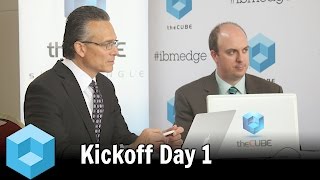
John Furrier, founder of SiliconANGLE, and Stu Miniman, senior analyst at Wikibon, were both optimistic about IBM’s new roadmap after the first day of IBM Edge 2015.
“There’s the big mega trends out there, like Cloud, Big Data analytics and open source really transforming infrastructure,” Miniman said. “And you would think that a storage, mainframe and power show — there’s some out there that would say these trends are leaving that behind. But really I came out of today … [saying] IBM has really recommitted.”
Creating a more open and innovative market
This is evident in IBM’s new willingness to collaborate and help create a more open, innovative, solution-focused market.
“You want Docker? Let’s run a z13 mainframe with z-Linux and put Docker on top of it,” Miniman said. “You want to talk Open? There’s the OpenPOWER foundation here. They’re working with OpenStack; they’re working with a lot of these big trends. And of course, analytics — huge play for IBM.”
IBM is even adapting to the increasingly powerful “platform” market, Miniman said. “We’ve been talking a lot this year about how it’s really going beyond products and going into platforms, open APIs and ecosystems, how these solutions can really fit together. And that really plays into IBM’s strengths. IBM has had huge partner ecosystems for years. IBM knows how to pull together a large number of partners, how to weave through how they play together and understand those business models. The first time I heard the word ‘co-opetition,’ it was linked to IBM. IBM has long been one that knows how to move things forward over a hundred years of innovation, and IBM knows how to keep up with the times and be relevant when it comes to these big trends.”
All about the outcomes
Furrier agreed after conducting multiple interviews with IBM clients who are seeing consistent, innovative service from the company.
“This is the new way. This is not about the speeds and feeds. It’s about the outcomes,” he said.
And those outcomes are positive enough that IBM is making old ideas new again. “Old words would become bad words, and then they come back to being good words again,” Furrier said. “I’ll give you a few of them. ‘Data processing’ – that’s an old term that went south. It went away. People talk about pipelining data, data processing. That’s an old IT term! ‘Glasshouse’ – not sure that’s back. ‘Big iron’ is a term that used to refer to the mainframe … [but] we had Wal-mart saying, hey, you know what? It runs Linux. I’ve got developers on there. I want ‘big iron!’”
And as software continues its rise to dominance across the industry, powerful infrastructure is going to become even more important, Furrier concludes. “I think that having the kind of power and the ‘big iron,’ the big servers and the ability to construct apps horizontally and vertically in a seamless way with choice is a good consumption, but more importantly with the threads [and] with the cores, software opportunity will be big,” he said.
This will improve offerings for everything from the internet of things to data-driven cities. “I think you’ll see a lot of innovation and efficiency. So to me, I think it’s all going to come down to software, and we’ve always been saying that on theCUBE.”
“I tell you, I’m impressed,” Miniman echoed. “I think I took my eye off it for a little bit, looked back, and … it’s really a new story that ties in with all the big trends we’ve been talking about.”
@theCUBE
#IBMEdge
Forgot Password
Almost there!
We just sent you a verification email. Please verify your account to gain access to
IBM Edge 2015 | Las Vegas. If you don’t think you received an email check your
spam folder.
In order to sign in, enter the email address you used to registered for the event. Once completed, you will receive an email with a verification link. Open this link to automatically sign into the site.
Register For IBM Edge 2015 | Las Vegas
Please fill out the information below. You will recieve an email with a verification link confirming your registration. Click the link to automatically sign into the site.
You’re almost there!
We just sent you a verification email. Please click the verification button in the email. Once your email address is verified, you will have full access to all event content for IBM Edge 2015 | Las Vegas.
I want my badge and interests to be visible to all attendees.
Checking this box will display your presense on the attendees list, view your profile and allow other attendees to contact you via 1-1 chat. Read the Privacy Policy. At any time, you can choose to disable this preference.
Select your Interests!
add
Upload your photo
Uploading..
OR
Connect via Twitter
Connect via Linkedin
EDIT PASSWORD
Share
Forgot Password
Almost there!
We just sent you a verification email. Please verify your account to gain access to
IBM Edge 2015 | Las Vegas. If you don’t think you received an email check your
spam folder.
In order to sign in, enter the email address you used to registered for the event. Once completed, you will receive an email with a verification link. Open this link to automatically sign into the site.
Sign in to gain access to IBM Edge 2015 | Las Vegas
Please sign in with LinkedIn to continue to IBM Edge 2015 | Las Vegas. Signing in with LinkedIn ensures a professional environment.
Are you sure you want to remove access rights for this user?
Details
Manage Access
email address
Community Invitation
Wrap Up Day 1 - IBM Edge 2015 - theCUBE
A new direction for IBM | #IBMEdge
by Elizabeth Kays | May 20, 2015
John Furrier, founder of SiliconANGLE, and Stu Miniman, senior analyst at Wikibon, were both optimistic about IBM’s new roadmap after the first day of IBM Edge 2015.
“There’s the big mega trends out there, like Cloud, Big Data analytics and open source really transforming infrastructure,” Miniman said. “And you would think that a storage, mainframe and power show — there’s some out there that would say these trends are leaving that behind. But really I came out of today … [saying] IBM has really recommitted.”
Creating a more open and innovative market
This is evident in IBM’s new willingness to collaborate and help create a more open, innovative, solution-focused market.
“You want Docker? Let’s run a z13 mainframe with z-Linux and put Docker on top of it,” Miniman said. “You want to talk Open? There’s the OpenPOWER foundation here. They’re working with OpenStack; they’re working with a lot of these big trends. And of course, analytics — huge play for IBM.”
IBM is even adapting to the increasingly powerful “platform” market, Miniman said. “We’ve been talking a lot this year about how it’s really going beyond products and going into platforms, open APIs and ecosystems, how these solutions can really fit together. And that really plays into IBM’s strengths. IBM has had huge partner ecosystems for years. IBM knows how to pull together a large number of partners, how to weave through how they play together and understand those business models. The first time I heard the word ‘co-opetition,’ it was linked to IBM. IBM has long been one that knows how to move things forward over a hundred years of innovation, and IBM knows how to keep up with the times and be relevant when it comes to these big trends.”
All about the outcomes
Furrier agreed after conducting multiple interviews with IBM clients who are seeing consistent, innovative service from the company.
“This is the new way. This is not about the speeds and feeds. It’s about the outcomes,” he said.
And those outcomes are positive enough that IBM is making old ideas new again. “Old words would become bad words, and then they come back to being good words again,” Furrier said. “I’ll give you a few of them. ‘Data processing’ – that’s an old term that went south. It went away. People talk about pipelining data, data processing. That’s an old IT term! ‘Glasshouse’ – not sure that’s back. ‘Big iron’ is a term that used to refer to the mainframe … [but] we had Wal-mart saying, hey, you know what? It runs Linux. I’ve got developers on there. I want ‘big iron!’”
And as software continues its rise to dominance across the industry, powerful infrastructure is going to become even more important, Furrier concludes. “I think that having the kind of power and the ‘big iron,’ the big servers and the ability to construct apps horizontally and vertically in a seamless way with choice is a good consumption, but more importantly with the threads [and] with the cores, software opportunity will be big,” he said.
This will improve offerings for everything from the internet of things to data-driven cities. “I think you’ll see a lot of innovation and efficiency. So to me, I think it’s all going to come down to software, and we’ve always been saying that on theCUBE.”
“I tell you, I’m impressed,” Miniman echoed. “I think I took my eye off it for a little bit, looked back, and … it’s really a new story that ties in with all the big trends we’ve been talking about.”
@theCUBE
#IBMEdge