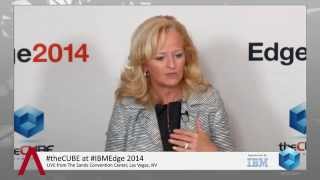
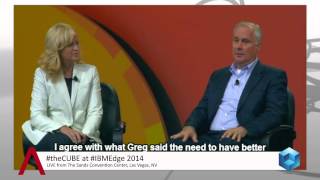
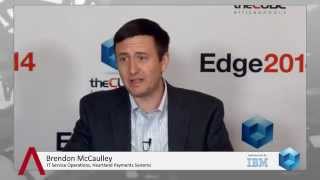
Dylan Larson, Intel, with Dave Vellante and Jeff Frick at IBM Edge 2014
@thecube
#ibmedge
Intel has applied a relentless pace to drive more and more innovation, striving for success in the data center business. This approach enables Intel to look at industry disruptions and challenges from a different perspective. At IBM Edge last month, Dylan Larson, Director for Xeon Product Lines at Intel, sat down with Dave Vellante and Jeff Frick and discussed Intel’s take on mega trends and the competition.
Disruption is good for Intel
.
Dylan LarsonWith so many disruptions going on, Vellante asked Larson to explain how these mega trends have affected Intel’s operation, behavior and other aspects of business. Larson said that these trends are good things. The innovation that happens around the core microprocessor space is great for Intel. Increases in IO performance and things like Flash memory all unlock the pathway to the processor and, from Intel’s perspective, the company can now unlock all the potential built into the CPU.
Larson also revealed that Intel is investing more broadly into portfolios to take into account elements like software-defined infrastructures and things that can be done in the CPU as well as in other components that connect into those platforms. He added that “these disruptions are great times of more and more innovations.”
In terms of the open source platform OpenStack, Larson said it gives “a new opportunity to take the open source playbook and put it to work on a very difficult problem, which is provisioning new services in a Cloud-like infrastructure.”
He’s curious to know how enterprise can get that same kind of economics and efficiency seen in large cloud infrastructures, and deliver that capability in a way that’s a cost-effective to break through to the enterprise.
Larson also mentioned that Intel believes, because OpenStack is an open source proposition, it can find ways to expose its value more effectively by working with its own inputs into the distributions, or putting more focus on capabilities that needed work in this world. Intel envisions the ability to take layers of OpenStack and propel low-level instrumentation northbound so the provisioning services that OpenStack exposes can take full advantage.
ARM, x86 and RISC
.
Frick brought up an interesting question. Can ARM do to x86 what x86 did to RISC? Based on Wikibon analyst David Floyer’s premises, Vellante responded with ‘no’ following up with a statement that it can’t happen in the data center. He then asked Larson to expound.
Larson said that there’s a huge base of software applications that people are used to developing on, which is a massive ecosystem that has worked there on the existing micro architecture. When you look at the number of ARM players that are trying to go after this market, the number are inverted. So, it will be difficult for them to reach critical mass.
Intel is taking this very seriously, but Larson wanted to make it clear that this doesn’t mean Intel won’t continue its relentless pace on lower power and new designs to support big scale architectures.
“We’re the UCLA Bruins, but we’re not giving up,” said Larson.
Forgot Password
Almost there!
We just sent you a verification email. Please verify your account to gain access to
IBM Edge 2014 | Las Vegas. If you don’t think you received an email check your
spam folder.
In order to sign in, enter the email address you used to registered for the event. Once completed, you will receive an email with a verification link. Open this link to automatically sign into the site.
Register For IBM Edge 2014 | Las Vegas
Please fill out the information below. You will recieve an email with a verification link confirming your registration. Click the link to automatically sign into the site.
You’re almost there!
We just sent you a verification email. Please click the verification button in the email. Once your email address is verified, you will have full access to all event content for IBM Edge 2014 | Las Vegas.
I want my badge and interests to be visible to all attendees.
Checking this box will display your presense on the attendees list, view your profile and allow other attendees to contact you via 1-1 chat. Read the Privacy Policy. At any time, you can choose to disable this preference.
Select your Interests!
add
Upload your photo
Uploading..
OR
Connect via Twitter
Connect via Linkedin
EDIT PASSWORD
Share
Forgot Password
Almost there!
We just sent you a verification email. Please verify your account to gain access to
IBM Edge 2014 | Las Vegas. If you don’t think you received an email check your
spam folder.
In order to sign in, enter the email address you used to registered for the event. Once completed, you will receive an email with a verification link. Open this link to automatically sign into the site.
Sign in to gain access to IBM Edge 2014 | Las Vegas
Please sign in with LinkedIn to continue to IBM Edge 2014 | Las Vegas. Signing in with LinkedIn ensures a professional environment.
Are you sure you want to remove access rights for this user?
Details
Manage Access
email address
Community Invitation
Dylan Larson, Intel | IBM Edge 2014
Dylan Larson, Intel, with Dave Vellante and Jeff Frick at IBM Edge 2014
@thecube
#ibmedge
Intel has applied a relentless pace to drive more and more innovation, striving for success in the data center business. This approach enables Intel to look at industry disruptions and challenges from a different perspective. At IBM Edge last month, Dylan Larson, Director for Xeon Product Lines at Intel, sat down with Dave Vellante and Jeff Frick and discussed Intel’s take on mega trends and the competition.
Disruption is good for Intel
.
Dylan LarsonWith so many disruptions going on, Vellante asked Larson to explain how these mega trends have affected Intel’s operation, behavior and other aspects of business. Larson said that these trends are good things. The innovation that happens around the core microprocessor space is great for Intel. Increases in IO performance and things like Flash memory all unlock the pathway to the processor and, from Intel’s perspective, the company can now unlock all the potential built into the CPU.
Larson also revealed that Intel is investing more broadly into portfolios to take into account elements like software-defined infrastructures and things that can be done in the CPU as well as in other components that connect into those platforms. He added that “these disruptions are great times of more and more innovations.”
In terms of the open source platform OpenStack, Larson said it gives “a new opportunity to take the open source playbook and put it to work on a very difficult problem, which is provisioning new services in a Cloud-like infrastructure.”
He’s curious to know how enterprise can get that same kind of economics and efficiency seen in large cloud infrastructures, and deliver that capability in a way that’s a cost-effective to break through to the enterprise.
Larson also mentioned that Intel believes, because OpenStack is an open source proposition, it can find ways to expose its value more effectively by working with its own inputs into the distributions, or putting more focus on capabilities that needed work in this world. Intel envisions the ability to take layers of OpenStack and propel low-level instrumentation northbound so the provisioning services that OpenStack exposes can take full advantage.
ARM, x86 and RISC
.
Frick brought up an interesting question. Can ARM do to x86 what x86 did to RISC? Based on Wikibon analyst David Floyer’s premises, Vellante responded with ‘no’ following up with a statement that it can’t happen in the data center. He then asked Larson to expound.
Larson said that there’s a huge base of software applications that people are used to developing on, which is a massive ecosystem that has worked there on the existing micro architecture. When you look at the number of ARM players that are trying to go after this market, the number are inverted. So, it will be difficult for them to reach critical mass.
Intel is taking this very seriously, but Larson wanted to make it clear that this doesn’t mean Intel won’t continue its relentless pace on lower power and new designs to support big scale architectures.
“We’re the UCLA Bruins, but we’re not giving up,” said Larson.