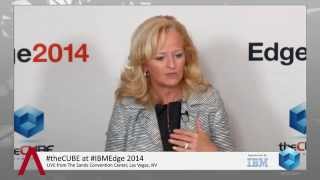
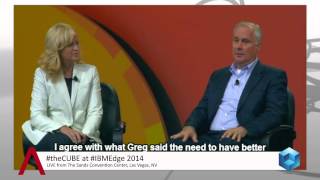
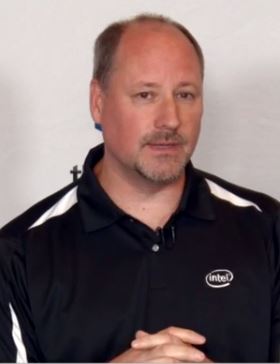
Jim Larsen, Intel, with Dave Vellante and Jeff Frick at IBM Edge 2014
@thecube #theCUBE #IBMEdge #IBM #SiliconANGLE
Apart from direct competitors, Intel seems to sell to and work with everyone in the business. Considering the way the industry is now evolving, the question is how Intel determines what to focus on.
In an interview with Dave Vellante and Jeff Frick at IBM Edge, Jim Larsen, Business Development Manager of Comms & Storage for Intel, said that Intel makes strategic investments into what the company thinks is going to happen in the future. He also said that there are always trends with each platform launch, and Intel understands that pretty well.
Pushing the Envelope vs. Calculated Innovation
.
There are those, like the Cloud guys and Telco customers, who tend to push the envelope first, rolling out new technologies and bringing those to market. From there, they start to roll over the enterprise markets and so forth.
At the moment, Intel is engaged with IBM to deliver new technologies around software-defined networking (SDN) and network function virtualization (NFV). These technologies give practitioners the tools needed to migrate jobs quickly, as use their policies and procedures to ensure that clusters of data don’t interact with one another if they’re not supposed to. This allows practitioners to quickly migrate data as needed.
SDN and NFV are on the cusp of a very big global deployments as vendors try to push out some new technologies, while also bringing down costs and offering flexibility. Companies like Netflix and other service providers are trying to push more content to the edge of the network, but want to ensure that they don’t bottleneck their whole data center by doing so. This is where Intel focused a lot of strategic investment, and the company has kept its ear close to the ground about what kind of software technology needs to be built on top of what hardware in order to make it work. “You’ve got to make both of them work otherwise you don’t have a full solution,” said Larsen.
NFV for the Telco Market
.
Vellante then asked Larsen which of Intel’s bets he thinks will pay off. Larsen said that NFV is one of the large investments that Intel is making at the moment within the Comms & Storage division. NFV is all about trying to use common x86 hardware to run jobs and functions and is really targeted at the Telco market.
Larsen described the Telco as being a very classical, tiered, structured and hardened environment. People in the Telco environment don’t change very often, only making investments every seven or so years. As they get ready to do their next deployment, they’re looking at network functions virtualization and running jobs, whether they’re switches, routers or load balancers, all on common hardware.
They’re also looking at whether the software provides the four-nines, five-nines or six-nines needed for reliably running their IT environments, referring to the reliability figure used in telecoms to measure downtime. For example, six-nines equates to a network that is guaranteed to be up 99.9999 percent of the time and down for no more than 32 seconds per year.
Forgot Password
Almost there!
We just sent you a verification email. Please verify your account to gain access to
IBM Edge 2014 | Las Vegas. If you don’t think you received an email check your
spam folder.
In order to sign in, enter the email address you used to registered for the event. Once completed, you will receive an email with a verification link. Open this link to automatically sign into the site.
Register For IBM Edge 2014 | Las Vegas
Please fill out the information below. You will recieve an email with a verification link confirming your registration. Click the link to automatically sign into the site.
You’re almost there!
We just sent you a verification email. Please click the verification button in the email. Once your email address is verified, you will have full access to all event content for IBM Edge 2014 | Las Vegas.
I want my badge and interests to be visible to all attendees.
Checking this box will display your presense on the attendees list, view your profile and allow other attendees to contact you via 1-1 chat. Read the Privacy Policy. At any time, you can choose to disable this preference.
Select your Interests!
add
Upload your photo
Uploading..
OR
Connect via Twitter
Connect via Linkedin
EDIT PASSWORD
Share
Forgot Password
Almost there!
We just sent you a verification email. Please verify your account to gain access to
IBM Edge 2014 | Las Vegas. If you don’t think you received an email check your
spam folder.
In order to sign in, enter the email address you used to registered for the event. Once completed, you will receive an email with a verification link. Open this link to automatically sign into the site.
Sign in to gain access to IBM Edge 2014 | Las Vegas
Please sign in with LinkedIn to continue to IBM Edge 2014 | Las Vegas. Signing in with LinkedIn ensures a professional environment.
Are you sure you want to remove access rights for this user?
Details
Manage Access
email address
Community Invitation
Jim Larsen, Intel | IBM Edge 2014
Jim Larsen, Intel, with Dave Vellante and Jeff Frick at IBM Edge 2014
@thecube #theCUBE #IBMEdge #IBM #SiliconANGLE
Apart from direct competitors, Intel seems to sell to and work with everyone in the business. Considering the way the industry is now evolving, the question is how Intel determines what to focus on.
In an interview with Dave Vellante and Jeff Frick at IBM Edge, Jim Larsen, Business Development Manager of Comms & Storage for Intel, said that Intel makes strategic investments into what the company thinks is going to happen in the future. He also said that there are always trends with each platform launch, and Intel understands that pretty well.
Pushing the Envelope vs. Calculated Innovation
.
There are those, like the Cloud guys and Telco customers, who tend to push the envelope first, rolling out new technologies and bringing those to market. From there, they start to roll over the enterprise markets and so forth.
At the moment, Intel is engaged with IBM to deliver new technologies around software-defined networking (SDN) and network function virtualization (NFV). These technologies give practitioners the tools needed to migrate jobs quickly, as use their policies and procedures to ensure that clusters of data don’t interact with one another if they’re not supposed to. This allows practitioners to quickly migrate data as needed.
SDN and NFV are on the cusp of a very big global deployments as vendors try to push out some new technologies, while also bringing down costs and offering flexibility. Companies like Netflix and other service providers are trying to push more content to the edge of the network, but want to ensure that they don’t bottleneck their whole data center by doing so. This is where Intel focused a lot of strategic investment, and the company has kept its ear close to the ground about what kind of software technology needs to be built on top of what hardware in order to make it work. “You’ve got to make both of them work otherwise you don’t have a full solution,” said Larsen.
NFV for the Telco Market
.
Vellante then asked Larsen which of Intel’s bets he thinks will pay off. Larsen said that NFV is one of the large investments that Intel is making at the moment within the Comms & Storage division. NFV is all about trying to use common x86 hardware to run jobs and functions and is really targeted at the Telco market.
Larsen described the Telco as being a very classical, tiered, structured and hardened environment. People in the Telco environment don’t change very often, only making investments every seven or so years. As they get ready to do their next deployment, they’re looking at network functions virtualization and running jobs, whether they’re switches, routers or load balancers, all on common hardware.
They’re also looking at whether the software provides the four-nines, five-nines or six-nines needed for reliably running their IT environments, referring to the reliability figure used in telecoms to measure downtime. For example, six-nines equates to a network that is guaranteed to be up 99.9999 percent of the time and down for no more than 32 seconds per year.