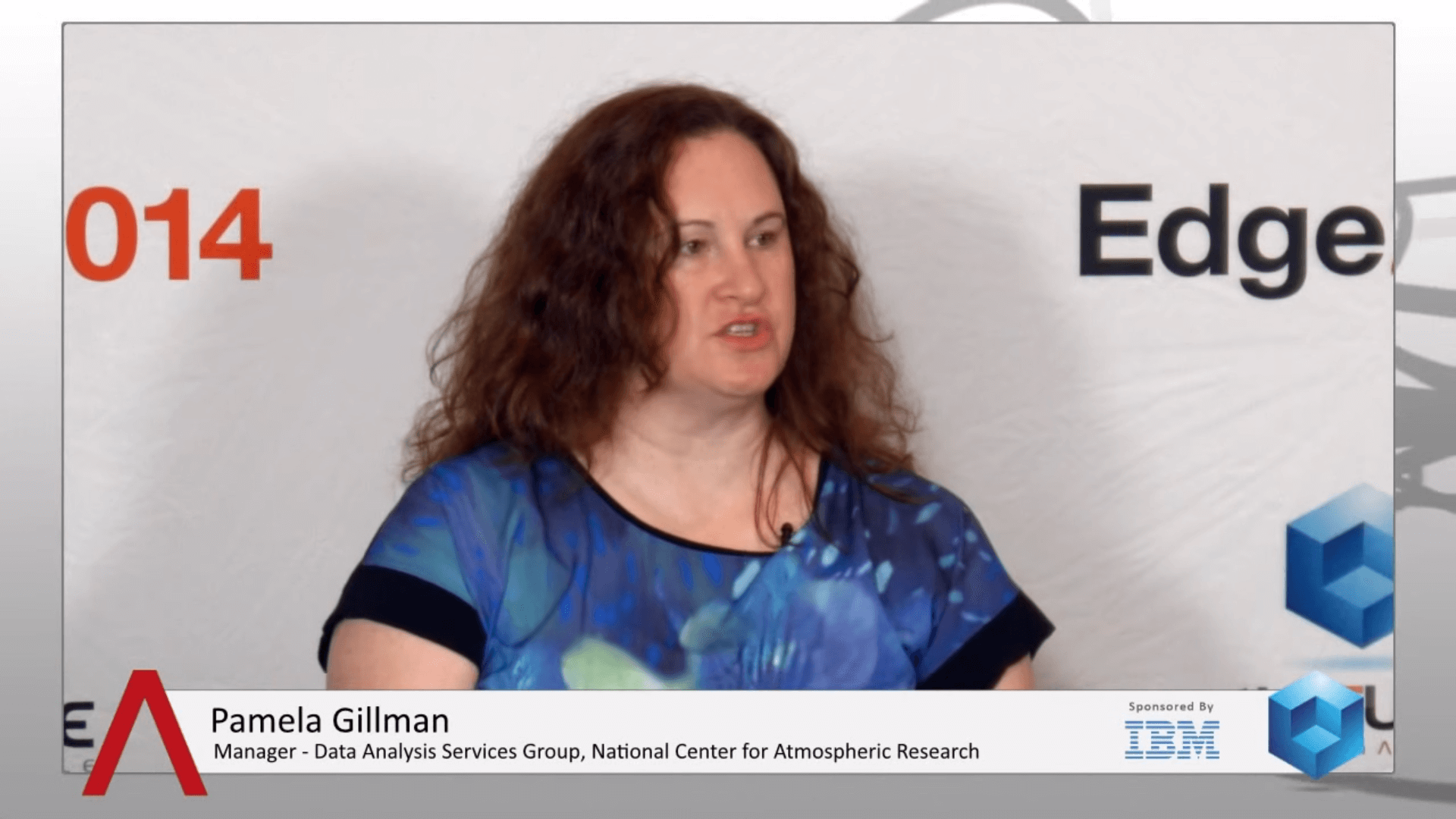
Pamela Gillman, National Center for Atmospheric Research, with Dave Vellante and Stu Miniman at IBM Edge 2014
@thecube #theCUBE #IBMEdge #IBM #SiliconANGLE
This week theCUBE is at IBM Edge in Las Vegas, broadcasting live for SiliconANGLE. In this interview, Pamela Gillman, Mgr. Data Analysis Services Groups for the National Center for Atmospheric Research (NCAR), sat down with Dave Vellante and Jeff Frick to talk about the resources her team uses for conducting research on the past, present and future of our climate.
The NCAR provides resources that allow atmospheric researchers to study the climate. It’s federally-funded and managed by the University Corporation of Atmospheric Research (UCAR), a consortium of universities that makes up their governing body.
Unlike weather forecasts, climate research is long-term. Gillman mentioned that some researchers run models where they look at what happened in the weather over a 1,000-year time period. Examples include cyclic patterns and correlations from year to year as well as through time.
Regarding today’s climate, Gillman said that “the majority of scientists believe that we’re in a period of change,” citing melting ice sheets and inconsistent weather changes. Gillman described that one group she works with is studying the climate in the Paleolithic era, trying to determine if their predictive models are able to show what happened in that time period.
“They’re trying to look at what they think can occur and what’s happening,” said Gillman, explaining this research is mostly for trying to figure why these current changes in the climate are occurring, if it’s normal change and reaching a consensus.
NCAR’s Supercomputer center
.
To gain clarity on what NCAR offers to researchers, Frick questioned Gillman on what they specifically provide. Gillman said that NCAR is built of five or six labs, where all but one does the science. She works with two groups that do the models; one produces the Paleolithic and future climate data, while the other focuses on hurricane forecasting. The Computational Information Sciences Lab where Gillman works produces and manages those resources. It’s a 25,000 sq. ft. supercomputer center that stores their flagship iDataPlex system.
Forgot Password
Almost there!
We just sent you a verification email. Please verify your account to gain access to
IBM Edge 2014 | Las Vegas. If you don’t think you received an email check your
spam folder.
In order to sign in, enter the email address you used to registered for the event. Once completed, you will receive an email with a verification link. Open this link to automatically sign into the site.
Register For IBM Edge 2014 | Las Vegas
Please fill out the information below. You will recieve an email with a verification link confirming your registration. Click the link to automatically sign into the site.
You’re almost there!
We just sent you a verification email. Please click the verification button in the email. Once your email address is verified, you will have full access to all event content for IBM Edge 2014 | Las Vegas.
I want my badge and interests to be visible to all attendees.
Checking this box will display your presense on the attendees list, view your profile and allow other attendees to contact you via 1-1 chat. Read the Privacy Policy. At any time, you can choose to disable this preference.
Select your Interests!
add
Upload your photo
Uploading..
OR
Connect via Twitter
Connect via Linkedin
EDIT PASSWORD
Share
Forgot Password
Almost there!
We just sent you a verification email. Please verify your account to gain access to
IBM Edge 2014 | Las Vegas. If you don’t think you received an email check your
spam folder.
In order to sign in, enter the email address you used to registered for the event. Once completed, you will receive an email with a verification link. Open this link to automatically sign into the site.
Sign in to gain access to IBM Edge 2014 | Las Vegas
Please sign in with LinkedIn to continue to IBM Edge 2014 | Las Vegas. Signing in with LinkedIn ensures a professional environment.
Are you sure you want to remove access rights for this user?
Details
Manage Access
email address
Community Invitation
Pamela Gillman, National Center for Atmospheric Research | IBM Edge 2014
Pamela Gillman, National Center for Atmospheric Research, with Dave Vellante and Stu Miniman at IBM Edge 2014
@thecube #theCUBE #IBMEdge #IBM #SiliconANGLE
This week theCUBE is at IBM Edge in Las Vegas, broadcasting live for SiliconANGLE. In this interview, Pamela Gillman, Mgr. Data Analysis Services Groups for the National Center for Atmospheric Research (NCAR), sat down with Dave Vellante and Jeff Frick to talk about the resources her team uses for conducting research on the past, present and future of our climate.
The NCAR provides resources that allow atmospheric researchers to study the climate. It’s federally-funded and managed by the University Corporation of Atmospheric Research (UCAR), a consortium of universities that makes up their governing body.
Unlike weather forecasts, climate research is long-term. Gillman mentioned that some researchers run models where they look at what happened in the weather over a 1,000-year time period. Examples include cyclic patterns and correlations from year to year as well as through time.
Regarding today’s climate, Gillman said that “the majority of scientists believe that we’re in a period of change,” citing melting ice sheets and inconsistent weather changes. Gillman described that one group she works with is studying the climate in the Paleolithic era, trying to determine if their predictive models are able to show what happened in that time period.
“They’re trying to look at what they think can occur and what’s happening,” said Gillman, explaining this research is mostly for trying to figure why these current changes in the climate are occurring, if it’s normal change and reaching a consensus.
NCAR’s Supercomputer center
.
To gain clarity on what NCAR offers to researchers, Frick questioned Gillman on what they specifically provide. Gillman said that NCAR is built of five or six labs, where all but one does the science. She works with two groups that do the models; one produces the Paleolithic and future climate data, while the other focuses on hurricane forecasting. The Computational Information Sciences Lab where Gillman works produces and manages those resources. It’s a 25,000 sq. ft. supercomputer center that stores their flagship iDataPlex system.