The Cube - IBM Edge 2012 - Kerry Johns-Vano, IBM Storage, with John Furrier and John McArthur
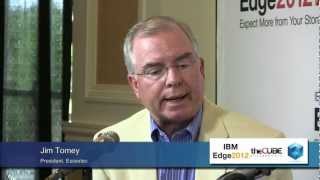
Is server virtualization the answer to utilization and IT budgetary problems that it is widely purported to be? No, says prominent blogger, consultant and 26-year DR planning veteran John W. Tiogo, founder of Tiogo Partners International.
“The preponderance of virtualized systems are low-traffic Web servers and file servers that don’t need virtualization at all,” he argues. “Many companies are abandoning their server virtualization projects when they are about 20% complete, which is good news. I don’t trust virtualization with my most mission-critical applications, and neither do my clients.”
Virtualization, he said in an interview in the SiliconAngle Cube from IBM Edge 2012, is often used to solve a problem that no longer exists, or should not exist (full video below). “People are spending a ton of money to virtualize dinosaur technology.”
The issue is that IT keeps too many applications and too much data in memory on servers, waiting to be used. A decade ago, when CPUs had much less power and storage systems were slower, loading everything into memory at the start of the day was necessary. That became standard practice and is still followed today, with the result that IT overuses and wastes resources.
“I can push a button on my smartphone and start an app,” he said. “that app was loaded from storage somewhere.” If IT followed that model it would not need virtualization to conserve resources.
Value of Big Data
Tiogo also questions whether most large companies need big data resources in-house or would be better advised to turn big data questions over to a service provider, provided that effective big data service providers evolve. He agrees that big data research can be valuable for answering specific questions. The basic question is how often do these questions arise for the average enterprise.
“I don’t have the money for petaflops of processor and petabytes of storage just on the chance that I might want to ask more than one question,” he says. “Looking for voter fraud is not something I need to do every day, for instance. I can do it once every three years.”
He implies that vendors may be using big data as an excuse to sell huge amounts of hardware that will stand underused in company data centers. “The question is do I ask my Global 2000 clients to buy a lot of infrastructure to ask these questions, or are they once-in-a-blue-moon questions that they are better off farming off to a service provider.”
#theCUBE #IBM #SiliconANGLE @IBM
Forgot Password
Almost there!
We just sent you a verification email. Please verify your account to gain access to
IBM Edge 2012 | Orlando. If you don’t think you received an email check your
spam folder.
In order to sign in, enter the email address you used to registered for the event. Once completed, you will receive an email with a verification link. Open this link to automatically sign into the site.
Register For IBM Edge 2012 | Orlando
Please fill out the information below. You will recieve an email with a verification link confirming your registration. Click the link to automatically sign into the site.
You’re almost there!
We just sent you a verification email. Please click the verification button in the email. Once your email address is verified, you will have full access to all event content for IBM Edge 2012 | Orlando.
I want my badge and interests to be visible to all attendees.
Checking this box will display your presense on the attendees list, view your profile and allow other attendees to contact you via 1-1 chat. Read the Privacy Policy. At any time, you can choose to disable this preference.
Select your Interests!
add
Upload your photo
Uploading..
OR
Connect via Twitter
Connect via Linkedin
EDIT PASSWORD
Share
Forgot Password
Almost there!
We just sent you a verification email. Please verify your account to gain access to
IBM Edge 2012 | Orlando. If you don’t think you received an email check your
spam folder.
In order to sign in, enter the email address you used to registered for the event. Once completed, you will receive an email with a verification link. Open this link to automatically sign into the site.
Sign in to gain access to IBM Edge 2012 | Orlando
Please sign in with LinkedIn to continue to IBM Edge 2012 | Orlando. Signing in with LinkedIn ensures a professional environment.
Are you sure you want to remove access rights for this user?
Details
Manage Access
email address
Community Invitation
Kerry Johns-Vano, IBM | IBM Edge 2012
The Cube - IBM Edge 2012 - Kerry Johns-Vano, IBM Storage, with John Furrier and John McArthur
Is server virtualization the answer to utilization and IT budgetary problems that it is widely purported to be? No, says prominent blogger, consultant and 26-year DR planning veteran John W. Tiogo, founder of Tiogo Partners International.
“The preponderance of virtualized systems are low-traffic Web servers and file servers that don’t need virtualization at all,” he argues. “Many companies are abandoning their server virtualization projects when they are about 20% complete, which is good news. I don’t trust virtualization with my most mission-critical applications, and neither do my clients.”
Virtualization, he said in an interview in the SiliconAngle Cube from IBM Edge 2012, is often used to solve a problem that no longer exists, or should not exist (full video below). “People are spending a ton of money to virtualize dinosaur technology.”
The issue is that IT keeps too many applications and too much data in memory on servers, waiting to be used. A decade ago, when CPUs had much less power and storage systems were slower, loading everything into memory at the start of the day was necessary. That became standard practice and is still followed today, with the result that IT overuses and wastes resources.
“I can push a button on my smartphone and start an app,” he said. “that app was loaded from storage somewhere.” If IT followed that model it would not need virtualization to conserve resources.
Value of Big Data
Tiogo also questions whether most large companies need big data resources in-house or would be better advised to turn big data questions over to a service provider, provided that effective big data service providers evolve. He agrees that big data research can be valuable for answering specific questions. The basic question is how often do these questions arise for the average enterprise.
“I don’t have the money for petaflops of processor and petabytes of storage just on the chance that I might want to ask more than one question,” he says. “Looking for voter fraud is not something I need to do every day, for instance. I can do it once every three years.”
He implies that vendors may be using big data as an excuse to sell huge amounts of hardware that will stand underused in company data centers. “The question is do I ask my Global 2000 clients to buy a lot of infrastructure to ask these questions, or are they once-in-a-blue-moon questions that they are better off farming off to a service provider.”
#theCUBE #IBM #SiliconANGLE @IBM