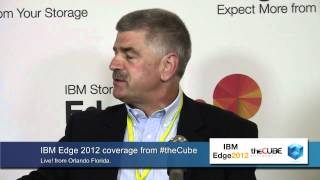
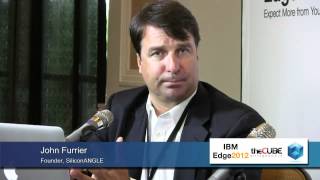
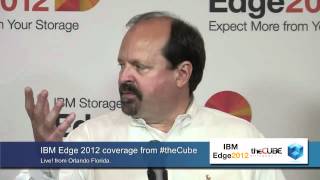
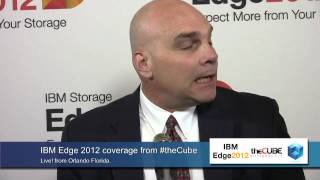
The Cube - IBM Edge 2012 - Jason McGee, IBM, with John McArthur and David Floyer
Single SKU integrated systems such as the new PureSystems from IBM can save four-to-five orders-of-magnitude in total cost versus traditional custom-built systems says Jason McGee, IBM distinguished engineer who was deeply involved in the multi-year development of IBM’s PureSystems.
“Basically IT organizations developed a model for building custom systems to meet the needs of their most difficult applications and then applied it to all their applications,” he said in an interview in The SiliconAngle Cube from IBM Edge 2012 with Wikibon CTO David Floyer and Analyst John T. McArthur. “It’s like custom building a house. You get exactly what you want, but it is time consuming and expensive.”
This is the reason that vendors are announcing solutions such as VCE’s Vblock and Oracle Exadata. But, he admits, single SKU systems are also inflexible and at their worst can become islands of automation in the data center, increasing the cost and complexity of data center management. PureSystems was designed to try to minimize that problem in two ways.
First, it is a family of systems rather than a single one-size-fits-all solution. So PureApplication is optimized around Web and database workloads, for instance. PureSystems also includes middleware as well as hardware. This creates a different dynamic in how companies deploy systems and software by removing the major concern of optimizing around middleware and software licensing costs.
And it is built to be as open as possible, with published interfaces and “plugs” to allow it to be connected to the rest of the data center at the middleware level. “So if you compare this with Oracle Exadata, which is very restrictive about what you can run on it, for example, we … have built in points where you can plug in your external monitoring and security systems, for example.”
And this includes non-IBM middleware. For example, while users of IBM Tivoli will find it easier to plug that into a PureSystems rack, it is also possible to monitor that rack with third-party solutions with a reasonable amount of integration. And while PureSystems can run a large database system completely on the rack, it is also possible to split loads between the PureSystems box and outside systems or have it draw or and feed an external Oracle or other database application.
On the other hand, he says, DB2 includes a specific Oracle compatibility feature that allows users to move existing Oracle applications onto DB2 on PureSystems with no rewriting of the software. “The DBA’s job changes,” he says, “but it is much easier to retrain a DBA than to rewrite 10 Oracle applications.”
Floyer, who has been highly critical of Oracle’s Exadata, commented that this can create a powerful negotiating point with Oracle. IBM customers in particular might want to have a PureSystems coffee mug on their desks when renegotiating licensing with Oracle.
The biggest challenge to adoption of single-SKU integrated systems, however, may be that they break down the traditional IT silos of server, networking, storage, and applications.
“Most customers are organized based on how IT technology was designed 10 years ago,” McGee says. “That is a major friction and something we believe has to be changed. All those guys – the networking guy, the database guy, the virtualization guy, etc., are still needed, but their roles have changed. They need to collaborate to validate their pieces of the total pattern. Then people can implement that pattern with the reasonable expectation that everything will run as expected.”
#theCUBE #IBM #SiliconANGLE @IBM
Forgot Password
Almost there!
We just sent you a verification email. Please verify your account to gain access to
IBM Edge 2012 | Orlando. If you don’t think you received an email check your
spam folder.
In order to sign in, enter the email address you used to registered for the event. Once completed, you will receive an email with a verification link. Open this link to automatically sign into the site.
Register For IBM Edge 2012 | Orlando
Please fill out the information below. You will recieve an email with a verification link confirming your registration. Click the link to automatically sign into the site.
You’re almost there!
We just sent you a verification email. Please click the verification button in the email. Once your email address is verified, you will have full access to all event content for IBM Edge 2012 | Orlando.
I want my badge and interests to be visible to all attendees.
Checking this box will display your presense on the attendees list, view your profile and allow other attendees to contact you via 1-1 chat. Read the Privacy Policy. At any time, you can choose to disable this preference.
Select your Interests!
add
Upload your photo
Uploading..
OR
Connect via Twitter
Connect via Linkedin
EDIT PASSWORD
Share
Forgot Password
Almost there!
We just sent you a verification email. Please verify your account to gain access to
IBM Edge 2012 | Orlando. If you don’t think you received an email check your
spam folder.
In order to sign in, enter the email address you used to registered for the event. Once completed, you will receive an email with a verification link. Open this link to automatically sign into the site.
Sign in to gain access to IBM Edge 2012 | Orlando
Please sign in with LinkedIn to continue to IBM Edge 2012 | Orlando. Signing in with LinkedIn ensures a professional environment.
Are you sure you want to remove access rights for this user?
Details
Manage Access
email address
Community Invitation
Jason McGee, IBM | IBM Edge 2012
The Cube - IBM Edge 2012 - Jason McGee, IBM, with John McArthur and David Floyer
Single SKU integrated systems such as the new PureSystems from IBM can save four-to-five orders-of-magnitude in total cost versus traditional custom-built systems says Jason McGee, IBM distinguished engineer who was deeply involved in the multi-year development of IBM’s PureSystems.
“Basically IT organizations developed a model for building custom systems to meet the needs of their most difficult applications and then applied it to all their applications,” he said in an interview in The SiliconAngle Cube from IBM Edge 2012 with Wikibon CTO David Floyer and Analyst John T. McArthur. “It’s like custom building a house. You get exactly what you want, but it is time consuming and expensive.”
This is the reason that vendors are announcing solutions such as VCE’s Vblock and Oracle Exadata. But, he admits, single SKU systems are also inflexible and at their worst can become islands of automation in the data center, increasing the cost and complexity of data center management. PureSystems was designed to try to minimize that problem in two ways.
First, it is a family of systems rather than a single one-size-fits-all solution. So PureApplication is optimized around Web and database workloads, for instance. PureSystems also includes middleware as well as hardware. This creates a different dynamic in how companies deploy systems and software by removing the major concern of optimizing around middleware and software licensing costs.
And it is built to be as open as possible, with published interfaces and “plugs” to allow it to be connected to the rest of the data center at the middleware level. “So if you compare this with Oracle Exadata, which is very restrictive about what you can run on it, for example, we … have built in points where you can plug in your external monitoring and security systems, for example.”
And this includes non-IBM middleware. For example, while users of IBM Tivoli will find it easier to plug that into a PureSystems rack, it is also possible to monitor that rack with third-party solutions with a reasonable amount of integration. And while PureSystems can run a large database system completely on the rack, it is also possible to split loads between the PureSystems box and outside systems or have it draw or and feed an external Oracle or other database application.
On the other hand, he says, DB2 includes a specific Oracle compatibility feature that allows users to move existing Oracle applications onto DB2 on PureSystems with no rewriting of the software. “The DBA’s job changes,” he says, “but it is much easier to retrain a DBA than to rewrite 10 Oracle applications.”
Floyer, who has been highly critical of Oracle’s Exadata, commented that this can create a powerful negotiating point with Oracle. IBM customers in particular might want to have a PureSystems coffee mug on their desks when renegotiating licensing with Oracle.
The biggest challenge to adoption of single-SKU integrated systems, however, may be that they break down the traditional IT silos of server, networking, storage, and applications.
“Most customers are organized based on how IT technology was designed 10 years ago,” McGee says. “That is a major friction and something we believe has to be changed. All those guys – the networking guy, the database guy, the virtualization guy, etc., are still needed, but their roles have changed. They need to collaborate to validate their pieces of the total pattern. Then people can implement that pattern with the reasonable expectation that everything will run as expected.”
#theCUBE #IBM #SiliconANGLE @IBM