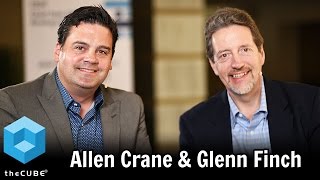
Cortnie Abercrombie & Caitlin Halferty Lepech, of IBM, sit down with hosts Jeff Frick & Peter Burris at the IBM Chief Data Officer Strategy Summit (Spring) in San Francisco, CA.
Is ‘cognitive’ the magic word to monetize enterprise big data?
https://siliconangle.com/2017/03/29/is-cognitive-the-magic-word-to-monetize-enterprise-big-data-ibmcdo/
As if technical hurdles to making data fit for use weren’t challenging enough, line of business people within enterprises are often clueless about mapping a big data strategy. Is there a single word that can make all the pieces fall into place?
Caitlin Lepech (pictured, right), communications and client engagement executive, Global Chief Data Office at IBM Corp., says it’s “cognitive.” This strategy is working internally for IBM, and it can work for the company’s enterprise customers, she said.
Lepech and Cortnie Abercrombie (pictured, left), cognitive and analytics offerings leader, Global Business Services, at IBM, spoke to Jeff Frick (@JeffFrick) and Peter Burris (@plburris), co-hosts of theCUBE, SiliconANGLE Media’s mobile live streaming studio, during the IBM Chief Data Officer Strategy Summit in San Francisco, California. (*Disclosure below.)
Companies often allow timelines of 18 to 24 months to map a big data strategy, Lepech explained. But the pace of change in business and technology is much faster than that. “You don’t have 18 months to come to a data strategy and get it by and get it implemented,” she said.
To get there faster, companies need to ask a single question: What is the end goal of our work with data?
“For us, it’s becoming a cognitive business. So … it’s selecting projects that we can infuse cognition [into] the quickest way, so Client 360 for example,” she said, referring to IBM’s strategy of gaining a full understanding of customers and what makes them tick.
CDO osmosis effect
Doing this quickly requires cohesion between IT and line of business people that has been lacking in enterprises, historically, said Abercrombie.
“And that’s where the chief data officer kicks into gear and is very creative and actually brings a whole new mindset to the person,” she said. The CDO combines insight from people on both sides and acts as an intermediary between them.
Toward the goal of going cognitive, the CDO can delineate a long-term holistic vision, as well as allocate short-term jobs to IT and business people to help realize it, Abercrombie added.
(*Disclosure: IBM and other companies sponsor some IBM CDO Strategy Summit segments on SiliconANGLE Media’s theCUBE. Neither IBM nor other sponsors have editorial control over content on theCUBE or SiliconANGLE.)
#theCUBE #IBM #IBMCDO #WomenInTech #SiliconANGLE @IBM Data and AI @IBM
Forgot Password
Almost there!
We just sent you a verification email. Please verify your account to gain access to
IBM Chief Data Officer (CDO) Strategy Summit Spring 2017 | San Francisco. If you don’t think you received an email check your
spam folder.
Sign in to IBM Chief Data Officer (CDO) Strategy Summit Spring 2017 | San Francisco.
In order to sign in, enter the email address you used to registered for the event. Once completed, you will receive an email with a verification link. Open this link to automatically sign into the site.
Register For IBM Chief Data Officer (CDO) Strategy Summit Spring 2017 | San Francisco
Please fill out the information below. You will recieve an email with a verification link confirming your registration. Click the link to automatically sign into the site.
You’re almost there!
We just sent you a verification email. Please click the verification button in the email. Once your email address is verified, you will have full access to all event content for IBM Chief Data Officer (CDO) Strategy Summit Spring 2017 | San Francisco.
Thanks for confirming your account. Now you can access IBM Chief Data Officer (CDO) Strategy Summit Spring 2017 | San Francisco with this email address.
I want my badge and interests to be visible to all attendees.
Checking this box will display your presense on the attendees list, view your profile and allow other attendees to contact you via 1-1 chat. Read the Privacy Policy. At any time, you can choose to disable this preference.
Select your Interests!
add
Upload your photo
Uploading..
OR
Connect via Twitter
Connect via Linkedin
EDIT PASSWORD
Share
Forgot Password
Almost there!
We just sent you a verification email. Please verify your account to gain access to
IBM Chief Data Officer (CDO) Strategy Summit Spring 2017 | San Francisco. If you don’t think you received an email check your
spam folder.
Sign in to IBM Chief Data Officer (CDO) Strategy Summit Spring 2017 | San Francisco.
In order to sign in, enter the email address you used to registered for the event. Once completed, you will receive an email with a verification link. Open this link to automatically sign into the site.
Sign in to gain access to IBM Chief Data Officer (CDO) Strategy Summit Spring 2017 | San Francisco
Please sign in with LinkedIn to continue to IBM Chief Data Officer (CDO) Strategy Summit Spring 2017 | San Francisco. Signing in with LinkedIn ensures a professional environment.
Are you sure you want to remove access rights for this user?
Details
Manage Access
email address
Community Invitation
Cortnie Abercrombie & Caitlin Halferty Lepech, IBM | IBM CDO Strategy Summit 2017
Cortnie Abercrombie & Caitlin Halferty Lepech, of IBM, sit down with hosts Jeff Frick & Peter Burris at the IBM Chief Data Officer Strategy Summit (Spring) in San Francisco, CA.
Is ��cognitive’ the magic word to monetize enterprise big data?
https://siliconangle.com/2017/03/29/is-cognitive-the-magic-word-to-monetize-enterprise-big-data-ibmcdo/
As if technical hurdles to making data fit for use weren’t challenging enough, line of business people within enterprises are often clueless about mapping a big data strategy. Is there a single word that can make all the pieces fall into place?
Caitlin Lepech (pictured, right), communications and client engagement executive, Global Chief Data Office at IBM Corp., says it’s “cognitive.” This strategy is working internally for IBM, and it can work for the company’s enterprise customers, she said.
Lepech and Cortnie Abercrombie (pictured, left), cognitive and analytics offerings leader, Global Business Services, at IBM, spoke to Jeff Frick (@JeffFrick) and Peter Burris (@plburris), co-hosts of theCUBE, SiliconANGLE Media’s mobile live streaming studio, during the IBM Chief Data Officer Strategy Summit in San Francisco, California. (*Disclosure below.)
Companies often allow timelines of 18 to 24 months to map a big data strategy, Lepech explained. But the pace of change in business and technology is much faster than that. “You don’t have 18 months to come to a data strategy and get it by and get it implemented,” she said.
To get there faster, companies need to ask a single question: What is the end goal of our work with data?
“For us, it’s becoming a cognitive business. So … it’s selecting projects that we can infuse cognition [into] the quickest way, so Client 360 for example,” she said, referring to IBM’s strategy of gaining a full understanding of customers and what makes them tick.
CDO osmosis effect
Doing this quickly requires cohesion between IT and line of business people that has been lacking in enterprises, historically, said Abercrombie.
“And that’s where the chief data officer kicks into gear and is very creative and actually brings a whole new mindset to the person,” she said. The CDO combines insight from people on both sides and acts as an intermediary between them.
Toward the goal of going cognitive, the CDO can delineate a long-term holistic vision, as well as allocate short-term jobs to IT and business people to help realize it, Abercrombie added.
(*Disclosure: IBM and other companies sponsor some IBM CDO Strategy Summit segments on SiliconANGLE Media’s theCUBE. Neither IBM nor other sponsors have editorial control over content on theCUBE or SiliconANGLE.)
#theCUBE #IBM #IBMCDO #WomenInTech #SiliconANGLE @IBM Data and AI @IBM