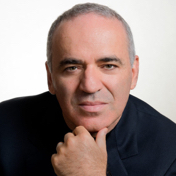
Garry Kasparov sits down with Dave Vellante and John Walls at theIBM Machine Learning Everywhere, build your ladder to AI event in New York City, Feb 2018
#IBMML #theCUBE
https://siliconangle.com/2018/03/01/ai-will-never-surpass-humans-according-to-former-chess-world-champion-ibmml/
AI will never surpass humans, says former chess world champion Garry Kasparov
Former world champion chess player Garry Kasparov famously beat 32 computers at chess simultaneously before being defeated by the Deep Blue AI in 1997. Kasparov has since taken a firm stance in support of machine learning and claims that many critics do not understand the difference between an open and a closed system. Once these closed systems have their parameters and objectives well-defined, machines will augment human abilities but still require our guidance, according to Kasparov.
“If it’s an open-ended system, the machine will never identify what is the … right question to be asked,” said Kasparov (pictured).
Kasparov, chairman of the Human Rights Foundation and author of the book “How Life Imitates Chess,” spoke with Dave Vellante (@dvellante) and John Walls (@JohnWalls21), co-hosts of theCUBE, SiliconANGLE Media’s mobile livestreaming studio, during the IBM Signature Moment — Machine Learning Everywhere event in New York. They discussed the future of artificial intelligence and the impact it will have on humankind. (* Disclosure below.)
Closed system computing
The expansion of machine learning into new areas of society will not erase jobs, according to Kasparov. As industries are disrupted, people will naturally move into sectors that require the type of cognitive processing that machines will not be able to achieve.
“The machine’s wheel will force a lot of talent actually to move into other areas that were not as attractive because there were other opportunities. There’s so many [of] what I call raw cognitive tasks that are still financially attractive,” Kasparov said.
People will transition into roles in which only a human’s intuition, vision and strategy can guide the machine to a solution. As these machines become more specialized in their closed systems, people also specialize in managing machines within these environments.
“We will have expert operators, I call them the shepherds, that will have to know exactly what are the requirements of this machine or that machine or that group of algorithms to guarantee that we’ll be able by our human input to compensate for their deficiencies,” Kasparov said.
Kasparov is a proponent of the idea of human and machine collaboration to augment capabilities and deliver a better outcome. In chess, for example, he explained that the best high-level human players suffer from mental fatigue, which produces inaccuracies.
“Humans cannot play at the same level throughout the whole game. The concentration, the vigilance are now required when humans face humans. Psychologically, when you have a strong machine, machines good enough to play with a steady hand, the game’s over,” he said.
With properly trained machines augmenting human exploration capabilities, new industrial opportunities can open up that were previously impossible for humans alone. Historically, discoveries of these new opportunities had been completely unintended and unforeseen, according to Kasparov.
“I see so many new challenges that we will be able to take, and challenges that we abandoned, like space exploration or deep ocean exploration, because they were too risky,” Kasparov concluded.
Watch the complete video interview below, and be sure to check out more of SiliconANGLE’s and theCUBE’s coverage of the IBM Signature Moment (IBM Machine Learning Everywhere) event. (* Disclosure: TheCUBE is a paid media partner for the IBM Signature Moment — Machine Learning Everywhere event. Neither IBM, the event sponsor, nor other sponsors have editorial control over content on theCUBE or SiliconANGLE.)
Forgot Password
Almost there!
We just sent you a verification email. Please verify your account to gain access to
IBM Machine Learning Everywhere 2017 | New York. If you don’t think you received an email check your
spam folder.
Sign in to IBM Machine Learning Everywhere 2017 | New York.
In order to sign in, enter the email address you used to registered for the event. Once completed, you will receive an email with a verification link. Open this link to automatically sign into the site.
Register For IBM Machine Learning Everywhere 2017 | New York
Please fill out the information below. You will recieve an email with a verification link confirming your registration. Click the link to automatically sign into the site.
You’re almost there!
We just sent you a verification email. Please click the verification button in the email. Once your email address is verified, you will have full access to all event content for IBM Machine Learning Everywhere 2017 | New York.
I want my badge and interests to be visible to all attendees.
Checking this box will display your presense on the attendees list, view your profile and allow other attendees to contact you via 1-1 chat. Read the Privacy Policy. At any time, you can choose to disable this preference.
Select your Interests!
add
Upload your photo
Uploading..
OR
Connect via Twitter
Connect via Linkedin
EDIT PASSWORD
Share
Forgot Password
Almost there!
We just sent you a verification email. Please verify your account to gain access to
IBM Machine Learning Everywhere 2017 | New York. If you don’t think you received an email check your
spam folder.
Sign in to IBM Machine Learning Everywhere 2017 | New York.
In order to sign in, enter the email address you used to registered for the event. Once completed, you will receive an email with a verification link. Open this link to automatically sign into the site.
Sign in to gain access to IBM Machine Learning Everywhere 2017 | New York
Please sign in with LinkedIn to continue to IBM Machine Learning Everywhere 2017 | New York. Signing in with LinkedIn ensures a professional environment.
Are you sure you want to remove access rights for this user?
Details
Manage Access
email address
Community Invitation
Garry Kasparov | Machine Learning Everywhere 2018
Garry Kasparov sits down with Dave Vellante and John Walls at theIBM Machine Learning Everywhere, build your ladder to AI event in New York City, Feb 2018
#IBMML #theCUBE
https://siliconangle.com/2018/03/01/ai-will-never-surpass-humans-according-to-former-chess-world-champion-ibmml/
AI will never surpass humans, says former chess world champion Garry Kasparov
Former world champion chess player Garry Kasparov famously beat 32 computers at chess simultaneously before being defeated by the Deep Blue AI in 1997. Kasparov has since taken a firm stance in support of machine learning and claims that many critics do not understand the difference between an open and a closed system. Once these closed systems have their parameters and objectives well-defined, machines will augment human abilities but still require our guidance, according to Kasparov.
“If it’s an open-ended system, the machine will never identify what is the … right question to be asked,” said Kasparov (pictured).
Kasparov, chairman of the Human Rights Foundation and author of the book “How Life Imitates Chess,” spoke with Dave Vellante (@dvellante) and John Walls (@JohnWalls21), co-hosts of theCUBE, SiliconANGLE Media’s mobile livestreaming studio, during the IBM Signature Moment — Machine Learning Everywhere event in New York. They discussed the future of artificial intelligence and the impact it will have on humankind. (* Disclosure below.)
Closed system computing
The expansion of machine learning into new areas of society will not erase jobs, according to Kasparov. As industries are disrupted, people will naturally move into sectors that require the type of cognitive processing that machines will not be able to achieve.
“The machine’s wheel will force a lot of talent actually to move into other areas that were not as attractive because there were other opportunities. There’s so many [of] what I call raw cognitive tasks that are still financially attractive,” Kasparov said.
People will transition into roles in which only a human’s intuition, vision and strategy can guide the machine to a solution. As these machines become more specialized in their closed systems, people also specialize in managing machines within these environments.
“We will have expert operators, I call them the shepherds, that will have to know exactly what are the requirements of this machine or that machine or that group of algorithms to guarantee that we’ll be able by our human input to compensate for their deficiencies,” Kasparov said.
Kasparov is a proponent of the idea of human and machine collaboration to augment capabilities and deliver a better outcome. In chess, for example, he explained that the best high-level human players suffer from mental fatigue, which produces inaccuracies.
“Humans cannot play at the same level throughout the whole game. The concentration, the vigilance are now required when humans face humans. Psychologically, when you have a strong machine, machines good enough to play with a steady hand, the game’s over,” he said.
With properly trained machines augmenting human exploration capabilities, new industrial opportunities can open up that were previously impossible for humans alone. Historically, discoveries of these new opportunities had been completely unintended and unforeseen, according to Kasparov.
“I see so many new challenges that we will be able to take, and challenges that we abandoned, like space exploration or deep ocean exploration, because they were too risky,” Kasparov concluded.
Watch the complete video interview below, and be sure to check out more of SiliconANGLE’s and theCUBE’s coverage of the IBM Signature Moment (IBM Machine Learning Everywhere) event. (* Disclosure: TheCUBE is a paid media partner for the IBM Signature Moment — Machine Learning Everywhere event. Neither IBM, the event sponsor, nor other sponsors have editorial control over content on theCUBE or SiliconANGLE.)