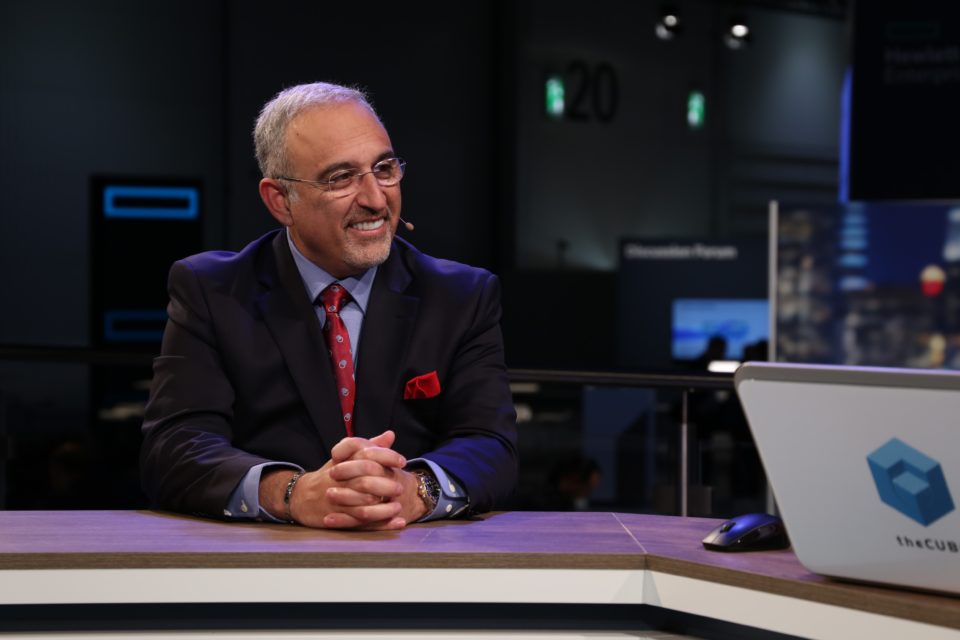
01. Dr. Tom Bradicich, HPE, visits #theCUBE!. (00:18)
02. Howard Heppelman, PTC, visits #theCUBE!. (00:48)
03. The PTC Partnership and the Partner Ecosystem. (02:28)
04. Merging and Unifying the Worlds of IT and OT. (04:12)
05. Linguistics Barriers in IT and OT. (05:52)
06. The Convergence of Digital and Physical. (06:55)
07. Economics of the Data Flows. (08:30)
08. Engineering Collaborations. (12:23)
09. The Dimensions of IOT Disruption. (14:53)
10. The Vibe at the Show. (17:23)
11. The Other-Centeredness. (17:56)
Track List created with http://www.vinjavideo.com.
--- ---
Don’t get carried away: When to leave IoT data at the edge | #HPEDiscover
by R. DANES
As companies struggle to break the networking bottleneck, the question of how to process IoT data hangs in the air. Moving tons of data from sensors to the cloud over current networks is proving to be time consuming and costly. On the other hand, progress in compute power keeps zooming ahead. Some say the obvious solution is to forget moving the data around and simply bring compute to the edge.
Tom Bradicich, Ph.D., VP and GM of server and IoT systems at Hewlett Packard Enterprise Co., and Howard Heppelmann, divisional VP and GM of connnected manufacturing at PTC Inc., spoke to Dave Vellante (@dvellante) and Paul Gillin (@pgillin), co-hosts of theCUBE*, from the SiliconANGLE Media team, during HPE Discover EU. The duo spoke about the network and compute divide. (*Disclosure below)
“I believe that the curve in terms of power that’s driving compute is moving much faster today than the ability to transport data, and so that’s leaving this sort of value gap open,” Heppelmann said.
Pushed to the edge
Bradicich said HPE’s Edgeline IoT system offers companies choices: compute at the edge, in the cloud or in a hybrid manner.
The growth of Big Data is outstripping the network’s ability to transfer it, he explained. “So, therefore, processing it and capturing it at the edge makes a lot of sense, because again, the pipe’s not big enough or it’s not economical enough to take it all the way back to the cloud,” he said.
When to make the network trek
Heppelmann added that it is not that compute at the edge is automatically better than sending data back to cloud. “If it’s a quality process on a machine, you don’t want to send the data to the cloud and wait for a certain response to tell you that something’s wrong with that,” he explained.
However, if you have a large number of machines of the same type, there’s value in sending a subset of that data once it’s been processed up to the cloud in order to look at them as a group, he said.
Forgot Password
Almost there!
We just sent you a verification email. Please verify your account to gain access to
HPE Discover 2016 | London. If you don’t think you received an email check your
spam folder.
In order to sign in, enter the email address you used to registered for the event. Once completed, you will receive an email with a verification link. Open this link to automatically sign into the site.
Register For HPE Discover 2016 | London
Please fill out the information below. You will recieve an email with a verification link confirming your registration. Click the link to automatically sign into the site.
You’re almost there!
We just sent you a verification email. Please click the verification button in the email. Once your email address is verified, you will have full access to all event content for HPE Discover 2016 | London.
I want my badge and interests to be visible to all attendees.
Checking this box will display your presense on the attendees list, view your profile and allow other attendees to contact you via 1-1 chat. Read the Privacy Policy. At any time, you can choose to disable this preference.
Select your Interests!
add
Upload your photo
Uploading..
OR
Connect via Twitter
Connect via Linkedin
EDIT PASSWORD
Share
Forgot Password
Almost there!
We just sent you a verification email. Please verify your account to gain access to
HPE Discover 2016 | London. If you don’t think you received an email check your
spam folder.
In order to sign in, enter the email address you used to registered for the event. Once completed, you will receive an email with a verification link. Open this link to automatically sign into the site.
Sign in to gain access to HPE Discover 2016 | London
Please sign in with LinkedIn to continue to HPE Discover 2016 | London. Signing in with LinkedIn ensures a professional environment.
Are you sure you want to remove access rights for this user?
Details
Manage Access
email address
Community Invitation
Dr. Tom Bradicich, HPE & Howard Heppelman, PTC | HPE Discover London 2016
01. Dr. Tom Bradicich, HPE, visits #theCUBE!. (00:18)
02. Howard Heppelman, PTC, visits #theCUBE!. (00:48)
03. The PTC Partnership and the Partner Ecosystem. (02:28)
04. Merging and Unifying the Worlds of IT and OT. (04:12)
05. Linguistics Barriers in IT and OT. (05:52)
06. The Convergence of Digital and Physical. (06:55)
07. Economics of the Data Flows. (08:30)
08. Engineering Collaborations. (12:23)
09. The Dimensions of IOT Disruption. (14:53)
10. The Vibe at the Show. (17:23)
11. The Other-Centeredness. (17:56)
Track List created with http://www.vinjavideo.com.
--- ---
Don’t get carried away: When to leave IoT data at the edge | #HPEDiscover
by R. DANES
As companies struggle to break the networking bottleneck, the question of how to process IoT data hangs in the air. Moving tons of data from sensors to the cloud over current networks is proving to be time consuming and costly. On the other hand, progress in compute power keeps zooming ahead. Some say the obvious solution is to forget moving the data around and simply bring compute to the edge.
Tom Bradicich, Ph.D., VP and GM of server and IoT systems at Hewlett Packard Enterprise Co., and Howard Heppelmann, divisional VP and GM of connnected manufacturing at PTC Inc., spoke to Dave Vellante (@dvellante) and Paul Gillin (@pgillin), co-hosts of theCUBE*, from the SiliconANGLE Media team, during HPE Discover EU. The duo spoke about the network and compute divide. (*Disclosure below)
“I believe that the curve in terms of power that’s driving compute is moving much faster today than the ability to transport data, and so that’s leaving this sort of value gap open,” Heppelmann said.
Pushed to the edge
Bradicich said HPE’s Edgeline IoT system offers companies choices: compute at the edge, in the cloud or in a hybrid manner.
The growth of Big Data is outstripping the network’s ability to transfer it, he explained. “So, therefore, processing it and capturing it at the edge makes a lot of sense, because again, the pipe’s not big enough or it’s not economical enough to take it all the way back to the cloud,” he said.
When to make the network trek
Heppelmann added that it is not that compute at the edge is automatically better than sending data back to cloud. “If it’s a quality process on a machine, you don’t want to send the data to the cloud and wait for a certain response to tell you that something’s wrong with that,” he explained.
However, if you have a large number of machines of the same type, there’s value in sending a subset of that data once it’s been processed up to the cloud in order to look at them as a group, he said.