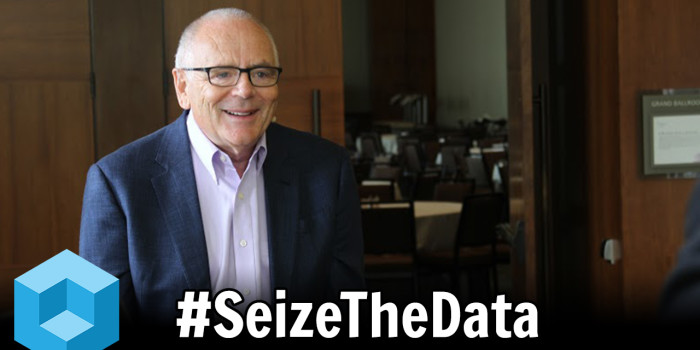
01. Amaresh Tripathy, PWC, Visists #theCUBE!. (00:18)
02. What Are You Seeing At The Show So Far. (00:29)
03. How Did PWC Get Started And What Is Your Role. (00:59)
04. What Are Some Of The Challenges That You Have. (02:39)
05. Talk About Initiatives That You're Involved In. (04:14)
06. Give Us Examples Of Customers Doing Something Revolutionary. (05:55)
07. What Do You See In The Analytics Service Heavy World. (09:48)
Track List created with http://www.vinjavideo.com.
--- ---
Making solutions simpler with Big Data | #SeizeTheData
by Timothy Walden | Aug 30, 2016
As technology grows more advanced, the streams of data through which companies sift also grow. Big Data is a central issue in the industry, and getting a firm grasp on all that incoming information can be difficult. Luckily, there are companies like PwC (PricewaterhouseCoopers LLP) that have dealt with business analytics for years and can shed a light of expertise on handling Big Data.
Amaresh Tripathy, partner and analytics leader at PwC, talked with Dave Vellante (@dvellante) and Paul Gillin (@pgillin), cohosts of theCUBE, from the SiliconANGLE Media team, during this week’s HPE Big Data Conference about PwC and how it plans to remain a leader in Big Data.
Experience is key
PwC has been an expert in business analytics for more 13 years and that experience aids the organization today. It has have become an “analytics hub,” said Tripathy. PwC incubates all the analytics its various services collect and finds a way to integrate them into every service line.
Handling Big Data analytics isn’t just the responsibility of a single department at PwC; it’s a part of “everything we do,” according to Tripathy.
Making it work
At PwC, it’s not just about collecting the data, but finding a way to make it useful. It can help companies build an analytics model and then work with organizations to “integrate those analytics,” said Tripathy.
However, in order to make data analytics a priority, it has to be supported from “the top down,” Tripathy explained. There has to be a tone for the organization to follow and must align with an organization’s vision. Big Data can be a big issue, and it takes the whole team to gain the best value.
Why Big Data?
Big Data in its simplest form is a large collection of data coming from a multitude of sources. It can help organizations and companies better understand patterns that may help their businesses succeed. For example, PwC is is partnering with HP to help change the healthcare industry.
RELATED: Innovations in cross-cloud management and hyper-converged infrastructure | #WomenInTech
A hospital that sees thousands of patients a year collects mountains of data and may not even realize “their biggest asset is the data they gather from patients,” said Tripathy. Finding better ways to collect, store and gather insight on that data would help hospitals and patients.
Big Data can even be used to improve predictive maintenance with airplane flights, and PwC has done just that. By combining flight sensor data with captains’ flight logs, it has decreased cancellations “by 20 percent,” according to Tripathy.
As technology gets more advanced, the data we collect should be used to “make solutions simpler,” said Tripathy.
Forgot Password
Almost there!
We just sent you a verification email. Please verify your account to gain access to
HPE Vertica Big Data Conference 2016 | Boston. If you don’t think you received an email check your
spam folder.
Sign in to HPE Vertica Big Data Conference 2016 | Boston.
In order to sign in, enter the email address you used to registered for the event. Once completed, you will receive an email with a verification link. Open this link to automatically sign into the site.
Register For HPE Vertica Big Data Conference 2016 | Boston
Please fill out the information below. You will recieve an email with a verification link confirming your registration. Click the link to automatically sign into the site.
You’re almost there!
We just sent you a verification email. Please click the verification button in the email. Once your email address is verified, you will have full access to all event content for HPE Vertica Big Data Conference 2016 | Boston.
I want my badge and interests to be visible to all attendees.
Checking this box will display your presense on the attendees list, view your profile and allow other attendees to contact you via 1-1 chat. Read the Privacy Policy. At any time, you can choose to disable this preference.
Select your Interests!
add
Upload your photo
Uploading..
OR
Connect via Twitter
Connect via Linkedin
EDIT PASSWORD
Share
Forgot Password
Almost there!
We just sent you a verification email. Please verify your account to gain access to
HPE Vertica Big Data Conference 2016 | Boston. If you don’t think you received an email check your
spam folder.
Sign in to HPE Vertica Big Data Conference 2016 | Boston.
In order to sign in, enter the email address you used to registered for the event. Once completed, you will receive an email with a verification link. Open this link to automatically sign into the site.
Sign in to gain access to HPE Vertica Big Data Conference 2016 | Boston
Please sign in with LinkedIn to continue to HPE Vertica Big Data Conference 2016 | Boston. Signing in with LinkedIn ensures a professional environment.
Are you sure you want to remove access rights for this user?
Details
Manage Access
email address
Community Invitation
Amaresh Tripathy, PwC - HPE Big Data Conference 2016 #SeizeTheData #theCUBE
01. Amaresh Tripathy, PWC, Visists #theCUBE!. (00:18)
02. What Are You Seeing At The Show So Far. (00:29)
03. How Did PWC Get Started And What Is Your Role. (00:59)
04. What Are Some Of The Challenges That You Have. (02:39)
05. Talk About Initiatives That You're Involved In. (04:14)
06. Give Us Examples Of Customers Doing Something Revolutionary. (05:55)
07. What Do You See In The Analytics Service Heavy World. (09:48)
Track List created with http://www.vinjavideo.com.
--- ---
Making solutions simpler with Big Data | #SeizeTheData
by Timothy Walden | Aug 30, 2016
As technology grows more advanced, the streams of data through which companies sift also grow. Big Data is a central issue in the industry, and getting a firm grasp on all that incoming information can be difficult. Luckily, there are companies like PwC (PricewaterhouseCoopers LLP) that have dealt with business analytics for years and can shed a light of expertise on handling Big Data.
Amaresh Tripathy, partner and analytics leader at PwC, talked with Dave Vellante (@dvellante) and Paul Gillin (@pgillin), cohosts of theCUBE, from the SiliconANGLE Media team, during this week’s HPE Big Data Conference about PwC and how it plans to remain a leader in Big Data.
Experience is key
PwC has been an expert in business analytics for more 13 years and that experience aids the organization today. It has have become an “analytics hub,” said Tripathy. PwC incubates all the analytics its various services collect and finds a way to integrate them into every service line.
Handling Big Data analytics isn’t just the responsibility of a single department at PwC; it’s a part of “everything we do,” according to Tripathy.
Making it work
At PwC, it’s not just about collecting the data, but finding a way to make it useful. It can help companies build an analytics model and then work with organizations to “integrate those analytics,” said Tripathy.
However, in order to make data analytics a priority, it has to be supported from “the top down,” Tripathy explained. There has to be a tone for the organization to follow and must align with an organization’s vision. Big Data can be a big issue, and it takes the whole team to gain the best value.
Why Big Data?
Big Data in its simplest form is a large collection of data coming from a multitude of sources. It can help organizations and companies better understand patterns that may help their businesses succeed. For example, PwC is is partnering with HP to help change the healthcare industry.
RELATED: Innovations in cross-cloud management and hyper-converged infrastructure | #WomenInTech
A hospital that sees thousands of patients a year collects mountains of data and may not even realize “their biggest asset is the data they gather from patients,” said Tripathy. Finding better ways to collect, store and gather insight on that data would help hospitals and patients.
Big Data can even be used to improve predictive maintenance with airplane flights, and PwC has done just that. By combining flight sensor data with captains’ flight logs, it has decreased cancellations “by 20 percent,” according to Tripathy.
As technology gets more advanced, the data we collect should be used to “make solutions simpler,” said Tripathy.