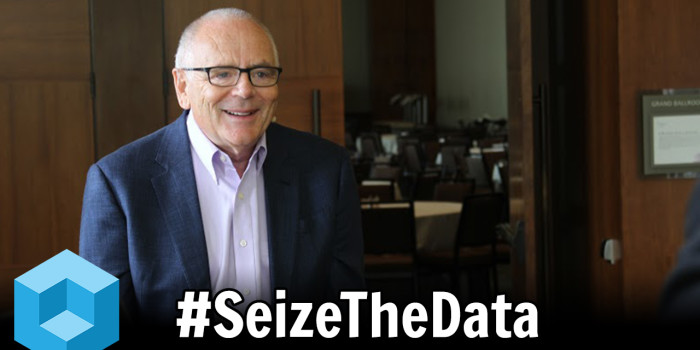
01. Mark Lockwood, Logi Analytics, visits #theCUBE!. (00:15)
02. Defining Operational Analytics. (01:54)
03. Tailoring Analytic Capabilities, Embedability, Integrating Workflow. (04:57)
04. Specifying the Logi Analytics Customer. (07:06)
05. Complexities of Embedability. (09:14)
06. The Relationship with HPE. (10:41)
07. Where Vertica and Haven Fit Into the Logi Analytics Model. (11:56)
Track List created with http://www.vinjavideo.com.
--- ---
How one company blends structured data and unstructured data together | #SeizeTheData
by Gabriel Pesek | Sep 3, 2016
The idea of power drawn from diversity has become a core feature for many businesses in the modern tech world, but for the majority, putting focus on finding ways of drawing data value from the specifics of that diversity has not yet become policy.
At this year’s HPE Big Data Conference, Mark Lockwood, director of Product Marketing at Logi Analytics, Inc., spoke with Dave Vellante (@dvellante) and Paul Gillin (@pgillin), cohosts of theCUBE, from the SiliconANGLE Media team, about the “continuum” of users, approaches to analytics and the importance of embedding capabilities.
Logi’s wares
“Logi Analytics is a platform for application owners and developers to build custom operational analytic applications,” Lockwood outlined, going on to explain his company’s deep connections to HPE.
“We’ve partnered with HPE for a while now,” he said. “We’re actually, I believe, the only vendor who has a native connection to both [HPE] Vertica and [HPE] IDOL, so we’re able to basically blend structured data from Vertica and unstructured data from IDOL together. It’s a rather kind of unique and impactful dashboard.”
Vertica is HPE’s SQL analytics engine, and HPE IDOL provides text and rich media analytics powered by machine learning.
Targeting data
Lockwood also gave his assessment of how these analytics tools are finding distribution: “There’s kind of two types of approaches to the analytic market. A lot of the data discovery merchants out there are looking at an out-of-the-box experience for a rather contained use-case. … We focus on really scalable information distribution operational use-cases.”
He shared an example use-case of Service King, an automobile maintenance chain, being able to use Logi Analytics’ services to engage in real-time monitoring and analysis of its employees’ performance across various physical centers, along with enabling center-to-center communications to find the best ways of doing specific jobs.
“There’s a lot of [data] tools out there … that focus on the analyst, [and] you have traditional BI [business intelligence] tools that are focused more on the kind of consumers who are passively looking at information,” Lockwood stated. “We really see that that gap between supply and demand as a problem [of] taking a one-size-fits-all approach and not tailoring applications to end-user experience.”
RELATED: Overcoming 'fiscal realities' to drive organizational growth | #IBMEdge
The continuum
A key point of the interview centered on Lockwood’s description of Logi Analytics’ concept of the continuum within businesses: “There’s the consumer … this is actually probably the majority of most organizations, and at this point, it’s really about reading information … it’s not about interacting with the underlying data. As you … become a more advanced information worker, you move into what we call ‘the creators,’ and these are more of the people who … want to supplement those dashboards and reports that they’re given with their own metrics and measures, and that’s also a fairly large portion of most enterprise deployments.”
Lockwood continued: “And then you have the analysts, which are kind of the guys who want that blank canvas where they can pull in [various data] and mash it all together into new insights.”
Logi Analytics finds out the grouping percentages for employees along this continuum for its studied companies “and then build analytic capabilities tailored to their needs. We also focus … on embedability, and the reason that we focus on that is because we want to make sure that that information is delivered in the context of where people are actually working.”
Describing Logi Analytics’ “direct-connect” model, which allows the company to access foundational databases without moving the contents, Lockwood identified the core idea behind the company’s value to its users. “Basically, what we provide is a really kind of custom presentation tier, our front-end, to what they do really well on the back-end, which allows us to basically translate the value of their back-end systems into solutions and business use-cases.”
Forgot Password
Almost there!
We just sent you a verification email. Please verify your account to gain access to
HPE Vertica Big Data Conference 2016 | Boston. If you don’t think you received an email check your
spam folder.
Sign in to HPE Vertica Big Data Conference 2016 | Boston.
In order to sign in, enter the email address you used to registered for the event. Once completed, you will receive an email with a verification link. Open this link to automatically sign into the site.
Register For HPE Vertica Big Data Conference 2016 | Boston
Please fill out the information below. You will recieve an email with a verification link confirming your registration. Click the link to automatically sign into the site.
You’re almost there!
We just sent you a verification email. Please click the verification button in the email. Once your email address is verified, you will have full access to all event content for HPE Vertica Big Data Conference 2016 | Boston.
I want my badge and interests to be visible to all attendees.
Checking this box will display your presense on the attendees list, view your profile and allow other attendees to contact you via 1-1 chat. Read the Privacy Policy. At any time, you can choose to disable this preference.
Select your Interests!
add
Upload your photo
Uploading..
OR
Connect via Twitter
Connect via Linkedin
EDIT PASSWORD
Share
Forgot Password
Almost there!
We just sent you a verification email. Please verify your account to gain access to
HPE Vertica Big Data Conference 2016 | Boston. If you don’t think you received an email check your
spam folder.
Sign in to HPE Vertica Big Data Conference 2016 | Boston.
In order to sign in, enter the email address you used to registered for the event. Once completed, you will receive an email with a verification link. Open this link to automatically sign into the site.
Sign in to gain access to HPE Vertica Big Data Conference 2016 | Boston
Please sign in with LinkedIn to continue to HPE Vertica Big Data Conference 2016 | Boston. Signing in with LinkedIn ensures a professional environment.
Are you sure you want to remove access rights for this user?
Details
Manage Access
email address
Community Invitation
Mark Lockwood, Logi Analytics - HPE Big Data Conference - #SeizeTheData - #theCUBE
01. Mark Lockwood, Logi Analytics, visits #theCUBE!. (00:15)
02. Defining Operational Analytics. (01:54)
03. Tailoring Analytic Capabilities, Embedability, Integrating Workflow. (04:57)
04. Specifying the Logi Analytics Customer. (07:06)
05. Complexities of Embedability. (09:14)
06. The Relationship with HPE. (10:41)
07. Where Vertica and Haven Fit Into the Logi Analytics Model. (11:56)
Track List created with http://www.vinjavideo.com.
--- ---
How one company blends structured data and unstructured data together | #SeizeTheData
by Gabriel Pesek | Sep 3, 2016
The idea of power drawn from diversity has become a core feature for many businesses in the modern tech world, but for the majority, putting focus on finding ways of drawing data value from the specifics of that diversity has not yet become policy.
At this year’s HPE Big Data Conference, Mark Lockwood, director of Product Marketing at Logi Analytics, Inc., spoke with Dave Vellante (@dvellante) and Paul Gillin (@pgillin), cohosts of theCUBE, from the SiliconANGLE Media team, about the “continuum” of users, approaches to analytics and the importance of embedding capabilities.
Logi’s wares
“Logi Analytics is a platform for application owners and developers to build custom operational analytic applications,” Lockwood outlined, going on to explain his company’s deep connections to HPE.
“We’ve partnered with HPE for a while now,” he said. “We’re actually, I believe, the only vendor who has a native connection to both [HPE] Vertica and [HPE] IDOL, so we’re able to basically blend structured data from Vertica and unstructured data from IDOL together. It’s a rather kind of unique and impactful dashboard.”
Vertica is HPE’s SQL analytics engine, and HPE IDOL provides text and rich media analytics powered by machine learning.
Targeting data
Lockwood also gave his assessment of how these analytics tools are finding distribution: “There’s kind of two types of approaches to the analytic market. A lot of the data discovery merchants out there are looking at an out-of-the-box experience for a rather contained use-case. … We focus on really scalable information distribution operational use-cases.”
He shared an example use-case of Service King, an automobile maintenance chain, being able to use Logi Analytics’ services to engage in real-time monitoring and analysis of its employees’ performance across various physical centers, along with enabling center-to-center communications to find the best ways of doing specific jobs.
“There’s a lot of [data] tools out there … that focus on the analyst, [and] you have traditional BI [business intelligence] tools that are focused more on the kind of consumers who are passively looking at information,” Lockwood stated. “We really see that that gap between supply and demand as a problem [of] taking a one-size-fits-all approach and not tailoring applications to end-user experience.”
RELATED: Overcoming 'fiscal realities' to drive organizational growth | #IBMEdge
The continuum
A key point of the interview centered on Lockwood’s description of Logi Analytics’ concept of the continuum within businesses: “There’s the consumer … this is actually probably the majority of most organizations, and at this point, it’s really about reading information … it’s not about interacting with the underlying data. As you … become a more advanced information worker, you move into what we call ‘the creators,’ and these are more of the people who … want to supplement those dashboards and reports that they’re given with their own metrics and measures, and that’s also a fairly large portion of most enterprise deployments.”
Lockwood continued: “And then you have the analysts, which are kind of the guys who want that blank canvas where they can pull in [various data] and mash it all together into new insights.”
Logi Analytics finds out the grouping percentages for employees along this continuum for its studied companies “and then build analytic capabilities tailored to their needs. We also focus … on embedability, and the reason that we focus on that is because we want to make sure that that information is delivered in the context of where people are actually working.”
Describing Logi Analytics’ “direct-connect” model, which allows the company to access foundational databases without moving the contents, Lockwood identified the core idea behind the company’s value to its users. “Basically, what we provide is a really kind of custom presentation tier, our front-end, to what they do really well on the back-end, which allows us to basically translate the value of their back-end systems into solutions and business use-cases.”