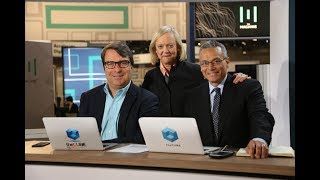
Paul Miller, VP of software defined and Cloud Group Marketing and Danny Yeo, Systems Administrator at Brigham Young University, joins John Furrier and Dave Vellante during HPE Discover 2017 in Las Vegas
#HPEDiscover #theCUBE
https://siliconangle.com/2017/06/12/is-simplivity-worth-the-lump-of-cash-hpe-paid-to-acquire-it-hpediscover/
Is SimpliVity worth the lump of cash HPE paid to acquire it?
Last February, Hewlett Packard Enterprise Co. plunked down $650 million in cash to buy hyperconverged server and storage systems provider SimpliVity Corp. How did SimpliVity command that price from the hardware legacy with its own portfolio of servers and storage?
SimpliVity is not like other hyperconverged infrastructure for sale today, according to Paul Miller (pictured, left), vice president of software defined and cloud group marketing, at HPE, during an interview at HPE Discover in Las Vegas, Nevada.
SimpliVity user Danny Yeo (pictured, right), computer systems administrator at Brigham Young University, joined Miller for the discussion.
“A lot of people started at, ‘I’m going to simplify the VM management layer.’ [SimpliVity] said, ‘No, I’m going to make the most robust virtualization data-services platform in the world,” Miller told John Furrier (@furrier) and Dave Vellante (@dvellante), co-hosts of theCUBE, SiliconANGLE Media’s mobile live streaming studio. (* Disclosure below.)
Once HPE decided to progress into the hyperconverged market, it shopped around gingerly, testing every system on the market. SimpliVity beat them all, Miller stated.
SimpliVity made a host of guarantees to customers, such as 90 percent capacity savings, which HPE will make good on as its owner, Miller said.
HPE is integrating SimpliVity into new offerings that blur the line between hardware and software. One of these is its Synergy composable infrastructure platform, which Miller described: “Just think about the ability to compose and recompose highly scalable software-defined storage for enterprise applications at enterprise scale.”
Quirky use-cases such as running containers (a virtual method for running distributed applications) on bare metal give SimpliVity reach beyond enterprise IT types; developers are expressing interest in the systems too now, according to Miller.
Crash-testing competitors
And for what it’s worth, one customer who began using SimpliVity prior to the acquisition would like to offer his account.
“A competitor — I’ll just put it that way — came in and asked us if we would consider doing a POC [proof of concept] with their product,” Yeo recalled. A BYU engineer decided to simulate a drive failure to compare their SimpliVity system already in production against the competitor’s.
“After we pulled out the sixth drive, the other technology failed; we couldn’t recover data, basically. We’d have to send it to a data recovery center,” Yeo said.
“SimpliVity — it was business as usual,” he said, noting that the system sent plenty of alerts, but even with six drives yanked, it continued running.
Watch the complete video interview below, and be sure to check out more of SiliconANGLE’s and theCUBE’s independent editorial coverage of HPE Discover US 2017. (* Disclosure: TheCUBE is a paid media partner for HPE Discover US 2017. Neither Hewlett Packard Enterprise Co., the event sponsor, nor other sponsors have editorial influence on theCUBE or SiliconANGLE.)
Forgot Password
Almost there!
We just sent you a verification email. Please verify your account to gain access to
HPE Discover 2017 | Las Vegas. If you don’t think you received an email check your
spam folder.
In order to sign in, enter the email address you used to registered for the event. Once completed, you will receive an email with a verification link. Open this link to automatically sign into the site.
Register For HPE Discover 2017 | Las Vegas
Please fill out the information below. You will recieve an email with a verification link confirming your registration. Click the link to automatically sign into the site.
You’re almost there!
We just sent you a verification email. Please click the verification button in the email. Once your email address is verified, you will have full access to all event content for HPE Discover 2017 | Las Vegas.
I want my badge and interests to be visible to all attendees.
Checking this box will display your presense on the attendees list, view your profile and allow other attendees to contact you via 1-1 chat. Read the Privacy Policy. At any time, you can choose to disable this preference.
Select your Interests!
add
Upload your photo
Uploading..
OR
Connect via Twitter
Connect via Linkedin
EDIT PASSWORD
Share
Forgot Password
Almost there!
We just sent you a verification email. Please verify your account to gain access to
HPE Discover 2017 | Las Vegas. If you don’t think you received an email check your
spam folder.
In order to sign in, enter the email address you used to registered for the event. Once completed, you will receive an email with a verification link. Open this link to automatically sign into the site.
Sign in to gain access to HPE Discover 2017 | Las Vegas
Please sign in with LinkedIn to continue to HPE Discover 2017 | Las Vegas. Signing in with LinkedIn ensures a professional environment.
Are you sure you want to remove access rights for this user?
Details
Manage Access
email address
Community Invitation
Paul Miller & Danny Yeo | HPE Discover 2017
Paul Miller, VP of software defined and Cloud Group Marketing and Danny Yeo, Systems Administrator at Brigham Young University, joins John Furrier and Dave Vellante during HPE Discover 2017 in Las Vegas
#HPEDiscover #theCUBE
https://siliconangle.com/2017/06/12/is-simplivity-worth-the-lump-of-cash-hpe-paid-to-acquire-it-hpediscover/
Is SimpliVity worth the lump of cash HPE paid to acquire it?
Last February, Hewlett Packard Enterprise Co. plunked down $650 million in cash to buy hyperconverged server and storage systems provider SimpliVity Corp. How did SimpliVity command that price from the hardware legacy with its own portfolio of servers and storage?
SimpliVity is not like other hyperconverged infrastructure for sale today, according to Paul Miller (pictured, left), vice president of software defined and cloud group marketing, at HPE, during an interview at HPE Discover in Las Vegas, Nevada.
SimpliVity user Danny Yeo (pictured, right), computer systems administrator at Brigham Young University, joined Miller for the discussion.
“A lot of people started at, ‘I’m going to simplify the VM management layer.’ [SimpliVity] said, ‘No, I’m going to make the most robust virtualization data-services platform in the world,” Miller told John Furrier (@furrier) and Dave Vellante (@dvellante), co-hosts of theCUBE, SiliconANGLE Media’s mobile live streaming studio. (* Disclosure below.)
Once HPE decided to progress into the hyperconverged market, it shopped around gingerly, testing every system on the market. SimpliVity beat them all, Miller stated.
SimpliVity made a host of guarantees to customers, such as 90 percent capacity savings, which HPE will make good on as its owner, Miller said.
HPE is integrating SimpliVity into new offerings that blur the line between hardware and software. One of these is its Synergy composable infrastructure platform, which Miller described: “Just think about the ability to compose and recompose highly scalable software-defined storage for enterprise applications at enterprise scale.”
Quirky use-cases such as running containers (a virtual method for running distributed applications) on bare metal give SimpliVity reach beyond enterprise IT types; developers are expressing interest in the systems too now, according to Miller.
Crash-testing competitors
And for what it’s worth, one customer who began using SimpliVity prior to the acquisition would like to offer his account.
“A competitor — I’ll just put it that way — came in and asked us if we would consider doing a POC [proof of concept] with their product,” Yeo recalled. A BYU engineer decided to simulate a drive failure to compare their SimpliVity system already in production against the competitor’s.
“After we pulled out the sixth drive, the other technology failed; we couldn’t recover data, basically. We’d have to send it to a data recovery center,” Yeo said.
“SimpliVity — it was business as usual,” he said, noting that the system sent plenty of alerts, but even with six drives yanked, it continued running.
Watch the complete video interview below, and be sure to check out more of SiliconANGLE’s and theCUBE’s independent editorial coverage of HPE Discover US 2017. (* Disclosure: TheCUBE is a paid media partner for HPE Discover US 2017. Neither Hewlett Packard Enterprise Co., the event sponsor, nor other sponsors have editorial influence on theCUBE or SiliconANGLE.)