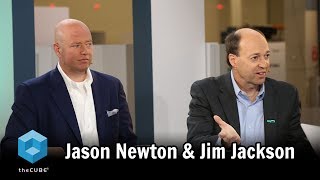
Randy Meyer, Vice President and General Manager of HPE Mission Critical Solutions and Dr. Steven Pratt, Corporate Technology Officer of CenterPoint Energy, join John Furrier and Dave Vellante for HPE Discover 2017 in Las Vegas
#HPEDiscover #theCUBE
https://siliconangle.com/2017/06/13/can-in-memory-compute-jumpstart-iot-analytics-hpediscover/
Can in-memory compute jumpstart IoT analytics?
Despite the kinks still tying up Internet of Things maturation — slow networks and inadequate compute at the edge, for instance — apparently, some companies are already finding success with the right mix of technologies.
“Ten years ago we had about 80,000 meter reads we did a day, and it took 400 people to do that; today we do meter reads 221 million times a day, and it takes no people to do that,” said Dr. Steven Pratt (pictured, right), corporate technology officer, CenterPoint Energy Inc. “That’s really what IoT devices are really intended to do. They do the work for us; it allows our people to focus on other things.”
Pratt, joined by Randy Meyer (pictured, left), vice president and general manager, Mission-Critical Solutions, at Hewlett Packard Enterprise Co., spoke with John Furrier (@furrier) and Dave Vellante (@dvellante), co-hosts of theCUBE, SiliconANGLE Media’s mobile live streaming studio, during HPE Discover in Las Vegas, Nevada. (* Disclosure below.)
CenterPoint Energy is not a competitive energy retailer; it delivers energy for a number of retailers — and its central position puts a ton of data collection and management responsibilities in its hands, Pratt said.
Aside from connected devices, the company manages the load with a devoted space to store and analyze the data.
“We don’t refer to it as a data lake; we refer to it as an advanced data management platform,” Pratt said.
CenterPoint has built this with SAP SE Hana — an in-memory data platform — on top of HPE hardware. The combined systems’ embedded intelligence allows the company to process data in real-time or log it for later analysis, Pratt explained.
Memory gets starring role in IoT?
This is a good example of the intelligence in-memory compute brings to bear on floods of real-time data, according to Meyer.
“We’re innovating in this in-memory scale-up space,” he said, referring to some of HPE’s latest hardware experiments.
“Data’s coming close to in-memory, where you can compute right on the fly. […] I can take you take to my labs and show you 48 terabytes of main memory all flying at the same problem,” Meyer said.
Watch the complete video interview below, and be sure to check out more of SiliconANGLE’s and theCUBE’s independent editorial coverage of HPE Discover US 2017. (* Disclosure: TheCUBE is a paid media partner for HPE Discover US 2017. Neither Hewlett Packard Enterprise Co. nor other sponsors have editorial control on theCUBE or SiliconANGLE.)
Forgot Password
Almost there!
We just sent you a verification email. Please verify your account to gain access to
HPE Discover 2017 | Las Vegas. If you don’t think you received an email check your
spam folder.
In order to sign in, enter the email address you used to registered for the event. Once completed, you will receive an email with a verification link. Open this link to automatically sign into the site.
Register For HPE Discover 2017 | Las Vegas
Please fill out the information below. You will recieve an email with a verification link confirming your registration. Click the link to automatically sign into the site.
You’re almost there!
We just sent you a verification email. Please click the verification button in the email. Once your email address is verified, you will have full access to all event content for HPE Discover 2017 | Las Vegas.
I want my badge and interests to be visible to all attendees.
Checking this box will display your presense on the attendees list, view your profile and allow other attendees to contact you via 1-1 chat. Read the Privacy Policy. At any time, you can choose to disable this preference.
Select your Interests!
add
Upload your photo
Uploading..
OR
Connect via Twitter
Connect via Linkedin
EDIT PASSWORD
Share
Forgot Password
Almost there!
We just sent you a verification email. Please verify your account to gain access to
HPE Discover 2017 | Las Vegas. If you don’t think you received an email check your
spam folder.
In order to sign in, enter the email address you used to registered for the event. Once completed, you will receive an email with a verification link. Open this link to automatically sign into the site.
Sign in to gain access to HPE Discover 2017 | Las Vegas
Please sign in with LinkedIn to continue to HPE Discover 2017 | Las Vegas. Signing in with LinkedIn ensures a professional environment.
Are you sure you want to remove access rights for this user?
Details
Manage Access
email address
Community Invitation
Randy Meyer & Dr. Steven Pratt | HPE Discover 2017
Randy Meyer, Vice President and General Manager of HPE Mission Critical Solutions and Dr. Steven Pratt, Corporate Technology Officer of CenterPoint Energy, join John Furrier and Dave Vellante for HPE Discover 2017 in Las Vegas
#HPEDiscover #theCUBE
https://siliconangle.com/2017/06/13/can-in-memory-compute-jumpstart-iot-analytics-hpediscover/
Can in-memory compute jumpstart IoT analytics?
Despite the kinks still tying up Internet of Things maturation — slow networks and inadequate compute at the edge, for instance — apparently, some companies are already finding success with the right mix of technologies.
“Ten years ago we had about 80,000 meter reads we did a day, and it took 400 people to do that; today we do meter reads 221 million times a day, and it takes no people to do that,” said Dr. Steven Pratt (pictured, right), corporate technology officer, CenterPoint Energy Inc. “That’s really what IoT devices are really intended to do. They do the work for us; it allows our people to focus on other things.”
Pratt, joined by Randy Meyer (pictured, left), vice president and general manager, Mission-Critical Solutions, at Hewlett Packard Enterprise Co., spoke with John Furrier (@furrier) and Dave Vellante (@dvellante), co-hosts of theCUBE, SiliconANGLE Media’s mobile live streaming studio, during HPE Discover in Las Vegas, Nevada. (* Disclosure below.)
CenterPoint Energy is not a competitive energy retailer; it delivers energy for a number of retailers — and its central position puts a ton of data collection and management responsibilities in its hands, Pratt said.
Aside from connected devices, the company manages the load with a devoted space to store and analyze the data.
“We don’t refer to it as a data lake; we refer to it as an advanced data management platform,” Pratt said.
CenterPoint has built this with SAP SE Hana — an in-memory data platform — on top of HPE hardware. The combined systems’ embedded intelligence allows the company to process data in real-time or log it for later analysis, Pratt explained.
Memory gets starring role in IoT?
This is a good example of the intelligence in-memory compute brings to bear on floods of real-time data, according to Meyer.
“We’re innovating in this in-memory scale-up space,” he said, referring to some of HPE’s latest hardware experiments.
“Data’s coming close to in-memory, where you can compute right on the fly. […] I can take you take to my labs and show you 48 terabytes of main memory all flying at the same problem,” Meyer said.
Watch the complete video interview below, and be sure to check out more of SiliconANGLE’s and theCUBE’s independent editorial coverage of HPE Discover US 2017. (* Disclosure: TheCUBE is a paid media partner for HPE Discover US 2017. Neither Hewlett Packard Enterprise Co. nor other sponsors have editorial control on theCUBE or SiliconANGLE.)