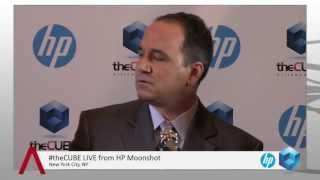
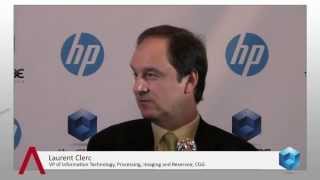
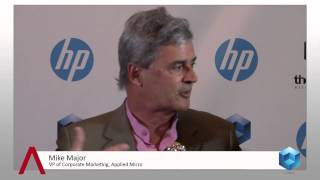
Scott Weller, HP’s VP and General Manager of Technology Services Support, discussed the company’s support and consulting services and how they have changed as a result of the Moonshot release with the Cube’s John Furrier and Dave Vellante.
“We’re very excited about what’s going to come in the future,” Weller said, as traditional architecture means “there is a real limit on how much you can optimize” for footprint, power, and price. This limitation this is what HP manages to revolutionize with Moonshot. Where services are concerned, customers want to make use of this technology quickly. Clients requiring education and training, help with workload migration, and also implementation services. HP has developed very tailored support portfolio that helps clients comprehend this new technology and discover how it fits into specific usage scenarios.
“This is really the same as every other new technology adoption,” Weller explained. There are players who are early adopters – small entrepreneurs or large companies alike. But for most of the companies, the challenge is to answer questions such as who to turn to in order to understand the promise of the technology and how it applies to specific processes and business models. Services revolve around workload analysis and how to migrate them to a very different type of technology.
HP’s Discovery Lab (which is different from its collaboration with Purdue) allows customers to come and learn about Moonshot, to test the technology and see its potential. There are configurations of Moonshot that are going to be a major improvement for specific verticals and operations, Weller added, and the newly announced product is really tuned towards the edge of the web – web retailers, for example. HP’s road map also focuses on use cases for Big Data analytics.
.
.
Fresh perspective from the Moon
.
While the Discovery Lab does help, the best way to discover Moonshot’s benefits is to test in a real business environment, and discover the best way to adapt and optimize. Moonshot is a new technology, it asks businesses to view workloads very differently, as it is a workload-oriented technology.
Speaking of large scale customers, Weller stated his company is automating in ways that don’t really happen in other industries or for other enterprises, thus they need a different kind of services. They always expect to have a dedicated call center, which now exists for Moonshot.
Extending HP’s Services strategy
As a service strategy, Weller explained that HP wants “to create a very consistent and great customer experience.” That means a set of processes, so “customization isn’t really your friend. We are focusing on a building a block approach,” instead of favoring an individual customer approach.
Expanding on HP’s consulting services, Weller mentioned that, thinking holistically about tech services, on a consulting side, consulting involves a team that advises clients on how to get the most out of a new technology, how to adapt it and implement it for a certain business. A customer needs a back-end customer service platform that understands the technology – thus the newly formed, dedicated call center for Moonshot.
Moonshot comes with a new notion and a shift of perception as workloads dictate the kind of technology that is being develop. “Over time, this technology, this model is going to become pervasive,” Weller stated. Right now there are so many workloads that are critical for business processes, and deciding which to try on the new technology is the challenge.
Asked how Moonshot changes the services model for HP, Weller said that he wants “to continue on this path of simplification for customers. What we’re on the path to do is to make everything a seamless experience for them”. HP want to avoid adding layers of complexity. We “keep the experience very proactive for them and very personalized for them and really remove all the complexity.”
Scott Weller, HP, at HP Moonshot 2013, with Jon Furrier and Dave Vellante
Forgot Password
Almost there!
We just sent you a verification email. Please verify your account to gain access to
HP Moonshot 2013 | New York. If you don’t think you received an email check your
spam folder.
In order to sign in, enter the email address you used to registered for the event. Once completed, you will receive an email with a verification link. Open this link to automatically sign into the site.
Register For HP Moonshot 2013 | New York
Please fill out the information below. You will recieve an email with a verification link confirming your registration. Click the link to automatically sign into the site.
You’re almost there!
We just sent you a verification email. Please click the verification button in the email. Once your email address is verified, you will have full access to all event content for HP Moonshot 2013 | New York.
I want my badge and interests to be visible to all attendees.
Checking this box will display your presense on the attendees list, view your profile and allow other attendees to contact you via 1-1 chat. Read the Privacy Policy. At any time, you can choose to disable this preference.
Select your Interests!
add
Upload your photo
Uploading..
OR
Connect via Twitter
Connect via Linkedin
EDIT PASSWORD
Share
Forgot Password
Almost there!
We just sent you a verification email. Please verify your account to gain access to
HP Moonshot 2013 | New York. If you don’t think you received an email check your
spam folder.
In order to sign in, enter the email address you used to registered for the event. Once completed, you will receive an email with a verification link. Open this link to automatically sign into the site.
Sign in to gain access to HP Moonshot 2013 | New York
Please sign in with LinkedIn to continue to HP Moonshot 2013 | New York. Signing in with LinkedIn ensures a professional environment.
Are you sure you want to remove access rights for this user?
Details
Manage Access
email address
Community Invitation
Scott Weller - HP Moonshot 2013 - theCUBE
Scott Weller, HP’s VP and General Manager of Technology Services Support, discussed the company’s support and consulting services and how they have changed as a result of the Moonshot release with the Cube’s John Furrier and Dave Vellante.
“We’re very excited about what’s going to come in the future,” Weller said, as traditional architecture means “there is a real limit on how much you can optimize” for footprint, power, and price. This limitation this is what HP manages to revolutionize with Moonshot. Where services are concerned, customers want to make use of this technology quickly. Clients requiring education and training, help with workload migration, and also implementation services. HP has developed very tailored support portfolio that helps clients comprehend this new technology and discover how it fits into specific usage scenarios.
“This is really the same as every other new technology adoption,” Weller explained. There are players who are early adopters – small entrepreneurs or large companies alike. But for most of the companies, the challenge is to answer questions such as who to turn to in order to understand the promise of the technology and how it applies to specific processes and business models. Services revolve around workload analysis and how to migrate them to a very different type of technology.
HP’s Discovery Lab (which is different from its collaboration with Purdue) allows customers to come and learn about Moonshot, to test the technology and see its potential. There are configurations of Moonshot that are going to be a major improvement for specific verticals and operations, Weller added, and the newly announced product is really tuned towards the edge of the web – web retailers, for example. HP’s road map also focuses on use cases for Big Data analytics.
.
.
Fresh perspective from the Moon
.
While the Discovery Lab does help, the best way to discover Moonshot’s benefits is to test in a real business environment, and discover the best way to adapt and optimize. Moonshot is a new technology, it asks businesses to view workloads very differently, as it is a workload-oriented technology.
Speaking of large scale customers, Weller stated his company is automating in ways that don’t really happen in other industries or for other enterprises, thus they need a different kind of services. They always expect to have a dedicated call center, which now exists for Moonshot.
Extending HP’s Services strategy
As a service strategy, Weller explained that HP wants “to create a very consistent and great customer experience.” That means a set of processes, so “customization isn’t really your friend. We are focusing on a building a block approach,” instead of favoring an individual customer approach.
Expanding on HP’s consulting services, Weller mentioned that, thinking holistically about tech services, on a consulting side, consulting involves a team that advises clients on how to get the most out of a new technology, how to adapt it and implement it for a certain business. A customer needs a back-end customer service platform that understands the technology – thus the newly formed, dedicated call center for Moonshot.
Moonshot comes with a new notion and a shift of perception as workloads dictate the kind of technology that is being develop. “Over time, this technology, this model is going to become pervasive,” Weller stated. Right now there are so many workloads that are critical for business processes, and deciding which to try on the new technology is the challenge.
Asked how Moonshot changes the services model for HP, Weller said that he wants “to continue on this path of simplification for customers. What we’re on the path to do is to make everything a seamless experience for them”. HP want to avoid adding layers of complexity. We “keep the experience very proactive for them and very personalized for them and really remove all the complexity.”
Scott Weller, HP, at HP Moonshot 2013, with Jon Furrier and Dave Vellante