Because it is a major vendor of all three of the traditional IT silo products -- servers, storage, and networking, Donatelli said it is in an excellent position to drive these trends. It was a pioneer in Converged Infrastructure and designs its new infrastructure pieces to integrate easily into converged products.
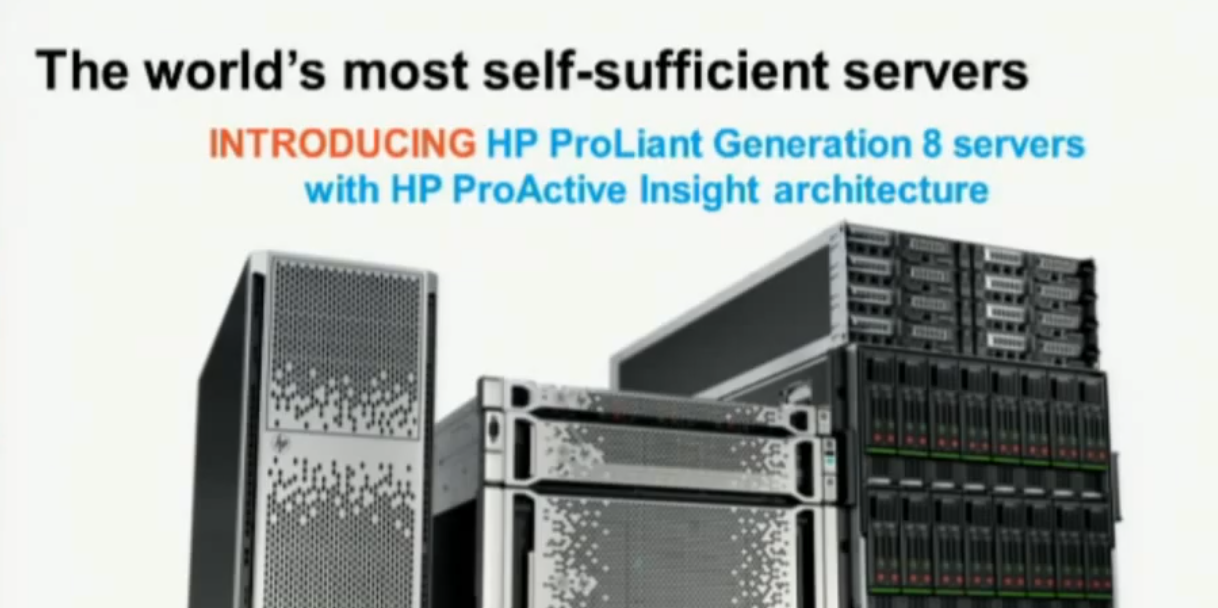
Its new Moonshot servers based on ARM and Adam processor chips are designed to support Cloud environments. Individual boards can be customized for specific applications, varying the amount of network speed, processing, and memory as needed. And because they are "just a little thicker than paper" and designed for lower heat generation, "thousands" can be placed into a rack, providing the huge scaling required by the new environment and workloads.
In the Software Defined Data Center, LeftHand, a startup HP purchased two years ago, actually introduced the first software-defined storage product. HP so far has sold 150,000 LeftHand licenses, making it a leader in virtualized storage. It is also shipping its software-defined network product, and Moonshot is its answer to the software-defined server.
More than that, however, Donatelli says HP's philosophy is that its hardware is the vehicle to deliver software, which is the real value in IT today. "We have thousands of engineers in the Enterprise Group. More than 80% of them are working on software."
Solid-state storage is a fourth major driver in IT infrastructure, he says, and HP again is moving to put itself in the lead in this trend. "We have unified our solid-state supply chain from the smart phone through the desktop to the server. Because many more smartphones are being sold than servers, riding that price curve will be great for consumers." He says that customers can save 50% out of the gate with HP today and that curve will enhance that savings over time.
The expansion of nonvolatile, solid-state memory is a huge strategic change in the infrastructure, he says. It will change the relationship in how servers are built and how storage and networks interact with those servers. "Since we have all three parts of the hardware equation, by putting flash storage in the center of developing in HP Labs we can drive that change."
"Our customers are asking us to do three things: reduce complexity, improve agility, and reduce price. What we have to show is that by moving to the newer technologies they will save money. Yesterday we announced a guarantee that our customers would be able to store twice the data in the same space with the new generation products or we would give them storage for free, that they can run twice the VMs on our new servers, or we give them servers for free."
That is part of HP's new heavy investment in go-to-market strategies to communicate its leading position in the IT infrastructure market, Donatelli said. But, he added, that investment will not take away from HP's commitment to maintain and build on its technical lead. "Some people have the hype. We prefer to have the products."
Forgot Password
Almost there!
We just sent you a verification email. Please verify your account to gain access to
HP Gen8 2012 | Las Vegas. If you don’t think you received an email check your
spam folder.
In order to sign in, enter the email address you used to registered for the event. Once completed, you will receive an email with a verification link. Open this link to automatically sign into the site.
Register For HP Gen8 2012 | Las Vegas
Please fill out the information below. You will recieve an email with a verification link confirming your registration. Click the link to automatically sign into the site.
You’re almost there!
We just sent you a verification email. Please click the verification button in the email. Once your email address is verified, you will have full access to all event content for HP Gen8 2012 | Las Vegas.
I want my badge and interests to be visible to all attendees.
Checking this box will display your presense on the attendees list, view your profile and allow other attendees to contact you via 1-1 chat. Read the Privacy Policy. At any time, you can choose to disable this preference.
Select your Interests!
add
Upload your photo
Uploading..
OR
Connect via Twitter
Connect via Linkedin
EDIT PASSWORD
Share
Forgot Password
Almost there!
We just sent you a verification email. Please verify your account to gain access to
HP Gen8 2012 | Las Vegas. If you don’t think you received an email check your
spam folder.
In order to sign in, enter the email address you used to registered for the event. Once completed, you will receive an email with a verification link. Open this link to automatically sign into the site.
Sign in to gain access to HP Gen8 2012 | Las Vegas
Please sign in with LinkedIn to continue to HP Gen8 2012 | Las Vegas. Signing in with LinkedIn ensures a professional environment.
Are you sure you want to remove access rights for this user?
Details
Manage Access
email address
Community Invitation
Dave Donatelli - Gen8 2012 - theCUBE
Because it is a major vendor of all three of the traditional IT silo products -- servers, storage, and networking, Donatelli said it is in an excellent position to drive these trends. It was a pioneer in Converged Infrastructure and designs its new infrastructure pieces to integrate easily into converged products.
Its new Moonshot servers based on ARM and Adam processor chips are designed to support Cloud environments. Individual boards can be customized for specific applications, varying the amount of network speed, processing, and memory as needed. And because they are "just a little thicker than paper" and designed for lower heat generation, "thousands" can be placed into a rack, providing the huge scaling required by the new environment and workloads.
In the Software Defined Data Center, LeftHand, a startup HP purchased two years ago, actually introduced the first software-defined storage product. HP so far has sold 150,000 LeftHand licenses, making it a leader in virtualized storage. It is also shipping its software-defined network product, and Moonshot is its answer to the software-defined server.
More than that, however, Donatelli says HP's philosophy is that its hardware is the vehicle to deliver software, which is the real value in IT today. "We have thousands of engineers in the Enterprise Group. More than 80% of them are working on software."
Solid-state storage is a fourth major driver in IT infrastructure, he says, and HP again is moving to put itself in the lead in this trend. "We have unified our solid-state supply chain from the smart phone through the desktop to the server. Because many more smartphones are being sold than servers, riding that price curve will be great for consumers." He says that customers can save 50% out of the gate with HP today and that curve will enhance that savings over time.
The expansion of nonvolatile, solid-state memory is a huge strategic change in the infrastructure, he says. It will change the relationship in how servers are built and how storage and networks interact with those servers. "Since we have all three parts of the hardware equation, by putting flash storage in the center of developing in HP Labs we can drive that change."
"Our customers are asking us to do three things: reduce complexity, improve agility, and reduce price. What we have to show is that by moving to the newer technologies they will save money. Yesterday we announced a guarantee that our customers would be able to store twice the data in the same space with the new generation products or we would give them storage for free, that they can run twice the VMs on our new servers, or we give them servers for free."
That is part of HP's new heavy investment in go-to-market strategies to communicate its leading position in the IT infrastructure market, Donatelli said. But, he added, that investment will not take away from HP's commitment to maintain and build on its technical lead. "Some people have the hype. We prefer to have the products."