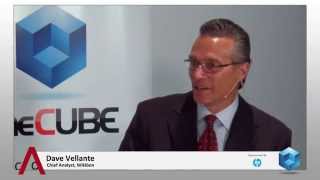
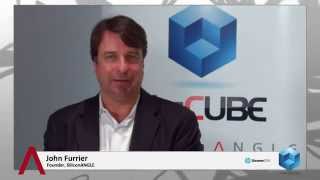
Craig Nunes, HP Storage, with John Furrier and Dave Vellante at HP Discover Las Vegas 2014
@thecube
#hpdiscover
Software-defined storage (SDS) is currently one of the hottest interests for today’s IT market, with ample uptake opportunity in the small to medium business (SMB) arena. At HP Discover in Las Vegas this month, Craig Nunes, VP of Marketing & Alliance for HP Storage, sat down with John Furrier and Dave Vellante in an interview for theCUBE to discuss how the game has changed for SMBs buying storage and why resiliency is so essential.
Software-defined Storage “is like firing up a VM”
Nunes said that, generally, if SMBs have a virtualization environment, they know that they have to “get into shared, resilient storage to get their environment off the ground,” which is precisely what SDS is.
“Software-defined storage is shared, resilient storage without buying shared, resilient storage,” Nunes explained. He went on to say that SDS is a low-cost, hassle-free converged infrastructure in a box that’s easy to manage, making it an ideal solution for small environments. In terms of procuring, deploying and configuring storage, Nunes said that SDS “is like firing up a VM.”
A Mix and Match of Use Cases
Furrier brought up a few varied use cases for storage, like not needing low latency when you want to have a good cost per gigabyte situation and rolling into structured databases for transactions. He said that mix and match use cases like these, which are normally seen in larger enterprises, are now coming down into the medium-sized enterprises. Furrier asked Nunes what this means for customers.
Nunes responded, saying generally small or medium-sized enterprises fundamentally desire what is being run in the larger enterprises, but need to find a way to fit that into a tighter budget. Small enterprises may consider a cost-effective SDS approach, while high-growth businesses may look in to accelerating out of SDS and onto an SDS on an appliance or even consider handling a second site.
The Importance of Resiliency
Nunes explained that “resilience is having the capability within a platform to handle anything that might go wrong and still serve the application with performance customers need.” Giving an example of non-resilience, he said that if you have dual controller arrays and the worst happens in the event that you lose one, the impact of that to the application would result in a 70 percent or 80 percent drop in performance, ultimately killing any business application.
When resiliency is put into play, the application will still run with the bulk of its performance, even with the loss of a controller. “You can only get to that if you’ve got a controller architecture that goes beyond the dual controller limitations which is exactly what converged storage is built on,” said Nunes.
Forgot Password
Almost there!
We just sent you a verification email. Please verify your account to gain access to
HP Discover 2014 | Las Vegas. If you don’t think you received an email check your
spam folder.
In order to sign in, enter the email address you used to registered for the event. Once completed, you will receive an email with a verification link. Open this link to automatically sign into the site.
Register For HP Discover 2014 | Las Vegas
Please fill out the information below. You will recieve an email with a verification link confirming your registration. Click the link to automatically sign into the site.
You’re almost there!
We just sent you a verification email. Please click the verification button in the email. Once your email address is verified, you will have full access to all event content for HP Discover 2014 | Las Vegas.
I want my badge and interests to be visible to all attendees.
Checking this box will display your presense on the attendees list, view your profile and allow other attendees to contact you via 1-1 chat. Read the Privacy Policy. At any time, you can choose to disable this preference.
Select your Interests!
add
Upload your photo
Uploading..
OR
Connect via Twitter
Connect via Linkedin
EDIT PASSWORD
Share
Forgot Password
Almost there!
We just sent you a verification email. Please verify your account to gain access to
HP Discover 2014 | Las Vegas. If you don’t think you received an email check your
spam folder.
In order to sign in, enter the email address you used to registered for the event. Once completed, you will receive an email with a verification link. Open this link to automatically sign into the site.
Sign in to gain access to HP Discover 2014 | Las Vegas
Please sign in with LinkedIn to continue to HP Discover 2014 | Las Vegas. Signing in with LinkedIn ensures a professional environment.
Are you sure you want to remove access rights for this user?
Details
Manage Access
email address
Community Invitation
Craig Nunes - HP Discover Las Vegas 2014 - theCUBE - #HPDiscover
Craig Nunes, HP Storage, with John Furrier and Dave Vellante at HP Discover Las Vegas 2014
@thecube
#hpdiscover
Software-defined storage (SDS) is currently one of the hottest interests for today’s IT market, with ample uptake opportunity in the small to medium business (SMB) arena. At HP Discover in Las Vegas this month, Craig Nunes, VP of Marketing & Alliance for HP Storage, sat down with John Furrier and Dave Vellante in an interview for theCUBE to discuss how the game has changed for SMBs buying storage and why resiliency is so essential.
Software-defined Storage “is like firing up a VM”
Nunes said that, generally, if SMBs have a virtualization environment, they know that they have to “get into shared, resilient storage to get their environment off the ground,” which is precisely what SDS is.
“Software-defined storage is shared, resilient storage without buying shared, resilient storage,” Nunes explained. He went on to say that SDS is a low-cost, hassle-free converged infrastructure in a box that’s easy to manage, making it an ideal solution for small environments. In terms of procuring, deploying and configuring storage, Nunes said that SDS “is like firing up a VM.”
A Mix and Match of Use Cases
Furrier brought up a few varied use cases for storage, like not needing low latency when you want to have a good cost per gigabyte situation and rolling into structured databases for transactions. He said that mix and match use cases like these, which are normally seen in larger enterprises, are now coming down into the medium-sized enterprises. Furrier asked Nunes what this means for customers.
Nunes responded, saying generally small or medium-sized enterprises fundamentally desire what is being run in the larger enterprises, but need to find a way to fit that into a tighter budget. Small enterprises may consider a cost-effective SDS approach, while high-growth businesses may look in to accelerating out of SDS and onto an SDS on an appliance or even consider handling a second site.
The Importance of Resiliency
Nunes explained that “resilience is having the capability within a platform to handle anything that might go wrong and still serve the application with performance customers need.” Giving an example of non-resilience, he said that if you have dual controller arrays and the worst happens in the event that you lose one, the impact of that to the application would result in a 70 percent or 80 percent drop in performance, ultimately killing any business application.
When resiliency is put into play, the application will still run with the bulk of its performance, even with the loss of a controller. “You can only get to that if you’ve got a controller architecture that goes beyond the dual controller limitations which is exactly what converged storage is built on,” said Nunes.