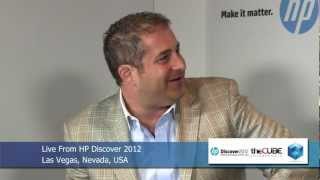
HP Discover 2012 - Kim Stevenson
In closing its latest round of funding, Cloudera has not only secured sufficient capital to fuel operations until its eventual public offering but also gained an important addition to the team in Kim Stevenson, the CIO of lead investor Intel. As the newest member of the Hadoop distributor’s board, the executive brings with her valuable insight into the challenges of managing and operationalizing the growing amounts of unstructured information pouring into the enterprise.
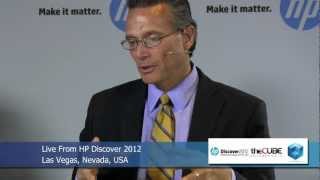
Stevenson had shared many of the lessons she’s learned at the helm of the chip maker’s IT organization on SiliconANGLE’s theCUBE over the years. She made her first appearance all the way back at HP Discover 2012, where she highlighted that an analytics strategy must be underpinned by a clearly defined set of business requirements in order to be successful.
Avoiding “technology for the sake of technology”
The digital universe has grown too big to tame, according to Stevenson, a reality that makes it impractical for companies to blindly jump into the data ocean. She says that technology leaders must take it upon themselves to identify the subsets that are most relevant to their organizations and combine those sources with existing assets for a holistic view of the business processes with the biggest impact on the bottom line.
Intel is leading by example. Stevenson details that the company has instrumented much of its fabrication infrastructure to enable continuous operational improvement throughout the manufacturing lifecycle. “All of the data about what happened in a previous process step is transferred to the next tool so that this information becomes the baseline of what happened and not what was supposed to happen for the next processes,” an approach that she claims has noticeably increased production.
Besides its plants, Intel also collects data from social networks to track buzz around various brands and products in real-time. Yet many of its fellow global enterprises have been slow to adopt social analytics, an adoption divide that Stevenson blames on “soft metrics,” or the lack of visibility into advertising investments.
IT at the speed of business
The issue is a symptom of the difficulty IT organizations face in keeping up with the fast evolving requirements of their users. But the status quo is quickly changing, Stevenson observed in a subsequent interview on theCUBE at Dell World 2012 five months later. The industry has made tremendous progress on reducing operational costs in the last decade, and now the focus is shifting towards generating business value. She considers cloud computing to be the primary driver behind this paradigm shift.
In particular, Stevenson says that the rise of new service delivery models has made it possible for organizations to leverage off-premise resources to tackle challenges that have historically could only be addressed internally. “You have provisioned infrastructure with the storage, the network and the compute available and then you’re just laying on the applications. That will cut out an enormous amount of time in what IT can deliver to the business,” she says.
Technology leaders should approach cloud services the same way as analytics, Stevenson continues: identify where they can be put to good use and try to reduce the legacy baggage standing in the way. “You can’t continue to make incremental upgrades to the past or you’ll never have the resources or the time to invent that future,” she stresses. “And that has to be a negotiation with the business part.”
Forgot Password
Almost there!
We just sent you a verification email. Please verify your account to gain access to
HP Discover 2012 | Las Vegas. If you don’t think you received an email check your
spam folder.
In order to sign in, enter the email address you used to registered for the event. Once completed, you will receive an email with a verification link. Open this link to automatically sign into the site.
Register For HP Discover 2012 | Las Vegas
Please fill out the information below. You will recieve an email with a verification link confirming your registration. Click the link to automatically sign into the site.
You’re almost there!
We just sent you a verification email. Please click the verification button in the email. Once your email address is verified, you will have full access to all event content for HP Discover 2012 | Las Vegas.
I want my badge and interests to be visible to all attendees.
Checking this box will display your presense on the attendees list, view your profile and allow other attendees to contact you via 1-1 chat. Read the Privacy Policy. At any time, you can choose to disable this preference.
Select your Interests!
add
Upload your photo
Uploading..
OR
Connect via Twitter
Connect via Linkedin
EDIT PASSWORD
Share
Forgot Password
Almost there!
We just sent you a verification email. Please verify your account to gain access to
HP Discover 2012 | Las Vegas. If you don’t think you received an email check your
spam folder.
In order to sign in, enter the email address you used to registered for the event. Once completed, you will receive an email with a verification link. Open this link to automatically sign into the site.
Sign in to gain access to HP Discover 2012 | Las Vegas
Please sign in with LinkedIn to continue to HP Discover 2012 | Las Vegas. Signing in with LinkedIn ensures a professional environment.
Are you sure you want to remove access rights for this user?
Details
Manage Access
email address
Community Invitation
Kim Stevenson, Intel - HP Discover 2012 - #HPDiscover #theCUBE
HP Discover 2012 - Kim Stevenson
In closing its latest round of funding, Cloudera has not only secured sufficient capital to fuel operations until its eventual public offering but also gained an important addition to the team in Kim Stevenson, the CIO of lead investor Intel. As the newest member of the Hadoop distributor’s board, the executive brings with her valuable insight into the challenges of managing and operationalizing the growing amounts of unstructured information pouring into the enterprise.
Stevenson had shared many of the lessons she’s learned at the helm of the chip maker’s IT organization on SiliconANGLE’s theCUBE over the years. She made her first appearance all the way back at HP Discover 2012, where she highlighted that an analytics strategy must be underpinned by a clearly defined set of business requirements in order to be successful.
Avoiding “technology for the sake of technology”
The digital universe has grown too big to tame, according to Stevenson, a reality that makes it impractical for companies to blindly jump into the data ocean. She says that technology leaders must take it upon themselves to identify the subsets that are most relevant to their organizations and combine those sources with existing assets for a holistic view of the business processes with the biggest impact on the bottom line.
Intel is leading by example. Stevenson details that the company has instrumented much of its fabrication infrastructure to enable continuous operational improvement throughout the manufacturing lifecycle. “All of the data about what happened in a previous process step is transferred to the next tool so that this information becomes the baseline of what happened and not what was supposed to happen for the next processes,” an approach that she claims has noticeably increased production.
Besides its plants, Intel also collects data from social networks to track buzz around various brands and products in real-time. Yet many of its fellow global enterprises have been slow to adopt social analytics, an adoption divide that Stevenson blames on “soft metrics,” or the lack of visibility into advertising investments.
IT at the speed of business
The issue is a symptom of the difficulty IT organizations face in keeping up with the fast evolving requirements of their users. But the status quo is quickly changing, Stevenson observed in a subsequent interview on theCUBE at Dell World 2012 five months later. The industry has made tremendous progress on reducing operational costs in the last decade, and now the focus is shifting towards generating business value. She considers cloud computing to be the primary driver behind this paradigm shift.
In particular, Stevenson says that the rise of new service delivery models has made it possible for organizations to leverage off-premise resources to tackle challenges that have historically could only be addressed internally. “You have provisioned infrastructure with the storage, the network and the compute available and then you’re just laying on the applications. That will cut out an enormous amount of time in what IT can deliver to the business,” she says.
Technology leaders should approach cloud services the same way as analytics, Stevenson continues: identify where they can be put to good use and try to reduce the legacy baggage standing in the way. “You can’t continue to make incremental upgrades to the past or you’ll never have the resources or the time to invent that future,” she stresses. “And that has to be a negotiation with the business part.”