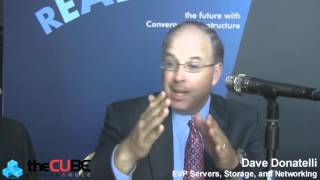
Inside the Cube in Barcelona, Dave Donatelli, HP's head of converged infrastructure speaks with Wikibon's Dave Vellante about the mix between organic R&D and acquisition strategies
Two of our interviews yesterday on theCube illuminated HP's long term goals for the Gen8 line of servers: the one with Dave Donatelli and the one with Gary Thome. Both executives talked about the role of big data and the cloud for HP's future.
Donatelli emphasized that there are multiple stakeholders in this, from HP's partners to the new market of webscale companies such as Zynga to the more traditional enterprise and SMB customers. Donatelli explains that although the Gen8 line is focused on solving long standing problems for HP's traditional customers (and Thome mentions that HP talked to over 100,000 customers while designing the new servers), the servers are ready to meet the needs of the next generation of companies.
Thome said that the current server model, with its high maintenance costs, is unsustainable as companies begin to migrate to the cloud. Although reducing maintenance costs is probably one of the big motivators that companies have for moving to the public cloud, many companies are still focusing on private and hybrid clouds for now.
The Gen8 servers are very much "big data ready." I've written before about how big data necessitates DevOps. The growing volumes of unstructured data require new tools, such as Apache Hadoop, for analysis. That means building clusters of servers, and often means writing new applications for scratch. Data center operations teams will need to take advantage of automation tools to deploy, configure and maintain all the servers that make up these new clusters, and will need to work closely with developers and data scientists to ensure smooth operation. The ServicesAngle team recently discussed what this is going to mean for organizations that haven't historically been engineering focused in a recent editorial call.
The Gen8 servers will, hopefully, ease this transition by providing capacity for solid-state drives, automating much of the work of managing servers and optimizing the allocation of energy and cooling resources. Thome emphasizes that it's not just that the servers are becoming more automated, but that more intelligence is being embedded into each of the servers. When every server is aware of its location within the data center, the optimization of its services become much easier and efficient. I expect many vendors to follow HP's lead on this.
Forgot Password
Almost there!
We just sent you a verification email. Please verify your account to gain access to
HP Converged Infrastructure 2012 | Barcelona. If you don’t think you received an email check your
spam folder.
Sign in to HP Converged Infrastructure 2012 | Barcelona.
In order to sign in, enter the email address you used to registered for the event. Once completed, you will receive an email with a verification link. Open this link to automatically sign into the site.
Register For HP Converged Infrastructure 2012 | Barcelona
Please fill out the information below. You will recieve an email with a verification link confirming your registration. Click the link to automatically sign into the site.
You’re almost there!
We just sent you a verification email. Please click the verification button in the email. Once your email address is verified, you will have full access to all event content for HP Converged Infrastructure 2012 | Barcelona.
I want my badge and interests to be visible to all attendees.
Checking this box will display your presense on the attendees list, view your profile and allow other attendees to contact you via 1-1 chat. Read the Privacy Policy. At any time, you can choose to disable this preference.
Select your Interests!
add
Upload your photo
Uploading..
OR
Connect via Twitter
Connect via Linkedin
EDIT PASSWORD
Share
Forgot Password
Almost there!
We just sent you a verification email. Please verify your account to gain access to
HP Converged Infrastructure 2012 | Barcelona. If you don’t think you received an email check your
spam folder.
Sign in to HP Converged Infrastructure 2012 | Barcelona.
In order to sign in, enter the email address you used to registered for the event. Once completed, you will receive an email with a verification link. Open this link to automatically sign into the site.
Sign in to gain access to HP Converged Infrastructure 2012 | Barcelona
Please sign in with LinkedIn to continue to HP Converged Infrastructure 2012 | Barcelona. Signing in with LinkedIn ensures a professional environment.
Are you sure you want to remove access rights for this user?
Details
Manage Access
email address
Community Invitation
HP's Dave Donatelli On Organic R&D Vs Acquisitions - HP Converged Infastructure - theCUBE
Inside the Cube in Barcelona, Dave Donatelli, HP's head of converged infrastructure speaks with Wikibon's Dave Vellante about the mix between organic R&D and acquisition strategies
Two of our interviews yesterday on theCube illuminated HP's long term goals for the Gen8 line of servers: the one with Dave Donatelli and the one with Gary Thome. Both executives talked about the role of big data and the cloud for HP's future.
Donatelli emphasized that there are multiple stakeholders in this, from HP's partners to the new market of webscale companies such as Zynga to the more traditional enterprise and SMB customers. Donatelli explains that although the Gen8 line is focused on solving long standing problems for HP's traditional customers (and Thome mentions that HP talked to over 100,000 customers while designing the new servers), the servers are ready to meet the needs of the next generation of companies.
Thome said that the current server model, with its high maintenance costs, is unsustainable as companies begin to migrate to the cloud. Although reducing maintenance costs is probably one of the big motivators that companies have for moving to the public cloud, many companies are still focusing on private and hybrid clouds for now.
The Gen8 servers are very much "big data ready." I've written before about how big data necessitates DevOps. The growing volumes of unstructured data require new tools, such as Apache Hadoop, for analysis. That means building clusters of servers, and often means writing new applications for scratch. Data center operations teams will need to take advantage of automation tools to deploy, configure and maintain all the servers that make up these new clusters, and will need to work closely with developers and data scientists to ensure smooth operation. The ServicesAngle team recently discussed what this is going to mean for organizations that haven't historically been engineering focused in a recent editorial call.
The Gen8 servers will, hopefully, ease this transition by providing capacity for solid-state drives, automating much of the work of managing servers and optimizing the allocation of energy and cooling resources. Thome emphasizes that it's not just that the servers are becoming more automated, but that more intelligence is being embedded into each of the servers. When every server is aware of its location within the data center, the optimization of its services become much easier and efficient. I expect many vendors to follow HP's lead on this.