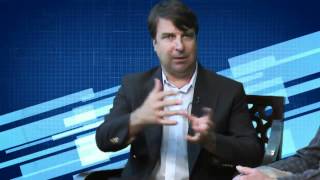
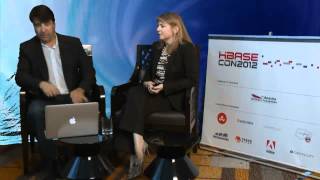
The Cube - hBase 2012 - Cristophe Bisciglia, Wibidata, with John Furrier
Wibidata is built on Apache Hadoop and HBase, which Cloudera specializes in supporting and developing. Monash defines investigative analytics as "seeking (previously unknown) patterns in data," as opposed to monitoring-oriented analytics that aren't investigative and don't necessarily yield new patterns.
Monash describes how Wibidata works:
ALL data pertaining to a single user (or mobile device) is kept in a single, possibly very long, HBase row.
There are two primary operators in WibiData, Produce and Gather.
Produce operates on single rows. It can operate on one row at HBase speed (milliseconds) if you need to inform an interactive user response. Or it can operate on the whole database in batch via Hadoop MapReduce.
It is reasonable to think of Produce as mainly doing two things. One is the aforementioned serving of data out of WibiData into interactive applications. The other is scoring, classifying, recommending, etc. on individual users (i.e. rows), in line with an analytic model.
Gather typically operates on all your rows at once, and emits suitable input for a MapReduce Reduce step. It is reasonable to think of Gather as being a key cog in the training of analytic models.
HBase schema management is done at the WibiData system level, not directly in applications. There's a WibiData HBase data dictionary, powered by a set of system tables, that specifies cell data types/record types and, in effect, primitive schemas.
The company is funded by Google Chairman Eric Schmidt, Cloudera CEO Mike Olsen, SV Angel and others.
Services Angle
We've been writing recently about both the difficulty of putting Apache Hadoop to good use due to its complexity, and about the the need for new data management and governance tools. It seems that Odiago is working on solving some of those problems by building tools on top of the Hadoop platform and by creating ways to centrally manage data.
Forgot Password
Almost there!
We just sent you a verification email. Please verify your account to gain access to
HBase Con 2012 | San Francisco. If you don’t think you received an email check your
spam folder.
In order to sign in, enter the email address you used to registered for the event. Once completed, you will receive an email with a verification link. Open this link to automatically sign into the site.
Register For HBase Con 2012 | San Francisco
Please fill out the information below. You will recieve an email with a verification link confirming your registration. Click the link to automatically sign into the site.
You’re almost there!
We just sent you a verification email. Please click the verification button in the email. Once your email address is verified, you will have full access to all event content for HBase Con 2012 | San Francisco.
I want my badge and interests to be visible to all attendees.
Checking this box will display your presense on the attendees list, view your profile and allow other attendees to contact you via 1-1 chat. Read the Privacy Policy. At any time, you can choose to disable this preference.
Select your Interests!
add
Upload your photo
Uploading..
OR
Connect via Twitter
Connect via Linkedin
EDIT PASSWORD
Share
Forgot Password
Almost there!
We just sent you a verification email. Please verify your account to gain access to
HBase Con 2012 | San Francisco. If you don’t think you received an email check your
spam folder.
In order to sign in, enter the email address you used to registered for the event. Once completed, you will receive an email with a verification link. Open this link to automatically sign into the site.
Sign in to gain access to HBase Con 2012 | San Francisco
Please sign in with LinkedIn to continue to HBase Con 2012 | San Francisco. Signing in with LinkedIn ensures a professional environment.
Are you sure you want to remove access rights for this user?
Details
Manage Access
email address
Community Invitation
Christophe Bisciglia - hBase 2012 - theCUBE
The Cube - hBase 2012 - Cristophe Bisciglia, Wibidata, with John Furrier
Wibidata is built on Apache Hadoop and HBase, which Cloudera specializes in supporting and developing. Monash defines investigative analytics as "seeking (previously unknown) patterns in data," as opposed to monitoring-oriented analytics that aren't investigative and don't necessarily yield new patterns.
Monash describes how Wibidata works:
ALL data pertaining to a single user (or mobile device) is kept in a single, possibly very long, HBase row.
There are two primary operators in WibiData, Produce and Gather.
Produce operates on single rows. It can operate on one row at HBase speed (milliseconds) if you need to inform an interactive user response. Or it can operate on the whole database in batch via Hadoop MapReduce.
It is reasonable to think of Produce as mainly doing two things. One is the aforementioned serving of data out of WibiData into interactive applications. The other is scoring, classifying, recommending, etc. on individual users (i.e. rows), in line with an analytic model.
Gather typically operates on all your rows at once, and emits suitable input for a MapReduce Reduce step. It is reasonable to think of Gather as being a key cog in the training of analytic models.
HBase schema management is done at the WibiData system level, not directly in applications. There's a WibiData HBase data dictionary, powered by a set of system tables, that specifies cell data types/record types and, in effect, primitive schemas.
The company is funded by Google Chairman Eric Schmidt, Cloudera CEO Mike Olsen, SV Angel and others.
Services Angle
We've been writing recently about both the difficulty of putting Apache Hadoop to good use due to its complexity, and about the the need for new data management and governance tools. It seems that Odiago is working on solving some of those problems by building tools on top of the Hadoop platform and by creating ways to centrally manage data.