Enhanced video at http://vinja.tv/j0TytKGv
01. Scott Gnau, Hortonworks, Visits #theCUBE!. (00:20)
02. What Has Changed In Two Weeks. (00:44)
03. What Is The Connected Data Platform. (01:15)
04. How Much Time Are You Putting Into Open Source. (02:37)
05. Cloud Seem To Be Cherry Picking Big Data Pipeline, Is The Deck Stacked For Them. (04:34)
06. What Is Your Big Announcement With Pivotal. (06:52)
07. How Do You See Spark Fitting Into Your Road Map. (08:01)
08. Are The Conversations In The States Difference In The States Versus Europe. (09:02)
09. What Do Boards Need To Know About The Change In Security. (10:17)
10. Are Executives Acknowledging That Companies Will Get Hacked. (12:06)
11. What Would You Tell New Prospective Customers About How You're Different. (13:11)
12. What Is One Thing You'd Like To Share About Hortonworks. (14:44)
13. What Is The White Space That You're Going After. (16:29)
14. Was Hadoop Originally Meant To Be A Storage Engine. (17:45)
15. Why Have World Pay Up On The Stage. (18:48)
Track List created with http://www.vinjavideo.com.
--- ---
Hortonworks’ data platform ready for future expansions | #HS16Dublin
by Gabriel Pesek | Apr 14, 2016
Among the efforts to introduce Hadoop’s functionality and capabilities to new audiences at this year’s Hadoop Summit in Dublin, those who have already adopted it are looking for ways to expand and upgrade their existing data platform options.
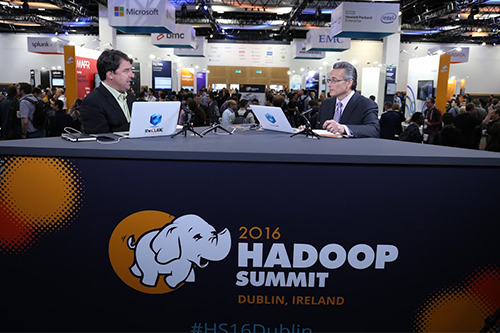
Scott Gnau, CTO of Hortonworks, Inc., met with John Furrier (@furrier) and Dave Vellante (@dvellante), cohosts of theCUBE, from the SiliconANGLE Media team, to talk about some of the ways in which Hortonworks is refining and widening its Hadoop operability, how it’s bringing customers in to use it and ways of keeping security tight.
Deploying the platform
One of the first topics approached by Gnau was Hortonworks’ focus on building a stable data platform for users to utilize for future upgrades, without the need to overhaul everything. As he laid it out, “In a rapidly-changing market … where there are new tools, new requirements, new applications every day, the key thing we think that makes it sustainable is the fact that there is a central platform that can go through this evolution and agility and remain basically the platform so that applications don’t have to be rewritten and rehosted every time there’s a new shining object.”
Having established this framework, Gnau continued to discuss what it meant for Hortonworks’ end-users: “Customers who are going down this path with us can futureproof the business by making sure they have a sustainable platform, into which new projects, new objects, new applications can be built, and they know because of our open-community model that we’ll support any of those things that come along.”
Connecting the pieces
As Gnau noted, for Hortonworks, “There’s a significant effort that goes into building interoperability and the platform,” but it is also trying to establish baseline pre-readiness by having each of the projects accomplish some of that interoperability on their own. As part of that snap-together future, Gnau felt that “one of the things that you’ll see us working on is ways to package that platform to make the simple on-boarding easier.”
Gnau expects that this will be a draw to customers looking to do more than just improve efficiency of existing practices, but that there will be a wide mark of improvement in that regard. “Customers who are building data lakes, one of the things they want to do is not only get new and emerging data into the lake, but they want to pull in some of the legacy data from their operational systems to get better analytics. … The DMX-h [a tool for initializing Hadoop ETL] is an ‘easy button’ for that.”
Platform security
With big announcements regarding a partnership with Pivotal Software, Inc., along with the ability to deploy Pivotal HAWQ for customers, Gnau felt confident that people could see that Hortonworks was “not building individual pieces, but in fact, we’re building a platform.”
Beyond this, he also addressed national and continental differences in data handling and privacy and security regulations as part of Hortonworks’ focus on security. He recognized that while security threats continue to evolve, the basic philosophy behind security practices remains the same, and though implementation of those practices was improving, companies should plan for the worst: “Plan on it happening, and build in that response.”
To that end, he noted that certain ways of handling internal organization of data storage can do a lot to lessen the impact when security is breached and improve understanding of what was accessed in such a case.
@theCUBE
#HS16Dublin
Forgot Password
Almost there!
We just sent you a verification email. Please verify your account to gain access to
Hadoop Summit 2016 | Dublin. If you don’t think you received an email check your
spam folder.
In order to sign in, enter the email address you used to registered for the event. Once completed, you will receive an email with a verification link. Open this link to automatically sign into the site.
Register For Hadoop Summit 2016 | Dublin
Please fill out the information below. You will recieve an email with a verification link confirming your registration. Click the link to automatically sign into the site.
You’re almost there!
We just sent you a verification email. Please click the verification button in the email. Once your email address is verified, you will have full access to all event content for Hadoop Summit 2016 | Dublin.
I want my badge and interests to be visible to all attendees.
Checking this box will display your presense on the attendees list, view your profile and allow other attendees to contact you via 1-1 chat. Read the Privacy Policy. At any time, you can choose to disable this preference.
Select your Interests!
add
Upload your photo
Uploading..
OR
Connect via Twitter
Connect via Linkedin
EDIT PASSWORD
Share
Forgot Password
Almost there!
We just sent you a verification email. Please verify your account to gain access to
Hadoop Summit 2016 | Dublin. If you don’t think you received an email check your
spam folder.
In order to sign in, enter the email address you used to registered for the event. Once completed, you will receive an email with a verification link. Open this link to automatically sign into the site.
Sign in to gain access to Hadoop Summit 2016 | Dublin
Please sign in with LinkedIn to continue to Hadoop Summit 2016 | Dublin. Signing in with LinkedIn ensures a professional environment.
Are you sure you want to remove access rights for this user?
Details
Manage Access
email address
Community Invitation
Scott Gnau, Hortonworks | Hadoop Summit Dublin 2016
Enhanced video at http://vinja.tv/j0TytKGv
01. Scott Gnau, Hortonworks, Visits #theCUBE!. (00:20)
02. What Has Changed In Two Weeks. (00:44)
03. What Is The Connected Data Platform. (01:15)
04. How Much Time Are You Putting Into Open Source. (02:37)
05. Cloud Seem To Be Cherry Picking Big Data Pipeline, Is The Deck Stacked For Them. (04:34)
06. What Is Your Big Announcement With Pivotal. (06:52)
07. How Do You See Spark Fitting Into Your Road Map. (08:01)
08. Are The Conversations In The States Difference In The States Versus Europe. (09:02)
09. What Do Boards Need To Know About The Change In Security. (10:17)
10. Are Executives Acknowledging That Companies Will Get Hacked. (12:06)
11. What Would You Tell New Prospective Customers About How You're Different. (13:11)
12. What Is One Thing You'd Like To Share About Hortonworks. (14:44)
13. What Is The White Space That You're Going After. (16:29)
14. Was Hadoop Originally Meant To Be A Storage Engine. (17:45)
15. Why Have World Pay Up On The Stage. (18:48)
Track List created with http://www.vinjavideo.com.
--- ---
Hortonworks’ data platform ready for future expansions | #HS16Dublin
by Gabriel Pesek | Apr 14, 2016
Among the efforts to introduce Hadoop’s functionality and capabilities to new audiences at this year’s Hadoop Summit in Dublin, those who have already adopted it are looking for ways to expand and upgrade their existing data platform options.
Scott Gnau, CTO of Hortonworks, Inc., met with John Furrier (@furrier) and Dave Vellante (@dvellante), cohosts of theCUBE, from the SiliconANGLE Media team, to talk about some of the ways in which Hortonworks is refining and widening its Hadoop operability, how it’s bringing customers in to use it and ways of keeping security tight.
Deploying the platform
One of the first topics approached by Gnau was Hortonworks’ focus on building a stable data platform for users to utilize for future upgrades, without the need to overhaul everything. As he laid it out, “In a rapidly-changing market … where there are new tools, new requirements, new applications every day, the key thing we think that makes it sustainable is the fact that there is a central platform that can go through this evolution and agility and remain basically the platform so that applications don’t have to be rewritten and rehosted every time there’s a new shining object.”
Having established this framework, Gnau continued to discuss what it meant for Hortonworks’ end-users: “Customers who are going down this path with us can futureproof the business by making sure they have a sustainable platform, into which new projects, new objects, new applications can be built, and they know because of our open-community model that we’ll support any of those things that come along.”
Connecting the pieces
As Gnau noted, for Hortonworks, “There’s a significant effort that goes into building interoperability and the platform,” but it is also trying to establish baseline pre-readiness by having each of the projects accomplish some of that interoperability on their own. As part of that snap-together future, Gnau felt that “one of the things that you’ll see us working on is ways to package that platform to make the simple on-boarding easier.”
Gnau expects that this will be a draw to customers looking to do more than just improve efficiency of existing practices, but that there will be a wide mark of improvement in that regard. “Customers who are building data lakes, one of the things they want to do is not only get new and emerging data into the lake, but they want to pull in some of the legacy data from their operational systems to get better analytics. … The DMX-h [a tool for initializing Hadoop ETL] is an ‘easy button’ for that.”
Platform security
With big announcements regarding a partnership with Pivotal Software, Inc., along with the ability to deploy Pivotal HAWQ for customers, Gnau felt confident that people could see that Hortonworks was “not building individual pieces, but in fact, we’re building a platform.”
Beyond this, he also addressed national and continental differences in data handling and privacy and security regulations as part of Hortonworks’ focus on security. He recognized that while security threats continue to evolve, the basic philosophy behind security practices remains the same, and though implementation of those practices was improving, companies should plan for the worst: “Plan on it happening, and build in that response.”
To that end, he noted that certain ways of handling internal organization of data storage can do a lot to lessen the impact when security is breached and improve understanding of what was accessed in such a case.
@theCUBE
#HS16Dublin