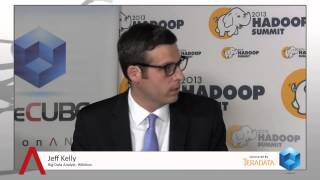
John Furrier and Jeff Kelly, theCUBE co-hosts, broadcasting live from Hadoop Summit 2013 in San Jose this week, discuss the challenges arising from massive Hadoop adoption in terms of security and governance with Yves de Montcheuil, VP of Marketing at Talend.
“Big Data is probably the fastest adopted technology in the history of IT,” said Montcheuil, and Furrier pointed out that “getting value out of the data is one of the most frequent things iterated at such events.” So, how does that work for a company with existing staff and legacy infrastructure? Montcheuil answered: “Big Data is not about inventing new stuff. Its role is to extract value out of existing insfrastructure and existing legacy. A Big Data project does not grow out of nothing, but on top of existing data.” Integration is extremely critical, because data needs to be aggregated andbrought in one place to be processed, from all the places it’s being generated.
In Montcheuil’s opinion, “bringing the data in” is just the first step. Because no one wants their data to be an island – it needs to be connected to the rest of the information system.
Compliant Big Data
Furrier added a couple of notes himself, based on his experience with CEOs and the Wikibon.org community, stating that “compliance is the number one issue” – on the governance side. To him that seems to be an inhibitor on the adoption process of new technology.
“Big Data projects have started primarily as pilots,” reckons Montcheuil. “When doing a pilot, you don’t really care about governance, information and compliance. You’re just trying to prove your point, prove that you can actually extract value out of those massive, untapped amounts of information.” Once past the pilot stage, in the event of deploying those projects, then the issues of Enterprise policies need to be addressed. That includes the governance, which is “part security, part compliance and part trustability of the data.”
For instance, Talend combines big data technologies into a unified open source environment, simplifying the loading, extraction, transformation and processing of large and diverse data sets.
Yves de Montcheuil points out that, historically, there’s been a great divide between the traditional data residing in traditional databases and the new sets of data (semi or multi-structured) that can be dumped into a Hadoop cluster. The new databases, the NoSQL databases, actually bring the best of both worlds. They offer both the structure and the degree of protection that a traditional database would bring, as well as the flexibility of unstructured databases. Talend unites integration projects and technologies to accelerate the time-to-value for the business, effectively enabling Integration at Any Scale.
Forgot Password
Almost there!
We just sent you a verification email. Please verify your account to gain access to
Hadoop Summit 2013 | San Jose. If you don’t think you received an email check your
spam folder.
In order to sign in, enter the email address you used to registered for the event. Once completed, you will receive an email with a verification link. Open this link to automatically sign into the site.
Register For Hadoop Summit 2013 | San Jose
Please fill out the information below. You will recieve an email with a verification link confirming your registration. Click the link to automatically sign into the site.
You’re almost there!
We just sent you a verification email. Please click the verification button in the email. Once your email address is verified, you will have full access to all event content for Hadoop Summit 2013 | San Jose.
I want my badge and interests to be visible to all attendees.
Checking this box will display your presense on the attendees list, view your profile and allow other attendees to contact you via 1-1 chat. Read the Privacy Policy. At any time, you can choose to disable this preference.
Select your Interests!
add
Upload your photo
Uploading..
OR
Connect via Twitter
Connect via Linkedin
EDIT PASSWORD
Share
Forgot Password
Almost there!
We just sent you a verification email. Please verify your account to gain access to
Hadoop Summit 2013 | San Jose. If you don’t think you received an email check your
spam folder.
In order to sign in, enter the email address you used to registered for the event. Once completed, you will receive an email with a verification link. Open this link to automatically sign into the site.
Sign in to gain access to Hadoop Summit 2013 | San Jose
Please sign in with LinkedIn to continue to Hadoop Summit 2013 | San Jose. Signing in with LinkedIn ensures a professional environment.
John Furrier and Jeff Kelly, theCUBE co-hosts, broadcasting live from Hadoop Summit 2013 in San Jose this week, discuss the challenges arising from massive Hadoop adoption in terms of security and governance with Yves de Montcheuil, VP of Marketing at Talend.
“Big Data is probably the fastest adopted technology in the history of IT,” said Montcheuil, and Furrier pointed out that “getting value out of the data is one of the most frequent things iterated at such events.” So, how does that work for a company with existing staff and legacy infrastructure? Montcheuil answered: “Big Data is not about inventing new stuff. Its role is to extract value out of existing insfrastructure and existing legacy. A Big Data project does not grow out of nothing, but on top of existing data.” Integration is extremely critical, because data needs to be aggregated andbrought in one place to be processed, from all the places it’s being generated.
In Montcheuil’s opinion, “bringing the data in” is just the first step. Because no one wants their data to be an island – it needs to be connected to the rest of the information system.
Compliant Big Data
Furrier added a couple of notes himself, based on his experience with CEOs and the Wikibon.org community, stating that “compliance is the number one issue” – on the governance side. To him that seems to be an inhibitor on the adoption process of new technology.
“Big Data projects have started primarily as pilots,” reckons Montcheuil. “When doing a pilot, you don’t really care about governance, information and compliance. You’re just trying to prove your point, prove that you can actually extract value out of those massive, untapped amounts of information.” Once past the pilot stage, in the event of deploying those projects, then the issues of Enterprise policies need to be addressed. That includes the governance, which is “part security, part compliance and part trustability of the data.”
For instance, Talend combines big data technologies into a unified open source environment, simplifying the loading, extraction, transformation and processing of large and diverse data sets.
Yves de Montcheuil points out that, historically, there’s been a great divide between the traditional data residing in traditional databases and the new sets of data (semi or multi-structured) that can be dumped into a Hadoop cluster. The new databases, the NoSQL databases, actually bring the best of both worlds. They offer both the structure and the degree of protection that a traditional database would bring, as well as the flexibility of unstructured databases. Talend unites integration projects and technologies to accelerate the time-to-value for the business, effectively enabling Integration at Any Scale.