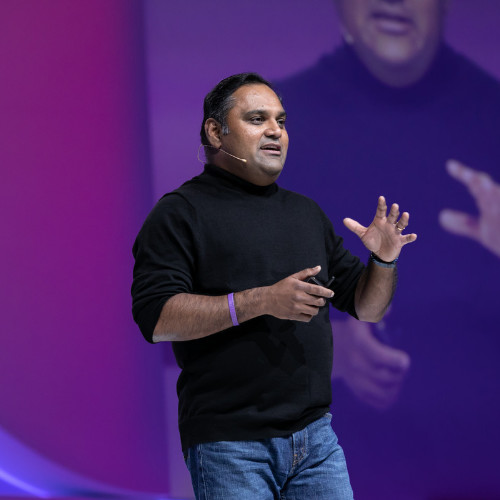
Sudhir Hasbe, Director, Product Management, Google Cloud | @shasbe, sits with John Furrier & Jeff Frick for Google Cloud Next 2018 from the Moscone Center in San Francisco, CA.
BigQuery ML addresses two major pain points of machine learning tech
https://siliconangle.com/2018/07/31/bigquery-ml-addresses-two-major-pain-points-of-machine-learning-tech-googlenext18/
Among the many announcements from last week’s Google Cloud Next event was a noteworthy update to Google LLC’s BigQuery, adding machine learning capabilities to the SQL data warehousing tool. The addition, dubbed BigQuery ML, makes it easier for developers to work in the perks of machine learning without having to export data from BigQuery to a separate engine, such as Cloud ML Engine or AutoML.
“Ease of use is a major focus for us. As we’re growing we want to make sure everybody in the organization can get access to their data and analyze it,” said Sudhir Hasbe (pictured), director of product management at Google Cloud. “We also announced clustering that allows you to reduce the cost, improve efficiency, and make queries almost two times faster.”
Hasbe spoke with John Furrier (@furrier) and Jeff Frick (@JeffFrick), co-hosts of theCUBE, SiliconANGLE Media’s mobile livestreaming studio, during the recently concluded Google Cloud Next event in San Francisco. They discussed Google’s integration of its enterprise data warehouse, BigQuery. (* Disclosure below.)
Leveraging lessons learned
In an effort to compete with service-heavy rivals, such as Amazon Web Services Inc. and Microsoft Azure, Google’s enterprise cloud play is honing its focus on problem-solving specific issues in the world of cloud computing. This is evident in BigQuery’s efforts to address two of the biggest problems in machine learning.
First, moving the data has historically been a complicated undertaking for data scientists, even with the development of early solutions like Hadoop’s open-source software for large-scale data computations. With BigQuery ML, Google has moved machine learning closer to the data, rather than moving the data closer to machine learning, according to Hasbe.
“That’s what BigQuery ML is; it’s an ability to run regression-like models inside the data warehouse itself, inside BigQuery,” he said.
Secondly, Google addressed the problem of skillset gaps. Customers of BigQuery are all assumed to know SQL and the business analytics, so all that they need to then do is “create the type of model you want to run; give us the data, and we’ll run the machine learning model on the backend and you can do predictions pretty easily,” Hasbe explained.
Google itself has been using a program extremely similar to BigQuery called Dremel, since before 2012, for all large-scale data analytics, according to Hasbe. “This is a way of taking a piece of technology that’s powered Google for a while and also make it available to enterprises,” he added.
The lessons learned internally could prove a competitive advantage for Google as it looks to gain market share in enterprise cloud, especially if the search engine leader can translate this experience into service-oriented client solutions.
As one of Google’s more notable accomplishments in machine learning, BigQuery has already gained interest from online music giant Spotify Technology SA for its analytics capabilities.
Watch the complete video interview below, and be sure to check out more of SiliconANGLE’s and theCUBE’s coverage of the Google Cloud Next event. (* Disclosure: Google Cloud sponsored this segment of theCUBE. Neither Google nor other sponsors have editorial control over content on theCUBE or SiliconANGLE.)
For more information:
https://www.thecube.net/google-cloud-next-18
SiliconANGLE BLOG Posts:
https://siliconangle.com/
@Google @Google Cloud Platform #GCP @SiliconANGLE theCUBE @theCUBE #theCUBE
Forgot Password
Almost there!
We just sent you a verification email. Please verify your account to gain access to
Google Cloud Next 2018 | San Francisco. If you don’t think you received an email check your
spam folder.
Sign in to Google Cloud Next 2018 | San Francisco.
In order to sign in, enter the email address you used to registered for the event. Once completed, you will receive an email with a verification link. Open this link to automatically sign into the site.
Register For Google Cloud Next 2018 | San Francisco
Please fill out the information below. You will recieve an email with a verification link confirming your registration. Click the link to automatically sign into the site.
You’re almost there!
We just sent you a verification email. Please click the verification button in the email. Once your email address is verified, you will have full access to all event content for Google Cloud Next 2018 | San Francisco.
I want my badge and interests to be visible to all attendees.
Checking this box will display your presense on the attendees list, view your profile and allow other attendees to contact you via 1-1 chat. Read the Privacy Policy. At any time, you can choose to disable this preference.
Select your Interests!
add
Upload your photo
Uploading..
OR
Connect via Twitter
Connect via Linkedin
EDIT PASSWORD
Share
Forgot Password
Almost there!
We just sent you a verification email. Please verify your account to gain access to
Google Cloud Next 2018 | San Francisco. If you don’t think you received an email check your
spam folder.
Sign in to Google Cloud Next 2018 | San Francisco.
In order to sign in, enter the email address you used to registered for the event. Once completed, you will receive an email with a verification link. Open this link to automatically sign into the site.
Sign in to gain access to Google Cloud Next 2018 | San Francisco
Please sign in with LinkedIn to continue to Google Cloud Next 2018 | San Francisco. Signing in with LinkedIn ensures a professional environment.
Are you sure you want to remove access rights for this user?
Details
Manage Access
email address
Community Invitation
Sudhir Hasbe, Google Cloud | Google Cloud Next 2018
Sudhir Hasbe, Director, Product Management, Google Cloud | @shasbe, sits with John Furrier & Jeff Frick for Google Cloud Next 2018 from the Moscone Center in San Francisco, CA.
BigQuery ML addresses two major pain points of machine learning tech
https://siliconangle.com/2018/07/31/bigquery-ml-addresses-two-major-pain-points-of-machine-learning-tech-googlenext18/
Among the many announcements from last week’s Google Cloud Next event was a noteworthy update to Google LLC’s BigQuery, adding machine learning capabilities to the SQL data warehousing tool. The addition, dubbed BigQuery ML, makes it easier for developers to work in the perks of machine learning without having to export data from BigQuery to a separate engine, such as Cloud ML Engine or AutoML.
“Ease of use is a major focus for us. As we’re growing we want to make sure everybody in the organization can get access to their data and analyze it,” said Sudhir Hasbe (pictured), director of product management at Google Cloud. “We also announced clustering that allows you to reduce the cost, improve efficiency, and make queries almost two times faster.”
Hasbe spoke with John Furrier (@furrier) and Jeff Frick (@JeffFrick), co-hosts of theCUBE, SiliconANGLE Media’s mobile livestreaming studio, during the recently concluded Google Cloud Next event in San Francisco. They discussed Google’s integration of its enterprise data warehouse, BigQuery. (* Disclosure below.)
Leveraging lessons learned
In an effort to compete with service-heavy rivals, such as Amazon Web Services Inc. and Microsoft Azure, Google’s enterprise cloud play is honing its focus on problem-solving specific issues in the world of cloud computing. This is evident in BigQuery’s efforts to address two of the biggest problems in machine learning.
First, moving the data has historically been a complicated undertaking for data scientists, even with the development of early solutions like Hadoop’s open-source software for large-scale data computations. With BigQuery ML, Google has moved machine learning closer to the data, rather than moving the data closer to machine learning, according to Hasbe.
“That’s what BigQuery ML is; it’s an ability to run regression-like models inside the data warehouse itself, inside BigQuery,” he said.
Secondly, Google addressed the problem of skillset gaps. Customers of BigQuery are all assumed to know SQL and the business analytics, so all that they need to then do is “create the type of model you want to run; give us the data, and we’ll run the machine learning model on the backend and you can do predictions pretty easily,” Hasbe explained.
Google itself has been using a program extremely similar to BigQuery called Dremel, since before 2012, for all large-scale data analytics, according to Hasbe. “This is a way of taking a piece of technology that’s powered Google for a while and also make it available to enterprises,” he added.
The lessons learned internally could prove a competitive advantage for Google as it looks to gain market share in enterprise cloud, especially if the search engine leader can translate this experience into service-oriented client solutions.
As one of Google’s more notable accomplishments in machine learning, BigQuery has already gained interest from online music giant Spotify Technology SA for its analytics capabilities.
Watch the complete video interview below, and be sure to check out more of SiliconANGLE’s and theCUBE’s coverage of the Google Cloud Next event. (* Disclosure: Google Cloud sponsored this segment of theCUBE. Neither Google nor other sponsors have editorial control over content on theCUBE or SiliconANGLE.)
For more information:
https://www.thecube.net/google-cloud-next-18
SiliconANGLE BLOG Posts:
https://siliconangle.com/
@Google @Google Cloud Platform #GCP @SiliconANGLE theCUBE @theCUBE #theCUBE