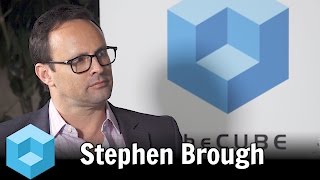
01. Rowan Trollope, Cisco, Visits #theCUBE!. (00:21)
02. Give Us A Quick Update With Cisco Spark\. (00:40)
03. Talk About The Dynamics Of Software. (01:28)
04. What Are The Areas You'd Like To See With Developers. (02:24)
05. What Do You See The Telephone Market Looking Like In The Future. (03:43)
06. How Should The Enterprise Be Thinking. (05:13)
07. How Are You Making It Easy For Developers. (06:42)
08. How Have You Changed Within Cisco. (08:10)
09. Share Why Integration Is Important. (09:49)
10. Technologies Of The Future Are Non Technology Companies. (11:19)
#theCUBE #Cisco #EnterpriseConnect #Five9 #EC16
--- ---
Does every company have to become a technology company? | #EC16
by R. Danes | Mar 8, 2016
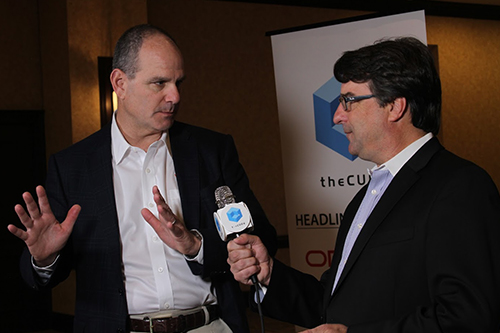
“Digitize or die” seems to be the ultimatum facing businesses these days, as competitors race for the technological tools that can give them an edge. Many find themselves wondering where to begin the transition. According to Rowan Trollope, SVP & GM of the collaboration technology group at Cisco Systems, Inc., the first order of business is better collaboration.
“When companies are digitizing, they need better collaboration tools. That’s the first thing they need,” Trollope told John Furrier, cohost of theCUBE, from the SiliconANGLE Media team, and Jim Burton, cofounder of UCStrategies. He contended that collaboration tools help make communication between IT and other employees as speedy and frictionless as digitization demands.
With the announcement of a $150 million development fund, Cisco is hoping to get talented developers to use Spark (Cisco’s unified communications service) as their collaboration platform. “We’ve implemented Spark on the latest cloud technologies, so it’s a DevOps model from start to finish,” he said.
Trollope spoke about integration of Spark into applications for ease of use and blendability. He said that APIs are the new interoperability and that they’ve facilitated integration.
Challenges of the new world
Trollope envisions a new world where technology isn’t something you have to deal with occasionally for tune-ups, but rather something that must be woven into the fabric of your business.
“Every company has to become a technology company,” he stated. “The question is how many of them are going to be able to make the transition. That’s a hard transition to make.”
Forgot Password
Almost there!
We just sent you a verification email. Please verify your account to gain access to
Enterprise Connect 2016 | Orlando. If you don’t think you received an email check your
spam folder.
In order to sign in, enter the email address you used to registered for the event. Once completed, you will receive an email with a verification link. Open this link to automatically sign into the site.
Register For Enterprise Connect 2016 | Orlando
Please fill out the information below. You will recieve an email with a verification link confirming your registration. Click the link to automatically sign into the site.
You’re almost there!
We just sent you a verification email. Please click the verification button in the email. Once your email address is verified, you will have full access to all event content for Enterprise Connect 2016 | Orlando.
I want my badge and interests to be visible to all attendees.
Checking this box will display your presense on the attendees list, view your profile and allow other attendees to contact you via 1-1 chat. Read the Privacy Policy. At any time, you can choose to disable this preference.
Select your Interests!
add
Upload your photo
Uploading..
OR
Connect via Twitter
Connect via Linkedin
EDIT PASSWORD
Share
Forgot Password
Almost there!
We just sent you a verification email. Please verify your account to gain access to
Enterprise Connect 2016 | Orlando. If you don’t think you received an email check your
spam folder.
In order to sign in, enter the email address you used to registered for the event. Once completed, you will receive an email with a verification link. Open this link to automatically sign into the site.
Sign in to gain access to Enterprise Connect 2016 | Orlando
Please sign in with LinkedIn to continue to Enterprise Connect 2016 | Orlando. Signing in with LinkedIn ensures a professional environment.
Are you sure you want to remove access rights for this user?
Details
Manage Access
email address
Community Invitation
Rowan Trollope, Cisco | Enterprise Connect 2016
01. Rowan Trollope, Cisco, Visits #theCUBE!. (00:21)
02. Give Us A Quick Update With Cisco Spark\. (00:40)
03. Talk About The Dynamics Of Software. (01:28)
04. What Are The Areas You'd Like To See With Developers. (02:24)
05. What Do You See The Telephone Market Looking Like In The Future. (03:43)
06. How Should The Enterprise Be Thinking. (05:13)
07. How Are You Making It Easy For Developers. (06:42)
08. How Have You Changed Within Cisco. (08:10)
09. Share Why Integration Is Important. (09:49)
10. Technologies Of The Future Are Non Technology Companies. (11:19)
#theCUBE #Cisco #EnterpriseConnect #Five9 #EC16
--- ---
Does every company have to become a technology company? | #EC16
by R. Danes | Mar 8, 2016
“Digitize or die” seems to be the ultimatum facing businesses these days, as competitors race for the technological tools that can give them an edge. Many find themselves wondering where to begin the transition. According to Rowan Trollope, SVP & GM of the collaboration technology group at Cisco Systems, Inc., the first order of business is better collaboration.
“When companies are digitizing, they need better collaboration tools. That’s the first thing they need,” Trollope told John Furrier, cohost of theCUBE, from the SiliconANGLE Media team, and Jim Burton, cofounder of UCStrategies. He contended that collaboration tools help make communication between IT and other employees as speedy and frictionless as digitization demands.
With the announcement of a $150 million development fund, Cisco is hoping to get talented developers to use Spark (Cisco’s unified communications service) as their collaboration platform. “We’ve implemented Spark on the latest cloud technologies, so it’s a DevOps model from start to finish,” he said.
Trollope spoke about integration of Spark into applications for ease of use and blendability. He said that APIs are the new interoperability and that they’ve facilitated integration.
Challenges of the new world
Trollope envisions a new world where technology isn’t something you have to deal with occasionally for tune-ups, but rather something that must be woven into the fabric of your business.
“Every company has to become a technology company,” he stated. “The question is how many of them are going to be able to make the transition. That’s a hard transition to make.”