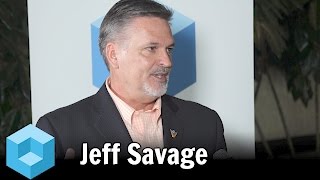
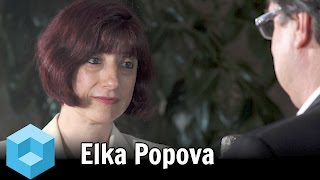
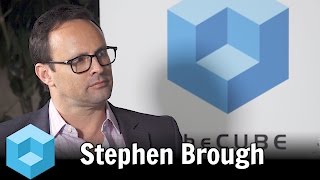
01. West Durow, Mitel Networks, Visits #theCUBE!. (00:21)
02. Do You See Unified Communications For The Future. (00:43)
03. Where Are You In The Cloud. (01:25)
04. You've Made A Big Aquisition That Gets You Into This Communication Space. (02:48)
05. What Is The Dynamic Of App Imbedded Software Along With The Hardware. (04:14)
Track List created with http://www.vinjavideo.com.
--- ---
The secrets to unifying unified communications | #EC16
by Gabriel Pesek | Mar 8, 2016
During the first day of the Enterprise Connect 2016 event in Orlando, FL, there were plenty of discussions on the topics of Unified Communications (UC) and their prioritization for companies from many different backgrounds and technical focuses.
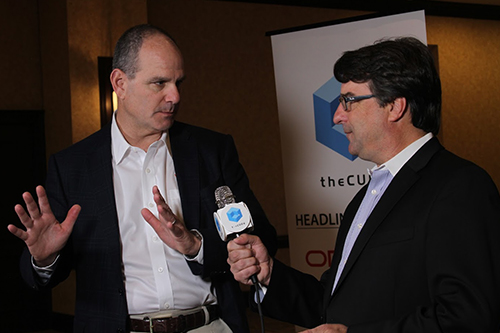
John Furrier, cohost of theCUBE, from the SiliconANGLE Media team, and Jim Burton, cofounder of UCStrategies, were joined by Wes Durow, CMO of Mitel Networks Corp., to talk about these subjects, the move to 5G and beyond, and the helpfulness of remaining agnostic when it comes to operating environments.
Pushing UC forward
Durow began the discussion with a pragmatic assessment of UC and its specialists. “I think we’ve talked the last 10 years about unified communications, and the reality is that we haven’t unified it,” he said, though he seemed positive on the opportunities for improvement in this regard in the near future. Giving consideration to the improvement of seamless data transitions from one device to another, he felt that “cloud and the transition to mobile are really going to drive that transition.”
For now, finding ways to make blended environments operate in ways that are uniform and effective is one of the top priorities for Durow and his teams at Mitel Networks. With more than 2 million cloud users drawing on its services, his assessment was that the changes were unlikely to slow any time soon.
“It’s not just public cloud environments, but hybrid and private cloud environments, and what we look forward to next is really this transition to mobile cloud,” he said.
Crossing device boundaries
To keep up with these changes, staying several steps ahead of proprietary systems lock-in is essential. Pointing to smartphones being the first and last devices used by people every day, and looking back to the revolutionary emergence of iPhones and their modeling, Durow noted that being able to move smoothly from one device’s system to another’s, without any data incompatibilities or the like emerging as a result, would be key.
“The move to 4G is the first transition point to IP, so we can really natively talk back to an enterprise network,” he said. “5G is just more speed … so all the notions of being able to really do rich, collaborative communications are wiped out. It’s now simply: ‘How do we make that experience intuitive, native and seamless?’”
Looking for where some of the biggest points of disruption could be found, Durow highlighted “this intersection between what the service providers are doing, what the device manufacturers are doing and how it plays back in the enterprise.” Moving past traditional “machine-to-machine” data and on to the “machine-to-person” form is what provoked the most enthusiasm: “That’s where things really, I think, get exciting and start to take off.”
Forgot Password
Almost there!
We just sent you a verification email. Please verify your account to gain access to
Enterprise Connect 2016 | Orlando. If you don’t think you received an email check your
spam folder.
In order to sign in, enter the email address you used to registered for the event. Once completed, you will receive an email with a verification link. Open this link to automatically sign into the site.
Register For Enterprise Connect 2016 | Orlando
Please fill out the information below. You will recieve an email with a verification link confirming your registration. Click the link to automatically sign into the site.
You’re almost there!
We just sent you a verification email. Please click the verification button in the email. Once your email address is verified, you will have full access to all event content for Enterprise Connect 2016 | Orlando.
I want my badge and interests to be visible to all attendees.
Checking this box will display your presense on the attendees list, view your profile and allow other attendees to contact you via 1-1 chat. Read the Privacy Policy. At any time, you can choose to disable this preference.
Select your Interests!
add
Upload your photo
Uploading..
OR
Connect via Twitter
Connect via Linkedin
EDIT PASSWORD
Share
Forgot Password
Almost there!
We just sent you a verification email. Please verify your account to gain access to
Enterprise Connect 2016 | Orlando. If you don’t think you received an email check your
spam folder.
In order to sign in, enter the email address you used to registered for the event. Once completed, you will receive an email with a verification link. Open this link to automatically sign into the site.
Sign in to gain access to Enterprise Connect 2016 | Orlando
Please sign in with LinkedIn to continue to Enterprise Connect 2016 | Orlando. Signing in with LinkedIn ensures a professional environment.
01. West Durow, Mitel Networks, Visits #theCUBE!. (00:21)
02. Do You See Unified Communications For The Future. (00:43)
03. Where Are You In The Cloud. (01:25)
04. You've Made A Big Aquisition That Gets You Into This Communication Space. (02:48)
05. What Is The Dynamic Of App Imbedded Software Along With The Hardware. (04:14)
Track List created with http://www.vinjavideo.com.
--- ---
The secrets to unifying unified communications | #EC16
by Gabriel Pesek | Mar 8, 2016
During the first day of the Enterprise Connect 2016 event in Orlando, FL, there were plenty of discussions on the topics of Unified Communications (UC) and their prioritization for companies from many different backgrounds and technical focuses.
John Furrier, cohost of theCUBE, from the SiliconANGLE Media team, and Jim Burton, cofounder of UCStrategies, were joined by Wes Durow, CMO of Mitel Networks Corp., to talk about these subjects, the move to 5G and beyond, and the helpfulness of remaining agnostic when it comes to operating environments.
Pushing UC forward
Durow began the discussion with a pragmatic assessment of UC and its specialists. “I think we’ve talked the last 10 years about unified communications, and the reality is that we haven’t unified it,” he said, though he seemed positive on the opportunities for improvement in this regard in the near future. Giving consideration to the improvement of seamless data transitions from one device to another, he felt that “cloud and the transition to mobile are really going to drive that transition.”
For now, finding ways to make blended environments operate in ways that are uniform and effective is one of the top priorities for Durow and his teams at Mitel Networks. With more than 2 million cloud users drawing on its services, his assessment was that the changes were unlikely to slow any time soon.
“It’s not just public cloud environments, but hybrid and private cloud environments, and what we look forward to next is really this transition to mobile cloud,” he said.
Crossing device boundaries
To keep up with these changes, staying several steps ahead of proprietary systems lock-in is essential. Pointing to smartphones being the first and last devices used by people every day, and looking back to the revolutionary emergence of iPhones and their modeling, Durow noted that being able to move smoothly from one device’s system to another’s, without any data incompatibilities or the like emerging as a result, would be key.
“The move to 4G is the first transition point to IP, so we can really natively talk back to an enterprise network,” he said. “5G is just more speed … so all the notions of being able to really do rich, collaborative communications are wiped out. It’s now simply: ‘How do we make that experience intuitive, native and seamless?’”
Looking for where some of the biggest points of disruption could be found, Durow highlighted “this intersection between what the service providers are doing, what the device manufacturers are doing and how it plays back in the enterprise.” Moving past traditional “machine-to-machine” data and on to the “machine-to-person” form is what provoked the most enthusiasm: “That’s where things really, I think, get exciting and start to take off.”