01. Adam Wood, Heritage Auctions, Visits theCUBE at EMCWorld !. (00:21)
02. Using Technology to Become One of the Largest Auction Houses. (02:28)
03. Switching from VMax to XtremIO. (03:56)
04. What are the Unexpected Benefits of XtremIO?. (04:45)
05. How is Storage Setup on XtremIO?. (05:59)
06. Managing Large Quantities of Digital Assets. (07:18)
07. Flash is Fast and Reliable. (07:43)
08. Utilizing EMC Syncplicity for Client Images. (09:30)
09. How has the Application Development Strategy Changed?. (11:20)
--- ---
From T-Rex skeletons to moon landing artifacts, all-flash is improving auctions | #theCUBE #EMC #HeritageAuctions #EMCWorld #SiliconANGLE
by Elizabeth Kays | May 11, 2015
As the third-largest auction house in the world, Heritage Auctions is a fascinating use-case for EMC’s storage and data management systems. With high-end auction items ranging from artifacts from the moon landings to T-Rex skeletons and transactions in the hundreds of thousands or even millions of dollars, reliable IT services are an absolute must.
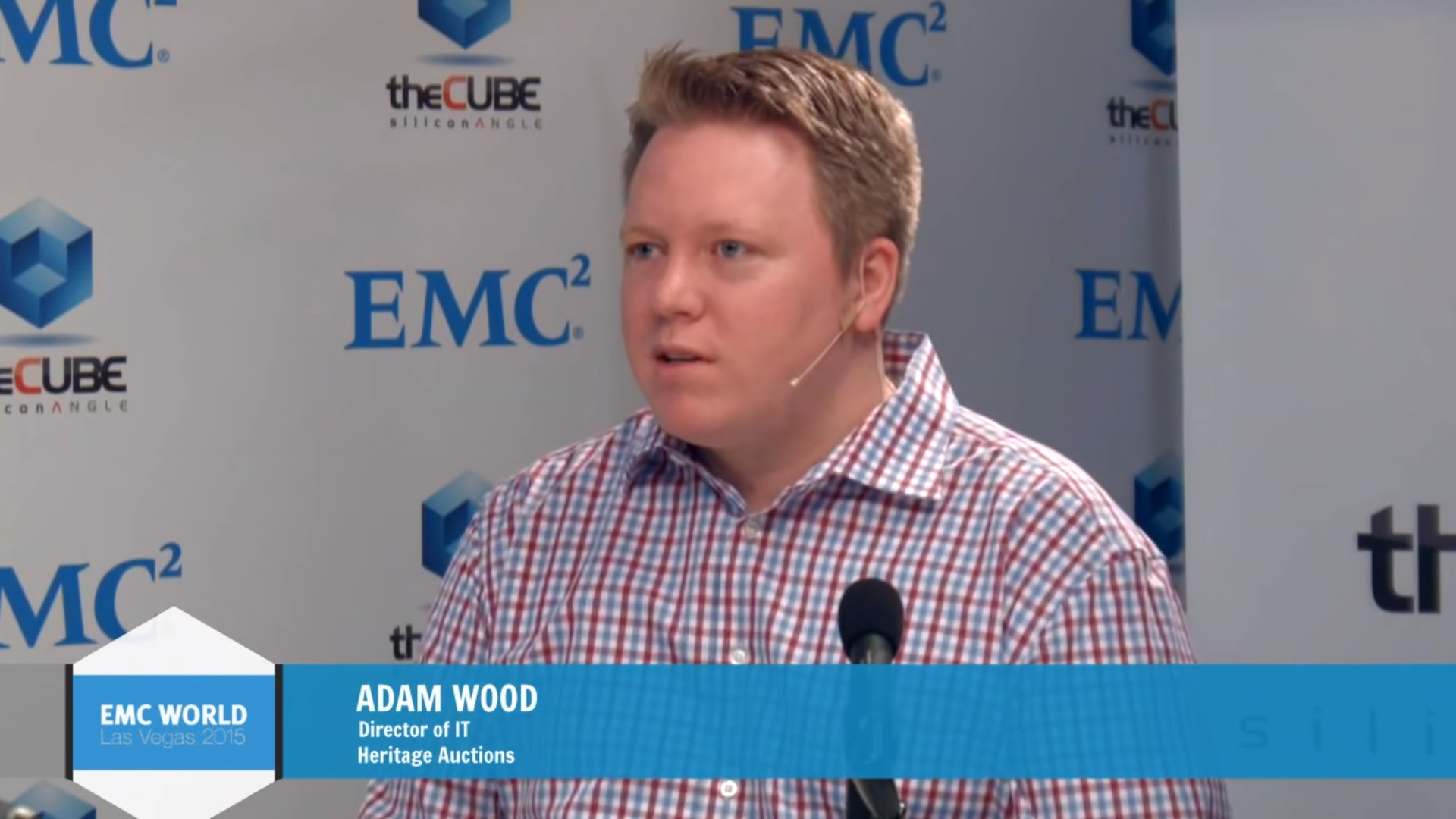
With Heritage’s live-bidding platform, a few hours of downtime could result in thousands of dollars in lost sales. But Adam Wood, Heritage’s director of IT, told theCUBE during EMC World 2015 that he was still excited about his work — and the company’s recent upgrade to all-flash storage.
The challenges of a large development team
Because the owner of Heritage is a big believer in IT, the company has a large development team. But that poses its own challenges, Wood said. “We have about 200+ internal apps. And as time goes on, we’re always adding more and more apps, everyone wants new features, all this stuff. And we’re wondering, how do we improve the performance of all the apps we’re using? We don’t have the time or the resources to go back and rewrite 200 apps … [so] how can we give all those apps a huge speed boost at once? And everything ties into SQL. It’s our bidding platform, our item inventory, our customer management platform … so it was really obvious to us, if we upgrade SQL, get rid of that latency … go all-flash, we can give a huge performance benefit to all those apps all at once.”
With the new all-flash storage, backups happen much more quickly, but the most important factor driving the switch was system latency, Wood said. “The latency in SQL was what we were looking to optimize. We’ve [now] got, I think, an average latency of under a millisecond. Which is insane!”
It’s also very reliable and potentially very long-lasting. “You get a much more reliable system when you don’t have those spinning disks failing all the time,” he says. “The longevity of that flash is incredible.”
@theCUBE
#EMCWORLD
Forgot Password
Almost there!
We just sent you a verification email. Please verify your account to gain access to
EMC World 2015 | Las Vegas. If you don’t think you received an email check your
spam folder.
In order to sign in, enter the email address you used to registered for the event. Once completed, you will receive an email with a verification link. Open this link to automatically sign into the site.
Register For EMC World 2015 | Las Vegas
Please fill out the information below. You will recieve an email with a verification link confirming your registration. Click the link to automatically sign into the site.
You’re almost there!
We just sent you a verification email. Please click the verification button in the email. Once your email address is verified, you will have full access to all event content for EMC World 2015 | Las Vegas.
I want my badge and interests to be visible to all attendees.
Checking this box will display your presense on the attendees list, view your profile and allow other attendees to contact you via 1-1 chat. Read the Privacy Policy. At any time, you can choose to disable this preference.
Select your Interests!
add
Upload your photo
Uploading..
OR
Connect via Twitter
Connect via Linkedin
EDIT PASSWORD
Share
Forgot Password
Almost there!
We just sent you a verification email. Please verify your account to gain access to
EMC World 2015 | Las Vegas. If you don’t think you received an email check your
spam folder.
In order to sign in, enter the email address you used to registered for the event. Once completed, you will receive an email with a verification link. Open this link to automatically sign into the site.
Sign in to gain access to EMC World 2015 | Las Vegas
Please sign in with LinkedIn to continue to EMC World 2015 | Las Vegas. Signing in with LinkedIn ensures a professional environment.
Are you sure you want to remove access rights for this user?
Details
Manage Access
email address
Community Invitation
Adam Wood, Heritage Auctions | EMC World 2015
01. Adam Wood, Heritage Auctions, Visits theCUBE at EMCWorld !. (00:21)
02. Using Technology to Become One of the Largest Auction Houses. (02:28)
03. Switching from VMax to XtremIO. (03:56)
04. What are the Unexpected Benefits of XtremIO?. (04:45)
05. How is Storage Setup on XtremIO?. (05:59)
06. Managing Large Quantities of Digital Assets. (07:18)
07. Flash is Fast and Reliable. (07:43)
08. Utilizing EMC Syncplicity for Client Images. (09:30)
09. How has the Application Development Strategy Changed?. (11:20)
--- ---
From T-Rex skeletons to moon landing artifacts, all-flash is improving auctions | #theCUBE #EMC #HeritageAuctions #EMCWorld #SiliconANGLE
by Elizabeth Kays | May 11, 2015
As the third-largest auction house in the world, Heritage Auctions is a fascinating use-case for EMC’s storage and data management systems. With high-end auction items ranging from artifacts from the moon landings to T-Rex skeletons and transactions in the hundreds of thousands or even millions of dollars, reliable IT services are an absolute must.
With Heritage’s live-bidding platform, a few hours of downtime could result in thousands of dollars in lost sales. But Adam Wood, Heritage’s director of IT, told theCUBE during EMC World 2015 that he was still excited about his work — and the company’s recent upgrade to all-flash storage.
The challenges of a large development team
Because the owner of Heritage is a big believer in IT, the company has a large development team. But that poses its own challenges, Wood said. “We have about 200+ internal apps. And as time goes on, we’re always adding more and more apps, everyone wants new features, all this stuff. And we’re wondering, how do we improve the performance of all the apps we’re using? We don’t have the time or the resources to go back and rewrite 200 apps … [so] how can we give all those apps a huge speed boost at once? And everything ties into SQL. It’s our bidding platform, our item inventory, our customer management platform … so it was really obvious to us, if we upgrade SQL, get rid of that latency … go all-flash, we can give a huge performance benefit to all those apps all at once.”
With the new all-flash storage, backups happen much more quickly, but the most important factor driving the switch was system latency, Wood said. “The latency in SQL was what we were looking to optimize. We’ve [now] got, I think, an average latency of under a millisecond. Which is insane!”
It’s also very reliable and potentially very long-lasting. “You get a much more reliable system when you don’t have those spinning disks failing all the time,” he says. “The longevity of that flash is incredible.”
@theCUBE
#EMCWORLD