Enhanced video at http://vinja.tv/K8609YVs
01. Matt Oostveen, APJ, Visits theCUBE at #EMCWorld. (00:21)
02. What's the Interest in EMC?. (00:47)
03. Do Customers Come Asking About Convergence?. (01:37)
04. How Do You Change the All In-House Attitude?. (03:17)
05. What's the Status of EMC in the Market?. (05:14)
06. Do Customers with VMWare Use Other Products too?. (07:22)
07. What Exactly Does VCE Do for Customers Long Term?. (09:13)
08. What are the Main Messages Coming Through #EMCWorld?. (10:25)
09. Are Customers Embracing the Newest Technology?. (12:18)
Track List created with http://www.vinjavideo.com.
--- ---
Convergent structures leading industry innovation | #emcworld
by Elizabeth Kays | May 12, 2015
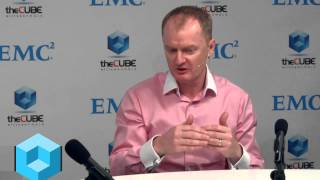
Thanks to his background as an analyst, Matt Oostveen, the CTO of VCE Company, LLC’s Asia-Pacific region, has a lot of insight regarding the state of convergent structure technology. In an interview with theCUBE during EMC World 2015, he pointed out, “If we have a look at some of the intersecting trends at play — the sheer growth that we see in data volume, the number of servers that are exploding across data center floors, and sitting on top of that, the amount of virtual machines — that’s a big problem. And I think the way that we’re architecting solutions at the moment, the way that we’re architecting our data centers, is starting to lose fidelity. It’s starting to granulate at scale, and we need to alter the way we’re approaching that.”
Liberating technical resources
This is a global problem, too, not just a national one. “Customers look at their data centers in Australia, and what do they see? They see a whole lot of problems when it comes to silos, and a lot of them are having some genuine issues when it comes to the operational cost.”
This causes some customers to fear getting ‘locked in’ to a particular platform, so many of them try to build and develop all their systems in-house — a strategy that may cost more in the end, Oostveen said.
“I would say that the number one competitor we face is internal IT — it is doing it yourself,” Oostveen said, adding that a lot of the resources spent on operations could be better spent. “I think what the value proposition from a VCE perspective is that we can liberate these technical resources that are being focused on what really are menial tasks and have them focused on business outcomes.”
A big future for microservices applications
What are those business outcomes? Oostveen sees a big future for microservices applications that connect little pieces of the supply and demand chains, rather than big, bloated, full-service packages. And he sees the company’s systems as a strong base for those kinds of solutions.
“What VCE does is we transcend the individual elements that are contained within the vBlock. We stand above storage, network and compute, and we bring that together,” he said. “What we want to do is have an infrastructure platform that is tuned to the task, the challenges that are being faced by the customers, not just today, but also tomorrow. And I think that’s one of the reasons that we are that center point, that pivot point, for what’s occurring in the Federation, because it is a fantastic platform to build these more sophisticated deployments on.”
@theCUBE
#EMCWORLD
Forgot Password
Almost there!
We just sent you a verification email. Please verify your account to gain access to
EMC World 2015 | Las Vegas. If you don’t think you received an email check your
spam folder.
In order to sign in, enter the email address you used to registered for the event. Once completed, you will receive an email with a verification link. Open this link to automatically sign into the site.
Register For EMC World 2015 | Las Vegas
Please fill out the information below. You will recieve an email with a verification link confirming your registration. Click the link to automatically sign into the site.
You’re almost there!
We just sent you a verification email. Please click the verification button in the email. Once your email address is verified, you will have full access to all event content for EMC World 2015 | Las Vegas.
I want my badge and interests to be visible to all attendees.
Checking this box will display your presense on the attendees list, view your profile and allow other attendees to contact you via 1-1 chat. Read the Privacy Policy. At any time, you can choose to disable this preference.
Select your Interests!
add
Upload your photo
Uploading..
OR
Connect via Twitter
Connect via Linkedin
EDIT PASSWORD
Share
Forgot Password
Almost there!
We just sent you a verification email. Please verify your account to gain access to
EMC World 2015 | Las Vegas. If you don’t think you received an email check your
spam folder.
In order to sign in, enter the email address you used to registered for the event. Once completed, you will receive an email with a verification link. Open this link to automatically sign into the site.
Sign in to gain access to EMC World 2015 | Las Vegas
Please sign in with LinkedIn to continue to EMC World 2015 | Las Vegas. Signing in with LinkedIn ensures a professional environment.
Are you sure you want to remove access rights for this user?
Details
Manage Access
email address
Community Invitation
Matt Oostveen | EMC World 2015
Enhanced video at http://vinja.tv/K8609YVs
01. Matt Oostveen, APJ, Visits theCUBE at #EMCWorld. (00:21)
02. What's the Interest in EMC?. (00:47)
03. Do Customers Come Asking About Convergence?. (01:37)
04. How Do You Change the All In-House Attitude?. (03:17)
05. What's the Status of EMC in the Market?. (05:14)
06. Do Customers with VMWare Use Other Products too?. (07:22)
07. What Exactly Does VCE Do for Customers Long Term?. (09:13)
08. What are the Main Messages Coming Through #EMCWorld?. (10:25)
09. Are Customers Embracing the Newest Technology?. (12:18)
Track List created with http://www.vinjavideo.com.
--- ---
Convergent structures leading industry innovation | #emcworld
by Elizabeth Kays | May 12, 2015
Thanks to his background as an analyst, Matt Oostveen, the CTO of VCE Company, LLC’s Asia-Pacific region, has a lot of insight regarding the state of convergent structure technology. In an interview with theCUBE during EMC World 2015, he pointed out, “If we have a look at some of the intersecting trends at play — the sheer growth that we see in data volume, the number of servers that are exploding across data center floors, and sitting on top of that, the amount of virtual machines — that’s a big problem. And I think the way that we’re architecting solutions at the moment, the way that we’re architecting our data centers, is starting to lose fidelity. It’s starting to granulate at scale, and we need to alter the way we’re approaching that.”
Liberating technical resources
This is a global problem, too, not just a national one. “Customers look at their data centers in Australia, and what do they see? They see a whole lot of problems when it comes to silos, and a lot of them are having some genuine issues when it comes to the operational cost.”
This causes some customers to fear getting ‘locked in’ to a particular platform, so many of them try to build and develop all their systems in-house — a strategy that may cost more in the end, Oostveen said.
“I would say that the number one competitor we face is internal IT — it is doing it yourself,” Oostveen said, adding that a lot of the resources spent on operations could be better spent. “I think what the value proposition from a VCE perspective is that we can liberate these technical resources that are being focused on what really are menial tasks and have them focused on business outcomes.”
A big future for microservices applications
What are those business outcomes? Oostveen sees a big future for microservices applications that connect little pieces of the supply and demand chains, rather than big, bloated, full-service packages. And he sees the company’s systems as a strong base for those kinds of solutions.
���What VCE does is we transcend the individual elements that are contained within the vBlock. We stand above storage, network and compute, and we bring that together,” he said. “What we want to do is have an infrastructure platform that is tuned to the task, the challenges that are being faced by the customers, not just today, but also tomorrow. And I think that’s one of the reasons that we are that center point, that pivot point, for what’s occurring in the Federation, because it is a fantastic platform to build these more sophisticated deployments on.”
@theCUBE
#EMCWORLD