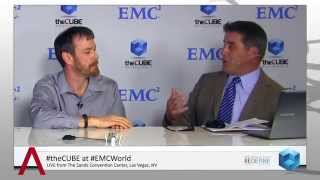
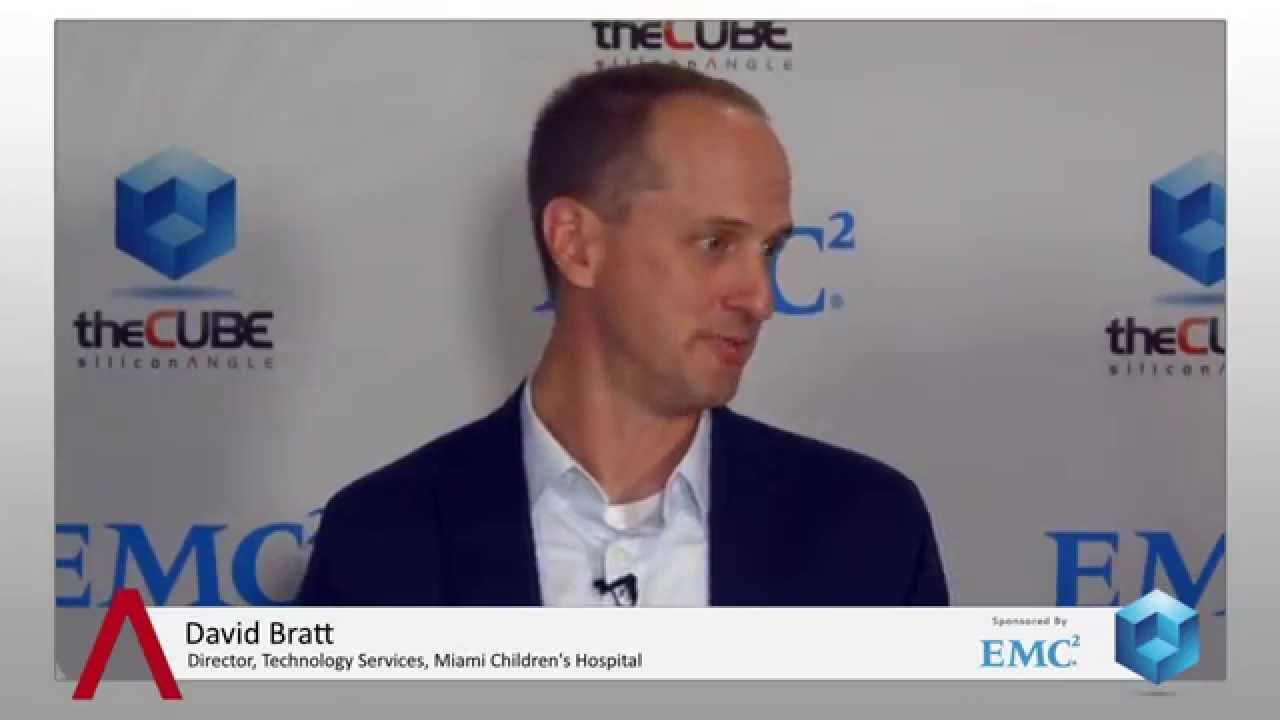
David Bratt, Director of Technology Services, Miami Children's Hospital, with John Furrier and Dave Vellante at EMC World 2014
https://siliconangle.com/2014/05/20/telemedicine-and-wearable-techs-impact-on-healthcare-regulation-emcworld/
Telemedicine, and wearable tech’s impact on healthcare regulation | #EMCworld
Earlier this month, theCUBE was at EMC World 2014, held at The Sands Convention Center in Las Vegas, featuring two live broadcasts for SiliconANGLE. In this interview, Jeff Frick and Steve Kenniston sat down with David Bratt, Director of Technology Services for Miami Children’s Hospital, to discuss how his organization benefits from Isilon, as well as the technologies they’re using for a telemedicine initiative.
After a brief introduction on Miami Children’s Hospital, Bratt mentioned that the majority of their infrastructure is “storage, storage, storage.” He said that it’s growing tremendously, and it’s where they spend most of their time. They also manage the network and telecommunications environment, but their storage environment is clearly the one that’s growing the most.
How and why Miami Children’s Hospital uses EMC Isilon
Bratt went on to explain his team’s involvement with EMC products, having been an Isilon customer for about a year, and that environment alone has tripled since then. Bratt described how they use Isilon for all facets of on-structure data, Digital Imaging and Communication in Medicine (DICOM) and any type of video repository. They’re also replicating that data for protection.
Bratt also said that they chose to go with the Isilon platform because of cost, manageability and ease of use. They wanted something that could grow with the organization, scale rapidly and not cause any complexities during migration. In terms of manageability and ease of use, Bratt said that they no longer need highly trained storage personnel specifically trained at one particular type of an array. They’re now able to manage the product very simply, allocate file shares and assign permissions in the snap of a finger.
Kenniston then asked Bratt how much capacity they have under management. Bratt said that they have a half a PB in their environment. They primarily rely on the Isilon technologies with the snaps as well as the replication to their secondary data center for data protection. A typical backup system is used to spin that off the tape and send it off site, but Bratt said it’s rare for them to have to go back to backup their system, which he considers another advantage of the Isilon product.
@thecube #theCUBE @SiliconANGLE theCUBE @Dell EMC #EMC
#emcworld
Forgot Password
Almost there!
We just sent you a verification email. Please verify your account to gain access to
EMC World 2014 | Las Vegas. If you don’t think you received an email check your
spam folder.
In order to sign in, enter the email address you used to registered for the event. Once completed, you will receive an email with a verification link. Open this link to automatically sign into the site.
Register For EMC World 2014 | Las Vegas
Please fill out the information below. You will recieve an email with a verification link confirming your registration. Click the link to automatically sign into the site.
You’re almost there!
We just sent you a verification email. Please click the verification button in the email. Once your email address is verified, you will have full access to all event content for EMC World 2014 | Las Vegas.
I want my badge and interests to be visible to all attendees.
Checking this box will display your presense on the attendees list, view your profile and allow other attendees to contact you via 1-1 chat. Read the Privacy Policy. At any time, you can choose to disable this preference.
Select your Interests!
add
Upload your photo
Uploading..
OR
Connect via Twitter
Connect via Linkedin
EDIT PASSWORD
Share
Forgot Password
Almost there!
We just sent you a verification email. Please verify your account to gain access to
EMC World 2014 | Las Vegas. If you don’t think you received an email check your
spam folder.
In order to sign in, enter the email address you used to registered for the event. Once completed, you will receive an email with a verification link. Open this link to automatically sign into the site.
Sign in to gain access to EMC World 2014 | Las Vegas
Please sign in with LinkedIn to continue to EMC World 2014 | Las Vegas. Signing in with LinkedIn ensures a professional environment.
Are you sure you want to remove access rights for this user?
Details
Manage Access
email address
Community Invitation
David Bratt, Miami Children's Hospital | EMC World 2014
David Bratt, Director of Technology Services, Miami Children's Hospital, with John Furrier and Dave Vellante at EMC World 2014
https://siliconangle.com/2014/05/20/telemedicine-and-wearable-techs-impact-on-healthcare-regulation-emcworld/
Telemedicine, and wearable tech’s impact on healthcare regulation | #EMCworld
Earlier this month, theCUBE was at EMC World 2014, held at The Sands Convention Center in Las Vegas, featuring two live broadcasts for SiliconANGLE. In this interview, Jeff Frick and Steve Kenniston sat down with David Bratt, Director of Technology Services for Miami Children’s Hospital, to discuss how his organization benefits from Isilon, as well as the technologies they’re using for a telemedicine initiative.
After a brief introduction on Miami Children’s Hospital, Bratt mentioned that the majority of their infrastructure is “storage, storage, storage.” He said that it’s growing tremendously, and it’s where they spend most of their time. They also manage the network and telecommunications environment, but their storage environment is clearly the one that’s growing the most.
How and why Miami Children’s Hospital uses EMC Isilon
Bratt went on to explain his team’s involvement with EMC products, having been an Isilon customer for about a year, and that environment alone has tripled since then. Bratt described how they use Isilon for all facets of on-structure data, Digital Imaging and Communication in Medicine (DICOM) and any type of video repository. They’re also replicating that data for protection.
Bratt also said that they chose to go with the Isilon platform because of cost, manageability and ease of use. They wanted something that could grow with the organization, scale rapidly and not cause any complexities during migration. In terms of manageability and ease of use, Bratt said that they no longer need highly trained storage personnel specifically trained at one particular type of an array. They’re now able to manage the product very simply, allocate file shares and assign permissions in the snap of a finger.
Kenniston then asked Bratt how much capacity they have under management. Bratt said that they have a half a PB in their environment. They primarily rely on the Isilon technologies with the snaps as well as the replication to their secondary data center for data protection. A typical backup system is used to spin that off the tape and send it off site, but Bratt said it’s rare for them to have to go back to backup their system, which he considers another advantage of the Isilon product.
@thecube #theCUBE @SiliconANGLE theCUBE @Dell EMC #EMC
#emcworld