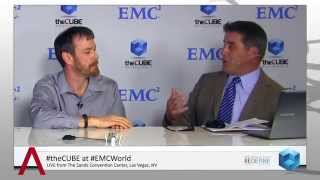
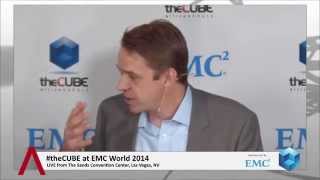
Darryl Smith, EMC Global IT, with Jeff Frick and Steve Kenniston, at EMC World 2014
@thecube #theCUBE #emcworld #EMC #SiliconANGLE
This week’s EMC World 2014 Event, held at The Sands Convention Center in Las Vegas, is theCUBE’s fifth year in attendance and also one of the two live broadcasts brought to you by SiliconANGLE. In this interview, Darryl Smith, Chief Database Architect for EMC Global IT, joins Jeff Frick and Steve Kenniston to discuss how IT can evolve in order to remain relevant.
Kenniston began the interview by asking Smith to offer insight into the IT environment at EMC in terms of where it is today and the thought process of where he wants to take it. Smith explained that EMC’s IT shop has over 2,000 databases, and what takes up the most time is day-to-day maintenance. Also, facing tightening constraints along with others in the industry, EMC’s IT has a budget that shrunk seven percent last year. He went on to say that the paradigm of minimizing IT budgets, along with more databases to support, has to change in order to grow.
The Future State of IT
.
Kenniston then asked Smith what the future state of IT will look like and what direction it should take.
Smith reiterated that one of things dragging IT down is the maintenance and day-to-day activities of a large number of databases, requiring several very specific skill sets amongst a whole different array.
“What I want to try and do is make it more of a database and provide that more of as a service,” Smith said, going on to explain that this isn’t a service for the end-users, where business units just simply place an order. The problem with this is that they don’t really understand what they need out of a database. Smith suggests providing the same capability with a broker-like service.
“The business knows that they need a database. They know they need an application,” Smith explained. “They’ll go to the database administrator, and the DBA will then be able to just log onto a webpage and literally just order up a database. Put that database in their hands in under an hour. Let them very quickly turn them around to the business.”
Smith then says that this is just day one. The day-to-day operations are what take a lot of effort. He likened the process of adding storage to a project, and this is how he broke it down:
.
Creator request
Request routed to storage administrator
Request routed to virtual administrator
Request routed to system administrator
DBA receives data files
.
Smith’s solution for this offers DBAs the ability to log in to a webpage, change an order, and then have storage immediately applied to the database server. This gets rid of all of those layers.
The Threat of Shadow IT
.
Frick then steered the interview over to the threat to Shadow IT. He asked Smith how this impacted his role and team.
Smith mentioned that, as a DBA in IT, one concern is relevancy. Businesses now have a choice: Go to the cloud, pay for a database and get it right away or go to IT, fill out a justification, sit down with solution architects and sculpt out the project. IT is now literally competing with cloud providers. If IT can’t do it and cloud can, the business is going to go out there
Forgot Password
Almost there!
We just sent you a verification email. Please verify your account to gain access to
EMC World 2014 | Las Vegas. If you don’t think you received an email check your
spam folder.
In order to sign in, enter the email address you used to registered for the event. Once completed, you will receive an email with a verification link. Open this link to automatically sign into the site.
Register For EMC World 2014 | Las Vegas
Please fill out the information below. You will recieve an email with a verification link confirming your registration. Click the link to automatically sign into the site.
You’re almost there!
We just sent you a verification email. Please click the verification button in the email. Once your email address is verified, you will have full access to all event content for EMC World 2014 | Las Vegas.
I want my badge and interests to be visible to all attendees.
Checking this box will display your presense on the attendees list, view your profile and allow other attendees to contact you via 1-1 chat. Read the Privacy Policy. At any time, you can choose to disable this preference.
Select your Interests!
add
Upload your photo
Uploading..
OR
Connect via Twitter
Connect via Linkedin
EDIT PASSWORD
Share
Forgot Password
Almost there!
We just sent you a verification email. Please verify your account to gain access to
EMC World 2014 | Las Vegas. If you don’t think you received an email check your
spam folder.
In order to sign in, enter the email address you used to registered for the event. Once completed, you will receive an email with a verification link. Open this link to automatically sign into the site.
Sign in to gain access to EMC World 2014 | Las Vegas
Please sign in with LinkedIn to continue to EMC World 2014 | Las Vegas. Signing in with LinkedIn ensures a professional environment.
Are you sure you want to remove access rights for this user?
Details
Manage Access
email address
Community Invitation
Darryl Smith, EMC | EMC World 2014
Darryl Smith, EMC Global IT, with Jeff Frick and Steve Kenniston, at EMC World 2014
@thecube #theCUBE #emcworld #EMC #SiliconANGLE
This week’s EMC World 2014 Event, held at The Sands Convention Center in Las Vegas, is theCUBE’s fifth year in attendance and also one of the two live broadcasts brought to you by SiliconANGLE. In this interview, Darryl Smith, Chief Database Architect for EMC Global IT, joins Jeff Frick and Steve Kenniston to discuss how IT can evolve in order to remain relevant.
Kenniston began the interview by asking Smith to offer insight into the IT environment at EMC in terms of where it is today and the thought process of where he wants to take it. Smith explained that EMC’s IT shop has over 2,000 databases, and what takes up the most time is day-to-day maintenance. Also, facing tightening constraints along with others in the industry, EMC’s IT has a budget that shrunk seven percent last year. He went on to say that the paradigm of minimizing IT budgets, along with more databases to support, has to change in order to grow.
The Future State of IT
.
Kenniston then asked Smith what the future state of IT will look like and what direction it should take.
Smith reiterated that one of things dragging IT down is the maintenance and day-to-day activities of a large number of databases, requiring several very specific skill sets amongst a whole different array.
“What I want to try and do is make it more of a database and provide that more of as a service,” Smith said, going on to explain that this isn’t a service for the end-users, where business units just simply place an order. The problem with this is that they don’t really understand what they need out of a database. Smith suggests providing the same capability with a broker-like service.
“The business knows that they need a database. They know they need an application,” Smith explained. “They’ll go to the database administrator, and the DBA will then be able to just log onto a webpage and literally just order up a database. Put that database in their hands in under an hour. Let them very quickly turn them around to the business.”
Smith then says that this is just day one. The day-to-day operations are what take a lot of effort. He likened the process of adding storage to a project, and this is how he broke it down:
.
Creator request
Request routed to storage administrator
Request routed to virtual administrator
Request routed to system administrator
DBA receives data files
.
Smith’s solution for this offers DBAs the ability to log in to a webpage, change an order, and then have storage immediately applied to the database server. This gets rid of all of those layers.
The Threat of Shadow IT
.
Frick then steered the interview over to the threat to Shadow IT. He asked Smith how this impacted his role and team.
Smith mentioned that, as a DBA in IT, one concern is relevancy. Businesses now have a choice: Go to the cloud, pay for a database and get it right away or go to IT, fill out a justification, sit down with solution architects and sculpt out the project. IT is now literally competing with cloud providers. If IT can’t do it and cloud can, the business is going to go out there